


The 24th Annual Retina Fellows Forum, held January 26-27, 2024, in Chicago, brought together 2nd-year retina fellows, faculty speakers, and a bevy of corporate partners for a weekend of mingling, surgical and clinical pearls, and bowling. This annual meeting is designed to foster the discussion of clinical cases, practice management, and early career advice between fellows and attendings from a variety of practice models.
Lectures touched on everything from the latest approaches to rhegmatogenous retinal detachments to what it’s like to start out as an attending. Here, I highlight some of the key conference takeaways.
FINDING YOUR FOREVER JOB
Guest speaker John T. Thompson, MD, spoke extensively on his experience of launching his career, what he learned from various pitfalls and successes, and how fellows can apply those learnings to their own journeys (Figure 1). Starting out in an academic position at Yale, Dr. Thompson discussed how he outgrew his position and left to start in the private sector. Despite the excitement of the new opportunity, he quickly realized he had gotten himself into a poor work environment, and this “nightmare job” turned into a protracted, multi-year legal battle. Eventually, he decided to start his own practice, which led to numerous personal successes and a blossoming career.
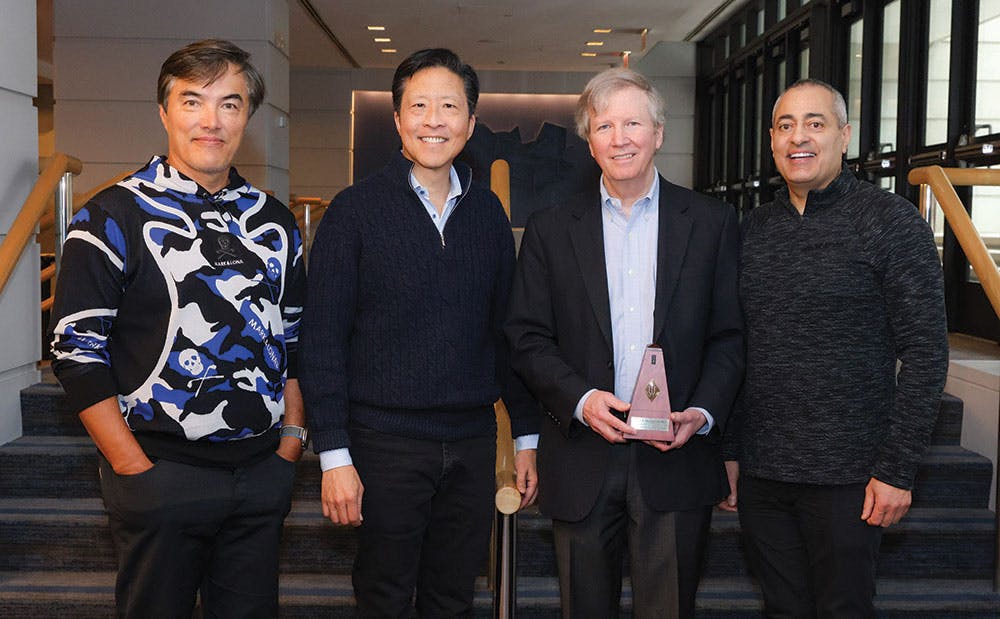
Figure 1. David R. Chow, MD; Carl C. Awh, MD; and Tarek S. Hassan, MD, presented Distinguished Guest Speaker John T. Thompson, MD, with a metronome as a token of appreciation. Image courtesy of Kevin Caldwell Photography.
The talk focused on key aspects of growing as a young surgeon. Dr. Thompson pointed out that, despite constant changes in the medical climate (he serves as an expert on the CMS committee where he advocates for ophthalmology reimbursement), retina specialists can easily make enough money to thrive if they stick to ethical business decisions and patient care as primary drivers of outpatient clinical medicine. He stressed lessons he learned from his own experiences and those of others: the important dos (ie, save for retirement and spend time with family) and the invaluable don’ts (ie, never engage in romantic relationships with patients, don’t pursue jobs and opportunities that are “too good to be true,” and don’t make decisions purely based on money).
Dr. Thompson’s lecture showed the young surgeons in the room the value of following his pearls so that they can avoid the same mistakes and repeat the successes of his storied career.
VITS, BUCKLES, AND PNEUMATICS
During the retinal detachment panel, moderated by Alan J. Ruby, MD, the panelists discussed their preferred methods and expectations for various cases, including what to do about rhegmatogenous retinal detachments in a diverse set of clinical scenarios (Figure 2).
One major topic on primary retinal detachment repair was the creation of a posterior drainage retinotomy. “I think posterior retinotomies are ugly,” Sunir J. Garg, MD, bluntly stated, further explaining that he prefers to drain through the primary break rather than create new holes in the retina. Dr. Ruby and Adrienne W. Scott, MD, agreed, the latter emphasizing that she likes to use PFO to express subretinal fluid through the original break to allow for the laser to be placed around the original hole. Dr. Ruby recounted a story of starting his first job, when his fellow was insistent on fully draining all subretinal fluid; the fellow was shocked at how much fluid Dr. Ruby left in the subretinal space, only for the patient to do very well.
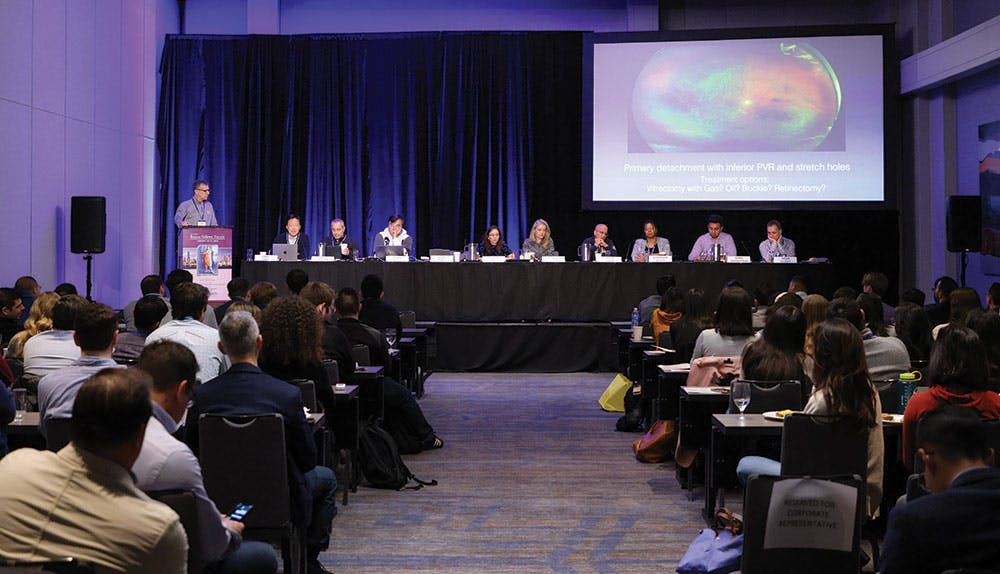
Figure 2. The retinal detachment panel, moderated by Alan J. Ruby, MD, included Carl C. Awh, MD; Tarek S. Hassan, MD; David R. Chow, MD; Amy C. Schefler, MD; Aleksandra V. Rachitskaya, MD; Sunir J. Garg, MD; Adrienne W. Scott, MD; Sunil K. Srivastava, MD; and Dean Eliott, MD. Image courtesy of Kevin Caldwell Photography.
Dr. Ruby then asked the panel about their approaches to the use of silicone oil in a primary retinal detachment repair. “If I am changing the plan in the middle of surgery, and the case calls for oil, I go to the waiting room to discuss this with the family before proceeding,” he explained. Other panelists said that they would get consent for these scenarios prior to starting the surgery and that consent for silicone oil is standard in their informed consent process. However, most of the panelists noted that they do not use oil often in primary detachments.
Lastly, Dr. Ruby brought up the use of scleral buckles in retinal detachment repair. Carl C. Awh, MD, felt that a buckle is not necessary in many cases, even in recurrent detachments; he often chooses to perform a retinectomy rather than a buckle. “The retinectomy provides more relief from traction without all the downsides to a buckle, such as operative time and buckle-related complications,” he explained. He uses a buckle for appropriate primary detachments and for select recurrent detachments, but rarely, he added. Sunil K. Srivastava, MD, took the opposite approach, stating, “I have a very low threshold to add a buckle.” Dr. Garg, Dr. Scott, and Aleksandra V. Rachitskaya, MD, favored adding a scleral buckle in retinal detachment reoperations.
Overall, this panel illustrated that there is no unanimous agreement in retinal detachment repair.
STARTING YOUR CAREER: THE REAL WORLD
Hosted by Dr. Awh, this session touched on the ways that attendings start their careers and how both professional and clinical decisions can have lasting repercussions. Dr. Awh used extended metaphors and scenarios to illustrate the difficulty in evaluating clinical trial data. He stressed that as new data and new drugs become a regular part of the marketplace, physicians will be confronted with intelligent interpretations of the data designed to impress the values and ideas of marketing, more than real-world results.
In addition, the panelists shared their experiences and lessons learned as they started their careers. Topics included managing referral patterns, being part of the local culture of eye care, interacting with staff, and making financial decisions. Dr. Srivastava reminisced about sitting on the floor of his new house after starting his first job, planning his finances with his wife to ensure good financial habits, and deciding to pay for services that many would call frivolous but saved his family their most valuable resource: time. Dr. Garg talked about office politics and relationships. “It’s important to not be friends with your staff; but rather, be friend-ly,” he suggested. Amy C. Schefler, MD, talked about managing your personal life and stressed the value of maintaining family and personal relationships while balancing the need to be readily available to the community and referring doctors.
The meeting wrapped up with an air of genuine excitement about next steps for the fellows in the room. Entering the workforce, they can feel confident they have all the tools necessary to succeed and should be excited to be part of the next generation of innovators and surgeons who will take care of the retina patients of tomorrow.
The faculty and fellows adjourned to 10Pin Bowling Lounge for an evening of friendly competition, good food, and relationship building (Team Awh/Thompson won!). The organizers look forward to the next class of fellows, who will attend the 25th Annual Fellows Forum on January 24-25, 2025, in Chicago.


_1784132761.jpg?auto=compress,format&w=75)





