





AT A GLANCE
- If the proliferative vitreoretinopathy (PVR) is mild and peripheral, consider adding a scleral buckle.
- Consider vitrectomy with PVR membrane peel in patients who are older, pseudophakic, and present with preretinal membranes.
- Because a shorter time to surgery after PVR redetachment is associated with better outcomes, get these eyes back to the OR quickly.
Proliferative vitreoretinopathy (PVR)—the proliferation of retinal pigment epithelium cells and the collateral inflammatory cells that are deposited on the retinal surface and vitreous—can cause contraction of and traction on the retina. This leads to retinal detachments (RDs) that can be tractional, rhegmatogenous, or a combination of both. PVR is the most common cause of failure for RD repair surgery; thus, surgeons must identify the risk factors and early signs of PVR and modify treatment plans to achieve better anatomical and functional outcomes.1 Here, I share the surgical pearls gleaned from conversations with experts on RD repair in the setting of PVR.
– Linnet Rodriguez, MD
TACKLING MEMBRANES
By Jordan D. Deaner, MD
When peeling membranes, I recommend starting from the nerve and proceeding peripherally. The nerve is an anchor, and it is always easier to peel against countertraction. Consider using ICG or brilliant blue G to stain the internal limiting membrane (ILM) and reveal negative staining of posterior membranes. Preservative-free triamcinolone is also useful in highlighting and peeling both posterior and more peripheral membranes.
Look for valleys and star folds in the retina. These are clues that PVR membranes are contracting and pulling the retina together. The grooves within the folded retina are your friend and can help you locate membranes that are easier to peel. If the PVR is mild and peripheral, don’t underestimate the benefits of adding a scleral buckle to the surgery. This may save the patient a retinectomy. All membranes should be peeled, if possible, prior to considering a retinectomy. If membranes are left on the residual retina, there will likely be further proliferation, contraction, and surgical failure.
In severe cases of PVR, especially those that are circumferential at the vitreous base or anterior loop, a chandelier and bimanual dissection may be necessary. I prefer bimanual dissection with either two Maxgrip forceps (Alcon) to sheer or pull apart the circumferential PVR or a Maxgrip forceps and vitreous cutter to pick up and cut the circumferential traction.
Finally, if a retinectomy is necessary, plan carefully. When the traction is minimal, I place PFO prior to cutting the retina to stabilize the macula and prevent progression of the RD due to changes in fluidics post-retinectomy.
Mark and cut the retina as peripherally as possible, saving as much retina as you can while still removing all the PVR membranes that are preventing successful retinal attachment. In general, localized retinectomies carry a high risk for redetachment. I recommend doing at least a 180° inferior retinectomy. The milieu of PVR tends to deposit gravitationally at the inferior aspect of the eye; leaving a retinectomy horn inferiorly is just asking for a PVR redetachment.
FOCUS ON PATIENT SELECTION
By Sonia Mehta, MD
For patients presenting with RDs with grade C or worse PVR, multiple factors affect my surgical approach. If the patient is young and phakic with subretinal bands or mild preretinal membranes limited to one quadrant, I may consider a straight scleral buckle with external drainage.
If the patient is older, pseudophakic, and presents with multiple preretinal membranes, my typical approach is vitrectomy with PVR membrane peel. If I am not planning for a retinectomy, I may also add a scleral buckle. I also typically inject ICG and peel the ILM. After the membrane peel, if the retina appears stiff and will not reattach, I proceed with an inferior 180° retinectomy. For advanced pathology, a 360° retinectomy may be necessary. I reattach the retina with PFO, laser, fluid-air exchange, and conclude with 1,000 cSt silicone oil (see Case No. 1). For patients with advanced PVR whom I am planning to leave the silicone oil in long term, I typically use 5,000 cSt silicone oil (see Case No. 2). If a retinectomy was not required, I may use a gas tamponade.
CASE NO. 1
A 59-year-old woman was referred for retinal detachment (RD) with proliferative vitreoretinopathy (PVR) in the right eye 7 weeks after vitrectomy for RD repair. Her VA was counting fingers at 5 ft OD and 20/30 OS. IOP was 4 mm Hg OD and 18 mm Hg OS. Fundus examination of the right eye showed a post-vitrectomized eye with a C3F8 bubble (Figure 1). There was an RD from the 1 to 10 clock positions with fixed retinal folds from the 6 to 10 clock positions. The macula was detached. OCT showed an RD involving the macula with intraretinal fluid and PVR temporally. The left eye was unremarkable.
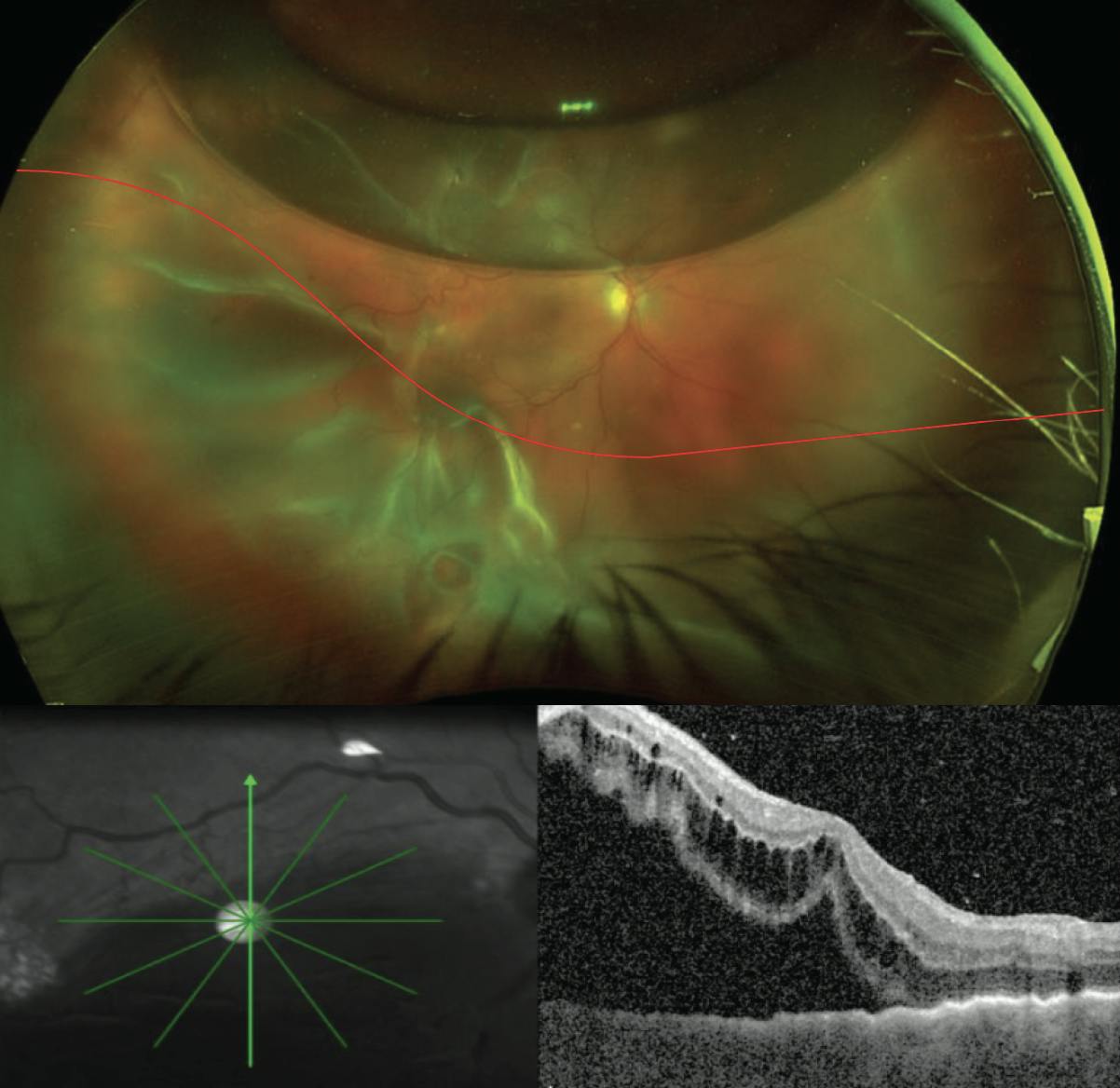
Figure 1. Imaging of the right eye revealed an RD with fixed retinal folds, a detached macula, and PVR. The patient underwent vitrectomy, membrane peel, inferior 180° retinectomy (red line), PFO, endolaser, and silicone oil tamponade.
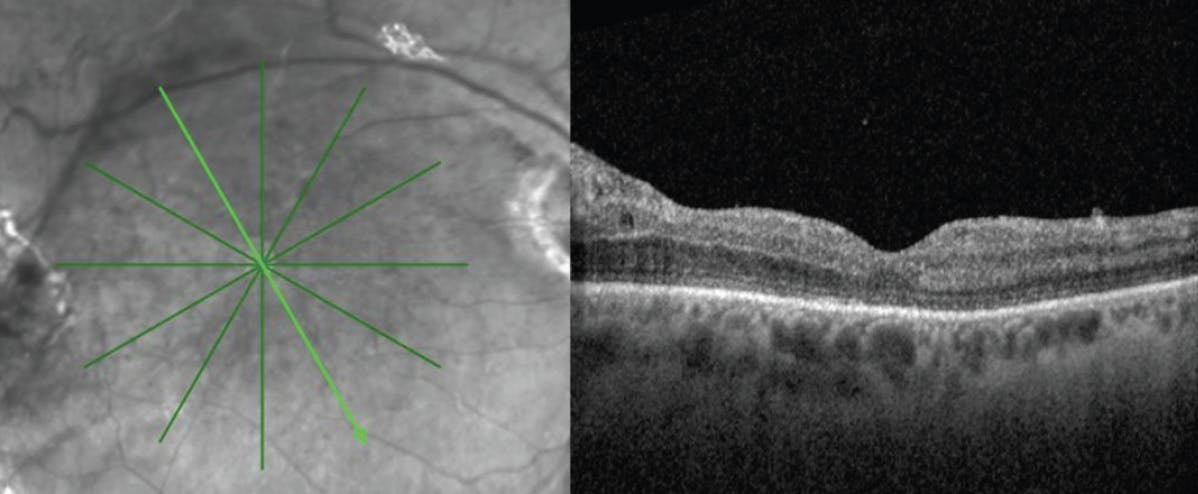
The patient underwent vitrectomy, brilliant blue G-assisted membrane peel, an inferior 180° retinectomy, PFO, endolaser, and 1,000 cSt silicone oil tamponade. Four months later, the patient returned for silicone oil removal, at which time the macula was attached, and her VA was 20/60 OD (Figure 2).
CASE NO. 2
A 61-year-old man presented with decreased vision in the right eye with an ocular history of vitrectomy for retinal detachment (RD) repair 2 years prior. His VA was counting fingers at 2 ft with an IOP of 14 mm Hg OD. The fundus examination showed a post-vitrectomized eye with an RD from the 1 to 10 clock positions with proliferative vitreoretinopathy and macular involvement (Figure 1).
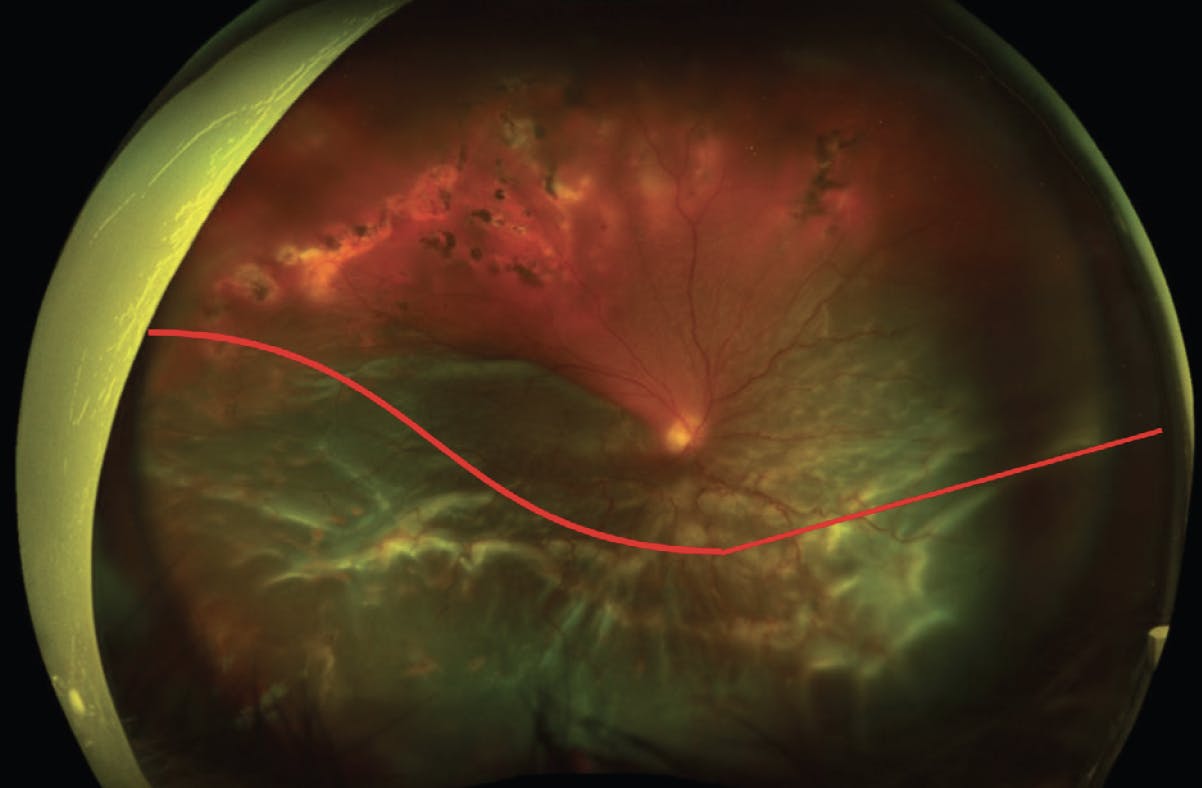
Figure 1. Fundus photography revealed an RD with proliferative vitreoretinopathy and macular involvement. The patient underwent vitrectomy, membrane peel, 180° inferior relaxing retinectomy (red line), PFO, endolaser, and silicone oil tamponade.
The patient underwent vitrectomy, ICG-assisted membrane peel, 180° inferior relaxing retinectomy, PFO, endolaser, and 5,000 cSt silicone oil tamponade.
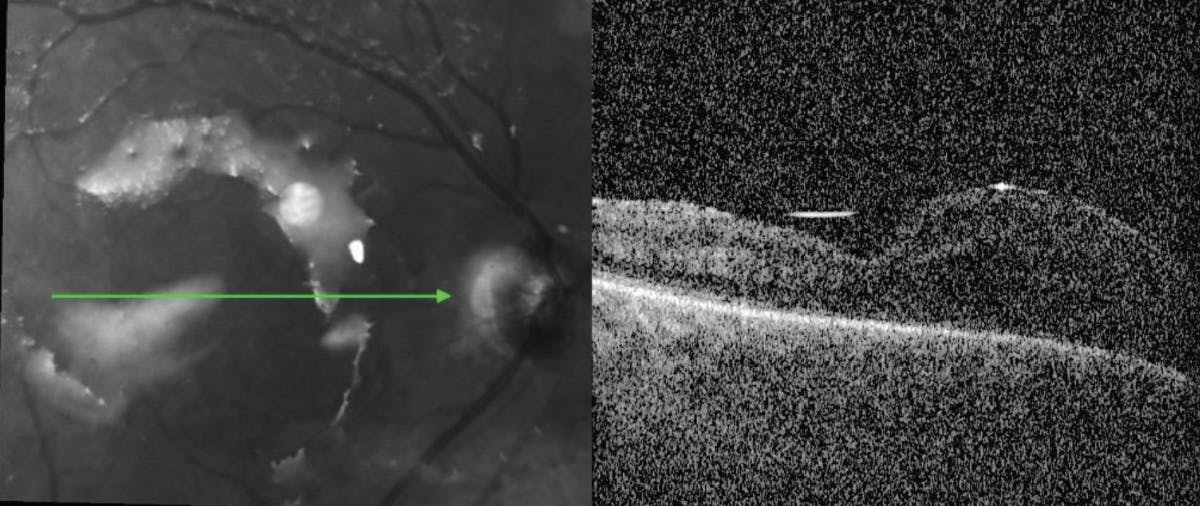
Four months postoperatively, the right eye had an attached macula under silicone oil with increased retinal thickness (Figure 2). The patient’s final VA was 20/400 OD.
Postoperatively, I monitor for cystoid macular edema, epiretinal membrane, recurrent PVR formation, and silicone oil emulsification.
For eyes that present with recurrent PVR and a history of multiple surgeries, I may consider using intravitreal methotrexate injections as per the GUARD clinical trial protocol (NCT04136366).
ONE STEP AT A TIME
By Jason Hsu, MD
I first consider how I am going to approach the case—with vitrectomy or a combined scleral buckle-vitrectomy procedure. In most cases, I place a scleral buckle, unless there is a funnel RD with a severe anterior loop and I plan to perform a 360° retinectomy.
Lens status also influences my surgical approach. I often place a buckle in phakic eyes with PVR because I don’t typically perform lensectomies (or concomitant cataract surgery) unless there is a significant cataract. Our group looked at the outcomes of vitrectomy with retinectomy without lensectomy for grade C PVR RDs in phakic eyes and found that the outcomes were similar to what has been reported in eyes that have undergone lensectomies.2
If a lensectomy is necessary, it’s important to take the whole capsule; leaving the anterior capsule intact may act as a scaffold for PVR proliferation over the ciliary body, leading to hypotony and poorer outcomes.
During the vitrectomy, I use triamcinolone to ensure the posterior hyaloid is up, and I peel any membranes that are posterior to the equator. Identifying star folds and pinching with forceps in the center of the fold can often help initiate the peel. Alternatively, using a Finesse Flex Loop (Alcon) to massage the surface of the retina may help to identify additional membranes or edges from which to initiate a peel. Preretinal pigmentation, often presenting in clumps, typically signifies an associated membrane.
I rarely use ICG or brilliant blue G to peel the ILM but have done so in cases where the retina keeps redetaching from PVR recurrences. In these situations, I peel the ILM as extensively as possible, focusing on the macula and the area of the PVR, which is typically the inferior periphery. Using a lighted pick can help to dissect tenacious membranes that are adherent to the retina, but it’s important not to be overly aggressive to avoid creating iatrogenic breaks.
In grade C PVR, I am more liberal about using retinectomy unless I’m confident I peeled all the membranes. I use diathermy to mark the edges and make sure to remove any retina that contains membranes that could not be peeled or areas of intrinsic PVR with thickening and folding. While I like to stay as anterior as possible, I also remove the vitreous base in the quadrants of the retinectomy. I place PFO over the macula, typically to the edges of the arcades, before initiating the retinectomy to help protect the macula and stabilize the retina.
When performing the retinectomy, I always watch the tip of my cutter to avoid hitting the choroid and causing a hemorrhage. I limit the amount of vacuum to avoid inadvertently eating more retina than is necessary. In addition, excessive hemorrhage may be a risk factor for recurrent PVR, and subretinal or preretinal hemorrhage at the retinectomy edge will block the laser uptake.
After completing the circumferential extent of the retinectomy, I remove the retina anteriorly. Although I trim it down, I don’t aggressively scleral depress and try to shave down the anterior retina, as this increases the risk of iatrogenic choroidal hemorrhaging.
Next, I fill the eye with PFO, tilting away from the retinectomy site to push the subretinal fluid out and lower the risk of small PFCL bubbles entering the subretinal space. I laser under PFO with longer-duration burns (150 ms to 200 ms).
Finally, I remove the PFO during air infusion while tilting the eye toward the retinectomy; I meticulously drain any residual balanced salt solution before removing the PFCL below the edge of the retinectomy. In nearly all cases, I use silicone oil tamponade. In the rare situation where a retinectomy isn’t necessary, I may use C3F8.
Upon studying factors associated with better visual outcomes in eyes with PVR undergoing retinectomy, we found that a shorter time to surgery after PVR redetachment (mean of 2.9 days) was associated with better outcomes, independent of whether the macula was on or off.3 Therefore, surgeons should get these eyes back to the OR in a timely fashion.
1. Sadda SR, Schachat AP, Wilkinson CP, et al, eds. Ryan's Retina. Elsevier Health Sciences; 2022.
2. Mahmoudzadeh R, Mokhashi N, Anderson H, et al. Outcomes of retinectomy without lensectomy in rhegmatogenous retinal detachments with proliferative vitreoretinopathy. Ophthalmol Retina. 2023;7(1):52-58.
3. Israilevich RN, Starr MR, Mahmoudzadeh R, et al. Factors associated with good visual acuity outcomes after retinectomy in eyes with proliferative vitreoretinopathy. Am J Ophthalmol. 2022;240:143-148.


_1784132761.jpg?auto=compress,format&w=75)





