


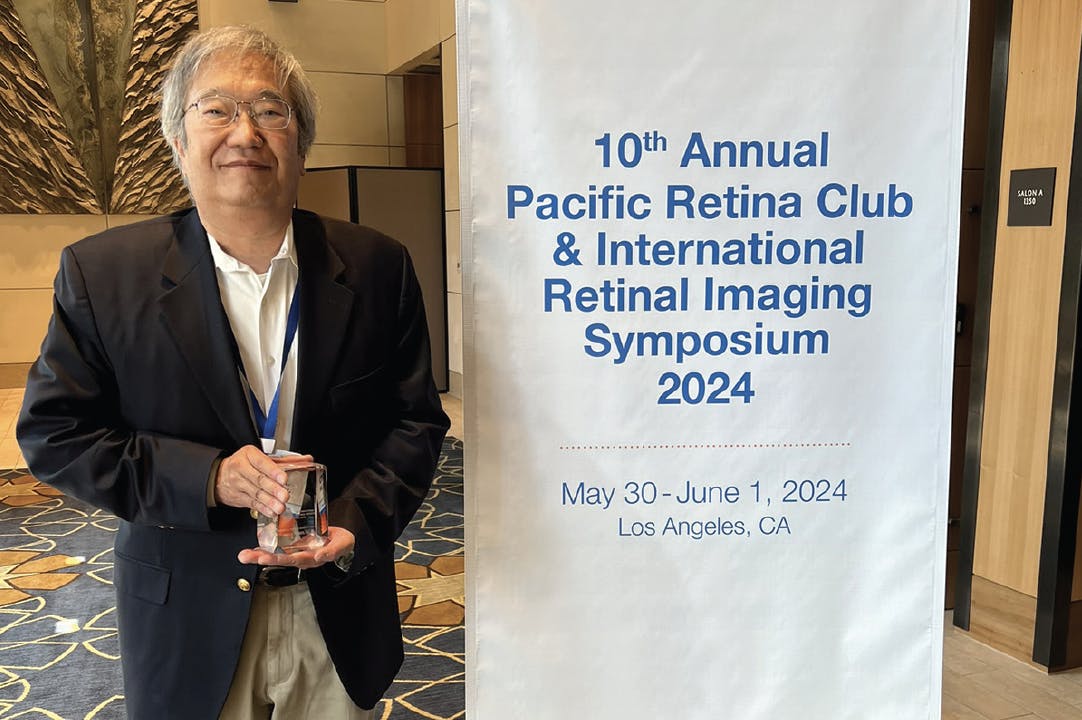
The 10th Annual Pacific Retina Club (PRC) and International Retinal Imaging Society (IntRIS) Symposium was held May 30 – June 1, 2024, at the University of California Los Angles Meyer & Renee Luskin Conference Center in Los Angeles. The meeting was expertly organized by David Sarraf, MD; Amani A. Fawzi, MD; K. Bailey Freund, MD; H. Richard McDonald, MD; and SriniVas Sadda, MD. Mark W. Johnson, MD, and James G. Fujimoto, PhD, were the award lecturers (Figures 1 and 2).
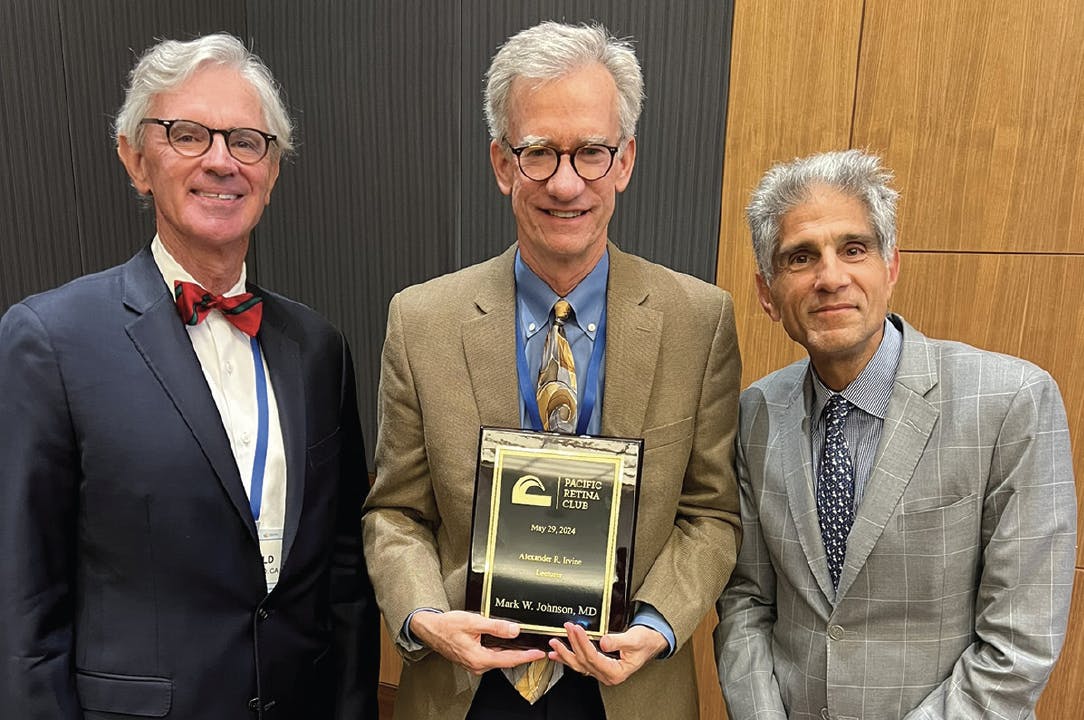
Figure 1. Dr. McDonald (left) and Dr. Sarraf (right) present Dr. Johnson (middle) with the 2024 Alexander R. Irvine Award.
CASE PRESENTATIONS
The first day of PRC kicked off with 30 mystery cases presented by trainees as part of a lively session moderated by Dr. Sarraf. With only 5 minutes for each case, it was challenging to determine the correct diagnosis, which included atypical presentations of angioid streaks, ocular sarcoidosis, primary vitreoretinal lymphoma, Loeys-Dietz syndrome associated with familial exudative vitreoretinopathy, and acute idiopathic maculopathy due to Coxsackie virus. Genetic disorders, such as A3243G mitochondrial retinopathy, PROM1 retinal dystrophy, and ocular albinism, were also discussed. Additional sessions were chaired by Anita Agarwal, MD, and Dr. McDonald, who moderated a second set of 30 compelling cases that included ophthalmomyasis, leiomyoma, and multifocal vitelliform maculopathy.
ALEXANDER R. IRVINE LECTURE
Dr. Johnson delivered the named lecture in honor of University of California San Francisco Professor Alexander R. Irvine, MD. The first part of his presentation focused on the clinical and surgical significance of internal limiting membrane tears associated with epiretinal membrane.
In the second part, Dr. Johnson discussed a new classification of maculopathies whose pathoanatomy and pathophysiology depend on Müller cells; he proposed the term Müller cell gliopathies. According to Dr. Johnson, the spectrum of these gliopathies may include traumatic, inflammatory, metabolic, and toxic diseases, such as lamellar macular holes, inner retinal dimples, macular teleangiectasia, and tamoxifen toxicity.
PRC 2024 RETINA UPDATE
The second day kicked off with sessions focusing on AI, inherited retinal diseases, pediatric surgery, and uveitis. During the imaging session, Dr. Fawzi discussed the thin double layer sign as a biomarker for geographic atrophy, while Dr. Freund introduced the concept of sealed versus unsealed retinal pigment epithelium (RPE) defects in different macular diseases, including AMD and pachychoroid disorder. Finally, Alain Gaudric, MD, explained the various types of acute choroidal ischemia and triangular syndrome.
Dr. Johnson presented a whirlwind of cases of macular disease to an expert panel of retinal imaging gurus and reviewed various novel disorders and new OCT findings, such as “snowflake-like” paracentral acute middle maculopathy.
After two panels on cutting-edge surgical and oncology cases led by David R. Chow, MD, and William F. Mieler, MD, respectively, the focus shifted to medical retina disorders, including sessions dedicated to AMD, retinal vascular disease, and diabetic retinopathy. During the AMD session, Dr. Sarraf discussed the clinical utility of OCT angiography (OCTA) in the diagnosis of type 1, 2, and 3 macular neovascularization and in the assessment of macular neovascularization growth and treatment response. Special attention in these sessions was also given to the latest clinical trial results.
INTRIS 2024 SYMPOSIUM
The first half of this year’s IntRIS Symposium was dedicated to technology innovations and advances in OCT and OCTA imaging. This was followed by a session on inherited retinal disease, during which Claudio Iovino, MD, gave a wonderful talk on the development of chorioretinal atrophy as a complication of voretigene neparvovec-ryzl (Luxturna, Spark Therapeutics) subretinal gene therapy. The data were based on one of the largest cohorts of patients in the world treated with this groundbreaking therapy for RPE65-related inherited retinal dystrophy.
The next session on dry AMD included presentations on the outcomes of various dry AMD lesions, including subretinal drusenoid deposits, acquired vitelliform lesions, and the progression of large drusen to a state of collapse.
The vitreoretinal disease section included talks about the findings of ultra-widefield OCT and fluorescein angiography in peripheral retinal disease and after epiretinal membrane surgery (by Anibal A. Francone, MD; Iksoo Byon, MD, PhD; and Dr. Gaudric). Another lecture by Fiammetta Catania, MD, FEBO, touched on the natural course of lamellar macular holes in pathologic myopia and pachychoroid disease, as studied by en face OCT and OCTA.
Important updates on the advanced multimodal imaging of diabetic retinopathy and geographic atrophy were provided during two sessions focusing on retinal vascular disease and dry AMD. The newly recognized entity of multizonal outer retinopathy and retinal pigment epitheliopathy was presented by Prithvi Ramtohul, MD, during the inflammatory and infectious disease session. Central serous chorioretinopathy was the focus of the next session, and Dr. Sarraf presented a novel theory regarding the potential link between the reversal of the RPE pump function and the pathogenesis of acute central serous chorioretinopathy.
LAWRENCE A. YANNUZZI AWARD LECTURE
Dr. Fujimoto presented the 5th Annual Lawrence A. Yannuzzi lecture focused on OCT. After explaining the evolution of this revolutionary imaging tool, Dr. Fujimoto provided a lesson in perseverance. He explained that after the first demonstration of in vitro OCT in 1991 and the first commercial introduction of the ophthalmic OCT device in 1996, only approximately 400 units were sold worldwide by 2001. Today, an OCT device is ubiquitous in retina practices worldwide and is an indispensable tool for retinal evaluation.
MEMBERS-IN-TRAINING
Eleven presentations by young IntRIS members-in-training concluded this year’s meeting. Key topics on advanced retinal imaging included en face OCT and OCTA of diabetic retinopathy, tamoxifen retinopathy, retinal ischemic perivascular lesions, pentosan polysulfate sodium maculopathy, and hyperreflective foci as a predictor of geographic atrophy.
SEE YOU NEXT YEAR!
The 2024 combined PRC-IntRIS meeting was a major success and exceeded expectations; it highlighted current updates on the evaluation and management of a broad spectrum of retinal disorders and offered exciting presentations of novel imaging systems. The discussions were dynamic and insightful, and the overall exchange among the participants was energetic and rewarding. The organizers, presenters, and participants are already looking forward to next year’s meeting, which will take place June 5 – 7, 2025, at the the University of California Los Angles Meyer & Renee Luskin Conference Center in Los Angeles.


_1784132761.jpg?auto=compress,format&w=75)





