




The 52nd Annual Aspen Retinal Detachment Society Meeting, held March 2-6, 2024, in Snowmass Village, Colorado, boasted many excellent lectures from world-renowned experts in retina. Here, I highlight the hot topics that kept the attendees engaged (Figure).
TREATING GEOGRAPHIC ATROPHY
Daniel F. Martin, MD, provided his perspective on pegcetacoplan (Syfovre, Apellis) and avacincaptad pegol (Izervay, Iveric Bio/Astellas), beginning with a review of the history of complement pathway research in AMD. Although variants in complement factor H (CFH) have been linked to the onset of advanced AMD, CFH has not been significantly correlated with the growth of geographic atrophy (GA), he said. Many clinical trials targeting complement for the treatment of GA have failed, including the SPECTRI and CHROMA trials for lampalizumab. The AREDS2 cohort paradoxically showed an inverse relationship between complement C3 AMD risk alleles and GA expansion.1 A more recent AREDS study showed that ARMS2/HTRA1 is highly predictive of the growth rate of small GA lesions, suggesting that there are other pathogenic pathways in the progression of GA.2
Dr. Martin then summarized the OAKS/DERBY trials, reminding the audience that OAKS met its primary endpoint but not DERBY, and that both trials showed significant reduction in GA lesion growth at 2 years. However, there were no significant differences in functional endpoints. A subgroup analysis showed that patients with extrafoveal GA did have slower vision loss, but this cohort included only 22% of all trial participants. Most patients (78%) with GA lesions closer to the fovea did not show this benefit.
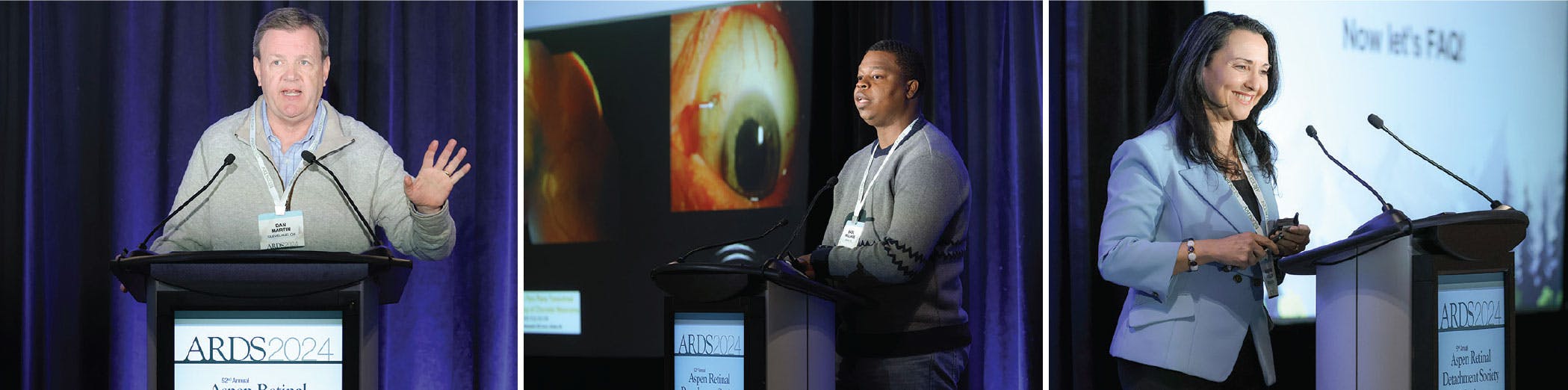
Figure. Drs. Martin (left), Williams (middle), and Parolini (right) engaged the ARDS 2024 attendees with top-notch education and clinical insights. Images courtesy of Kevin Caldwell Photography.
Similarly, the GATHER trials for avacincaptad pegol showed a significant reduction in GA lesion growth. A post-hoc analysis looking at trial patients who lost 15 letters or more at two consecutive visits showed significantly less loss in the avacincaptad pegol-treated cohort.
Dr. Martin reminded the audience that although the approximate 20% reduction in GA growth rate seen for both pegcetacoplan and avacincaptad pegol might seem impressive, this difference corresponded to an absolute area of approximately 1 mm2 at 24 months—not a significant clinical change for 2 years of therapy. In fact, he stated that AREDS2 supplementation had the same clinical efficacy. He calculated that, when aggregating the mean baseline characteristics from all trials for these two agents, treatment changes the average time from diagnosis to foveal involvement from 4 years to 5 years if it was extrafoveal at baseline.
Dr. Martin then discussed safety profiles. Pegcetacoplan had a four-fold increased risk for conversion to wet AMD, a 4% rate of intraocular inflammation, and a 2% rate of ischemic optic neuropathy for monthly dosing. Avacincaptad pegol had a 1.7-fold increased risk for conversion to wet AMD and no episodes of intraocular inflammation or ischemic optic neuropathy. Dr. Martin briefly discussed the retinal vasculitis reported by the ASRS Research and Safety in Therapeutics committee and noted that it remains to be seen whether avacincaptad pegol will cause similar inflammatory reactions.
SURGERY AND COMPLICATIONS IN OCULAR ONCOLOGY
Basil K. Williams Jr, MD, discussed the unique risks, surgical precautions, and potential complications of intraocular surgery for patients with malignant intraocular tumors. Surgeons must be cautious of tumor seeding, he said, which is more likely when the tumor has broken through Bruch membrane or when there is a release of subretinal fluid. Dr. Williams shared several precautions to mitigate tumor seeding, including precise identification of the tumor location, localized peritomy in the area surrounding each trocar, cryotherapy at the time of trocar removal, and sclerotomy closure with sutures. During fine needle aspiration biopsy, tumor seeding may occur if the biopsy needle penetrates too deeply into or through the sclera. Vitrectomy-assisted biopsy with subretinal cannulas, on the other hand, may allow more control and prevent this complication.

Eyetube Video Coverage: Aspen Retinal Detachment Society 2024
The greatest challenges usually occur when surgeons are not aware of an intraocular tumor. Dr. Williams shared the case of a 69-year-old woman who underwent vitrectomy with silicone oil for a rhegmatogenous retinal detachment (RD). The surgeon identified a mound of subretinal hemorrhage intraoperatively, which continued to grow over 6 months of observation. Upon presentation to Dr. Williams, the patient had already developed neovascular glaucoma and required enucleation after a large hypoechoic mass was discovered. Pathology revealed spindle B melanoma. He further described a case series by Shields et al, in which vitrectomy was performed in eyes with unsuspected retinoblastoma.3 With a median time to referral after vitrectomy of 4 days, one of 11 patients died due to pre-existing metastatic disease. In another series in India with a median time to referral of 7 months, eight of 14 patients died due to progressive disease.4
Rhegmatogenous RD is rare in patients with uveal melanoma, and repair is complex, with single-surgery success rates ranging from 40% to 60%.5,6 Exudative RD is very common with intraocular tumors (up to 75% of cases) and can cause photoreceptor damage over time. Dr. Williams prefers to perform internal drainage but acknowledges the disadvantages, which include introducing a break, the potential for tumor seeding, and the creation of a nidus for proliferative vitreoretinopathy. Dr. Williams considers RD repair only in monocular patients or in those with bilateral disease and prefers a primary scleral buckle, if possible.
Lastly, Dr. Williams discussed the controversial topic of tumor endoresection. In the United States, endoresection is not the primary mode of treatment for choroidal melanomas due to the risk of local recurrence and tumor dissemination. However, recent studies with smaller-gauge vitrectomy and valved trocars have not shown increased rates of metastasis and mortality compared with enucleation or radiation. Dr. Williams reserves endoresection for specific situations (ie, monocular patients with toxic tumor syndrome where the tumor has already been treated with radiation).
ABOUT THE SPEAKERS

Daniel F. Martin, MD
• Chair, Cleveland Clinic Cole Eye Institute; Barbara and A. Malachi Mixon III Institute Chair in Ophthalmology; Professor of Ophthalmology, Cleveland Clinic Lerner College of Medicine of Case Western Reserve University, Cleveland

Barbara Parolini, MD
• Head of Vitreoretinal Unit, Eyecare Clinic, Brescia, Italia

Basil K. William Jr, MD
• Associate Professor of Clinical Ophthalmology, Bascom Palmer Eye Institute, Miami
MYOPIC TRACTION MACULOPATHY
Barbara Parolini, MD, gave an excellent talk on myopic traction maculopathy (MTM), covering pathogenesis, clinical staging, and surgical treatment. She began by describing the forces at play in the pathogenesis of MTM. A centripetal force mediated by the Müller cells, external limiting membrane, and internal limiting membrane holds the retina together. These are opposed by forces acting perpendicular to the fovea, which cause schisis and detachment, as well as forces tangential to the fovea, which induce foveal splitting. The perpendicular forces are caused by scleral ectasia, in which the sclera is stretched posteriorly away from the retina while the vitreous pulls the retina anteriorly. Ectasia of the sclera also causes tangential forces that pull away from the fovea, leading to macular holes. The combination of these forces causes a macular hole with macular detachment.
Dr. Parolini then described her staging system for MTM, which was validated internationally with high interobserver agreement.7 Stage 1 consists of inner-outer macular schisis, and stage 2 involves predominantly outer macular schisis. In stage 3, there is macular schisis with RD. Stage 4 is an RD. Each stage is further subclassified into A, B, or C based on the foveal morphology. Grade A indicates a normal foveal morphology, grade B indicates a lamellar macular hole, and grade C refers to a full-thickness macular hole.
Dr. Parolini then transitioned the discussion to treatment, emphasizing the importance of understanding the pathogenesis of MTM to inform treatment decisions. She asserted the necessity of treating MTM, presenting evidence that observation alone yields poorer outcomes compared with treatment. Dr. Parolini then questioned the effectiveness of vitrectomy, citing literature reporting 60% functional success and 80% anatomical success, particularly noting the higher failure rates in advanced stages. In her opinion, the surgical approach should counteract the tractional forces. Forces perpendicular to the fovea need to be counteracted by macular buckling, whereas forces tangential to the fovea may require vitrectomy with internal limiting membrane peeling.
Finally, Dr. Parolini discussed the development of macular buckles and shared her own New Parolini Buckle, which has four eyelets for anterior scleral fixation, a curved arm to extend posteriorly, and a terminal ovoid bump for macular buckling effect. Furthermore, a canal within the curved arm allows insertion of a transilluminator to confirm positioning. Dr. Parolini has also created a preliminary nomogram for optimal suture placement positioning based on axial length. In total, she has performed more than 400 macular buckles and collected the outcomes of 236 cases with 1 to 15 years of follow-up. She reports an anatomical and functional success rate of nearly 100%.
Registration opens October 16th for the 53rd annual ARDS meeting, set for March 1-5, 2025, in Snowmass, Colorado. Click here for more information.
1. Keenan TD, Agron E, Domalpally A, et al. Progression of geographic atrophy in age-related macular degeneration: AREDS2 Report Number 16. Ophthalmology. 2018;125(12):1913-1928.
2. Agrón E, Domalpally A, Cukras CA, Chew EY, Keenan TDL. Critical dependence on area in relationship between ARMS2/HTRA1 genotype and faster geographic atrophy enlargement. Age-Related Eye Disease Study 2 Report Number 33. Ophthalmology. 2024;131(2):208-218.
3. Shields CL, Honavar S, Shields JA, Demirci H, Meadows AT. Vitrectomy in eyes with unsuspected retinoblastoma. Ophthalmology. 2000;107(12):2250-2255.
4. Kaliki S, Taneja S, Palkonda VAR. Inadvertent intraocular surgery in children with unsuspected retinoblastoma: a study of 14 cases. Retina. 2019;39(9):1794-1801.
5. Grixti A, Angi M, Damato BE, et al. Vitreoretinal surgery for complications of choroidal tumor biopsy. Ophthalmology. 2014;121(12):2482-2488.
6. Anguita R, Makuloluwa A, Bhalla M, Katta M, Sagoo MS, Charteris DG. Rhegmatogenous retinal detachment in choroidal melanoma: clinical features and surgical outcomes. Eye (Lond). 2024;38(3):494-498.
7. Parolini B, Palmieri M, Finzi A, et al. The new myopic traction maculopathy staging system. Eur J Ophthalmol. 2021;31(3):1299-1312.


_1784132761.jpg?auto=compress,format&w=75)





