


AT A GLANCE
- Organic intraocular foreign bodies (IOFBs) have a high risk of endophthalmitis, and immediate removal is recommended at the time of primary repair.
- Removal of a tempered glass IOFB is especially challenging because of its non-magnetic nature, shape, smooth surfaces, and relatively large size.
- Although an uncommon tool in the ophthalmic OR, a nitinol stone basket has been used to extract intraocular square glass and pellets.
Ocular trauma cases can be some of the most challenging experiences in the OR. Surgeons must review the patient’s history carefully to fully understand the injury, the initial steps to repair it, and the possibility of an intraocular foreign body (IOFB). The type of object—organic, glass, or metal—and the size both play into the surgical plan. Here, two surgeons share their unique IOFB cases and how they handled them in the OR.
DEALING WITH ORGANIC MATERIAL
By Haemoglobin Parida, MBBS, MS
A 9-year-old boy presented the day after being hit in the eye by a stick. He had a scleral tear in the left eye at the 4 clock position, 2 mm from the limbus, and his VA was light perception OS. An outside provider had repaired the scleral wound the day of the injury. However, the postoperative B-scan showed an IOFB, vitreous hemorrhage, retinal detachment (RD), and thickened retinochoroidal complex of 2.19 mm. Due to severe chemosis and a concern for panophthalmitis, intravenous antibiotics were administered for 5 days, after which the chemosis subsided and the cornea was clearer.
During the 23-gauge vitrectomy after the 5-day course of antibiotics, the large wooden IOFB was released from the entangled vitreous (Video 1). Perfluorocarbon liquid (PFCL) was injected to stabilize the detached retina, and a scleral tunnel was made in the superior sclera. The IOFB, measuring 15 mm x 5 mm, was grasped with intravitreal forceps and removed through the scleral tunnel with McPherson forceps and the support of an irrigating vectus (Figure 1). The exudates over the inferior necrotic retina were trimmed, fluid-air exchange was performed, endolaser was applied to the inferior break, and silicone oil was added with intravitreal vancomycin, ceftazidime, and voriconazole.
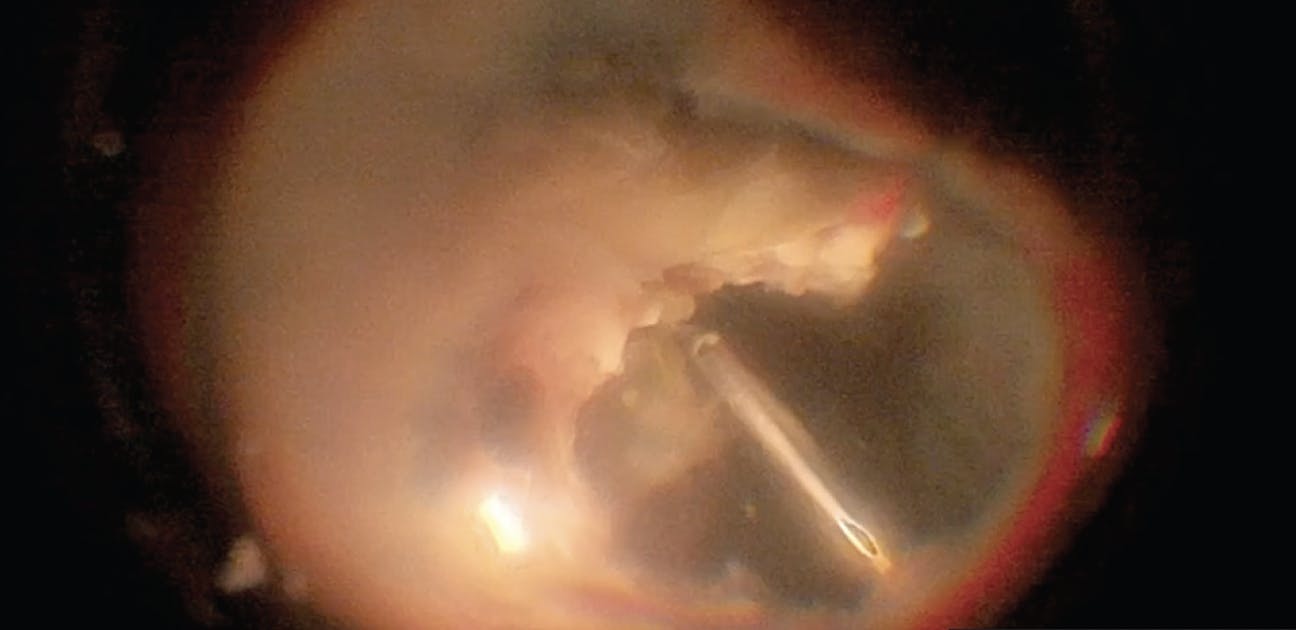
Video 1. Removing an Organic Intraocular Foreign Body
By Haemoglobin Parida, MBBS, MS
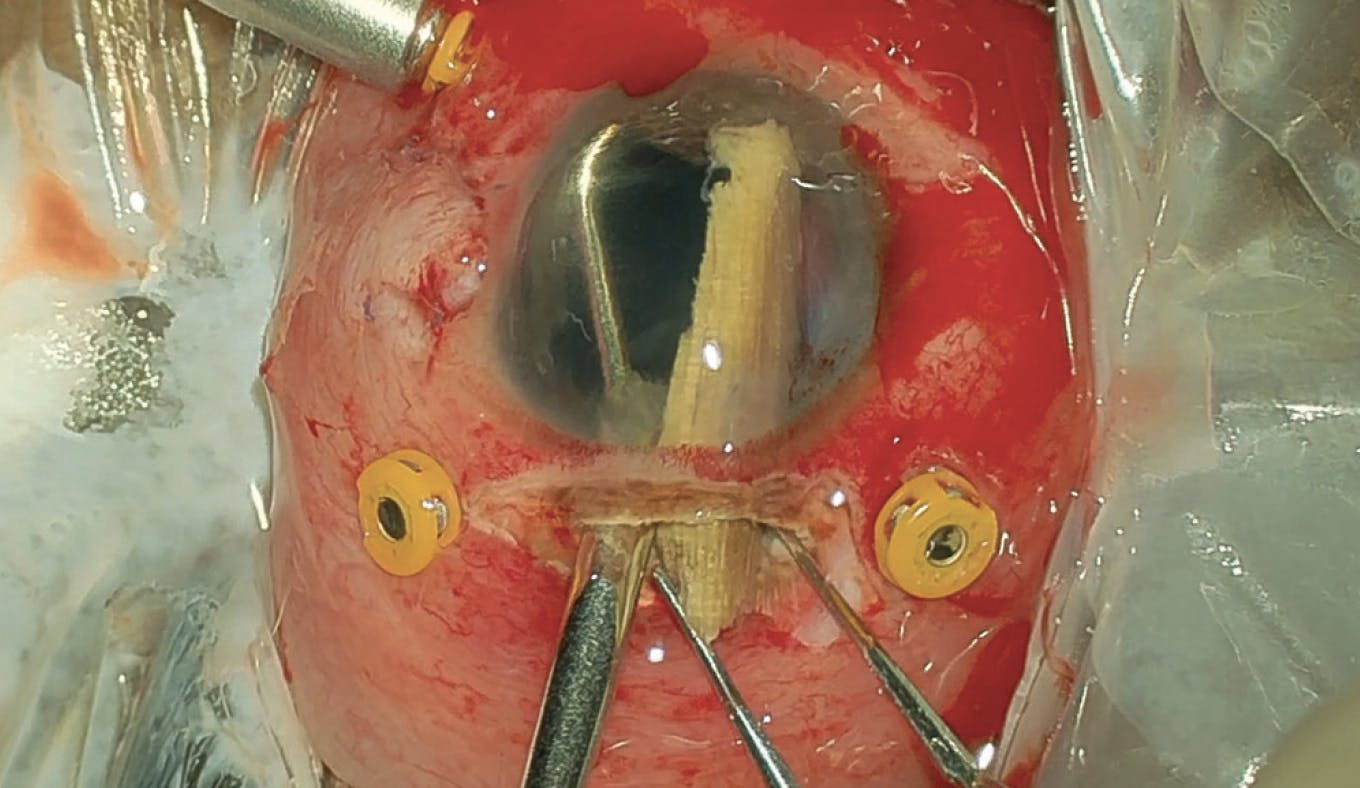
Figure 1. The wooden splinter was removed with the help of McPherson forceps and an irrigating vectus.
Although the retina was attached postoperatively, the globe developed hypotony over the next 4 months, with a final VA of light perception.
Discussion
Effort should be made to rule out an IOFB in every case of globe injury. B-scan ultrasonography with reduced gain should be performed gently to detect and localize any IOFBs and to assess the extent of intraocular damage. CT with thin cuts is the standard for detection and localization of all IOFBs.1-3 MRI is preferred if a metallic IOFB is ruled out.
Organic IOFBs have a high risk of endophthalmitis, and immediate removal is recommended at the time of primary repair.1,2,4,5 Associated vitreous hemorrhage and RD also prompt early intervention. Prophylactic intravenous antibiotics should be started as soon as possible.
Surgeons should consider repairing the entry wound first with a conjunctival peritomy and wound exploration in larger wounds. During standard 23- or 25-gauge vitrectomy, a 6 mm infusion cannula or anterior chamber maintainer should be placed if visibility is poor. Lensectomy may be done depending on lens damage or cataract presence or to facilitate large IOFB removal. Complete vitrectomy is preferred with induction of a posterior vitreous detachment.
The IOFB must be freed from vitreous adhesions with sharp dissection, if necessary. The sclerotomy size should be larger than the IOFB to prevent incarceration in the pars plana or fallback onto the retina. For larger sclerotomies, surgeons can use pre-placed sutures to prevent sudden hypotony after IOFB removal. When removing a large IOFB, scleral tunnels can be made superiorly. In some cases, PFCL may be used to float an organic IOFB and prevent retinal injury. Various forceps, snares, baskets, and loops can be used to grasp and remove the IOFB. To remove the IOFB, the object should be aligned perpendicular to the sclerotomy with the flatter end parallel to facilitate easy removal.
At the end of surgery, laser photocoagulation and intraocular tamponade can address associated retinal injuries. Intravitreal antimicrobials are recommended. Surgeons must monitor carefully for postoperative sequelae such as redetachment, proliferative vitreoretinopathy, and phthisis.
NOT-SO-SAFE SAFETY GLASS
By Juan Carlos Gutierrez Hernandez, MD
A 36-year-old patient who was involved in a motor vehicle accident presented with multiple glass fragment lacerations in the face and was taken to the OR for a primary scleral wound closure. Postoperatively, the patient was referred for a dilated fundus examination due to a non-clearing vitreous hemorrhage and a VA of counting fingers at 50 cm. No IOFB was identified on B-scan ultrasonography, and the anterior segment exploration was unremarkable; IOP was 16 mm Hg.
Despite the B-scan findings, the history of multiple glass fragment lacerations on the face and a scleral wound repair raised suspicions for an intraocular glass shard. Side vehicle windows are made of tempered glass, which shatters into small chunks rather than sharp fragments, the latter of which are more prone to producing significant damage.6 However, if shattered tempered glass fragments achieve significant speed, they can penetrate the globe wall.
In this case, we took the patient to the OR for a complete vitrectomy, which revealed a 0.4 mm square-shaped tempered glass fragment lying over the posterior pole (Figure 2) and two retinal lesions in the periphery. Because the patient was young with a clear lens and preserved accommodation, we chose to extract the IOFB through the pars plana. Due to the size of the IOFB and the lack of special instrumentation at the time of surgery, we used 0.12 forceps to remove the glass shard; a wide non-valved incision and a firm and steady grasp were enough to extract the IOFB without complications (Video 2). We repaired the scleral wound with interrupted 7-0 vicryl stiches. The retinal lesions were lasered, and a 12% C3F8 gas tamponade was added.
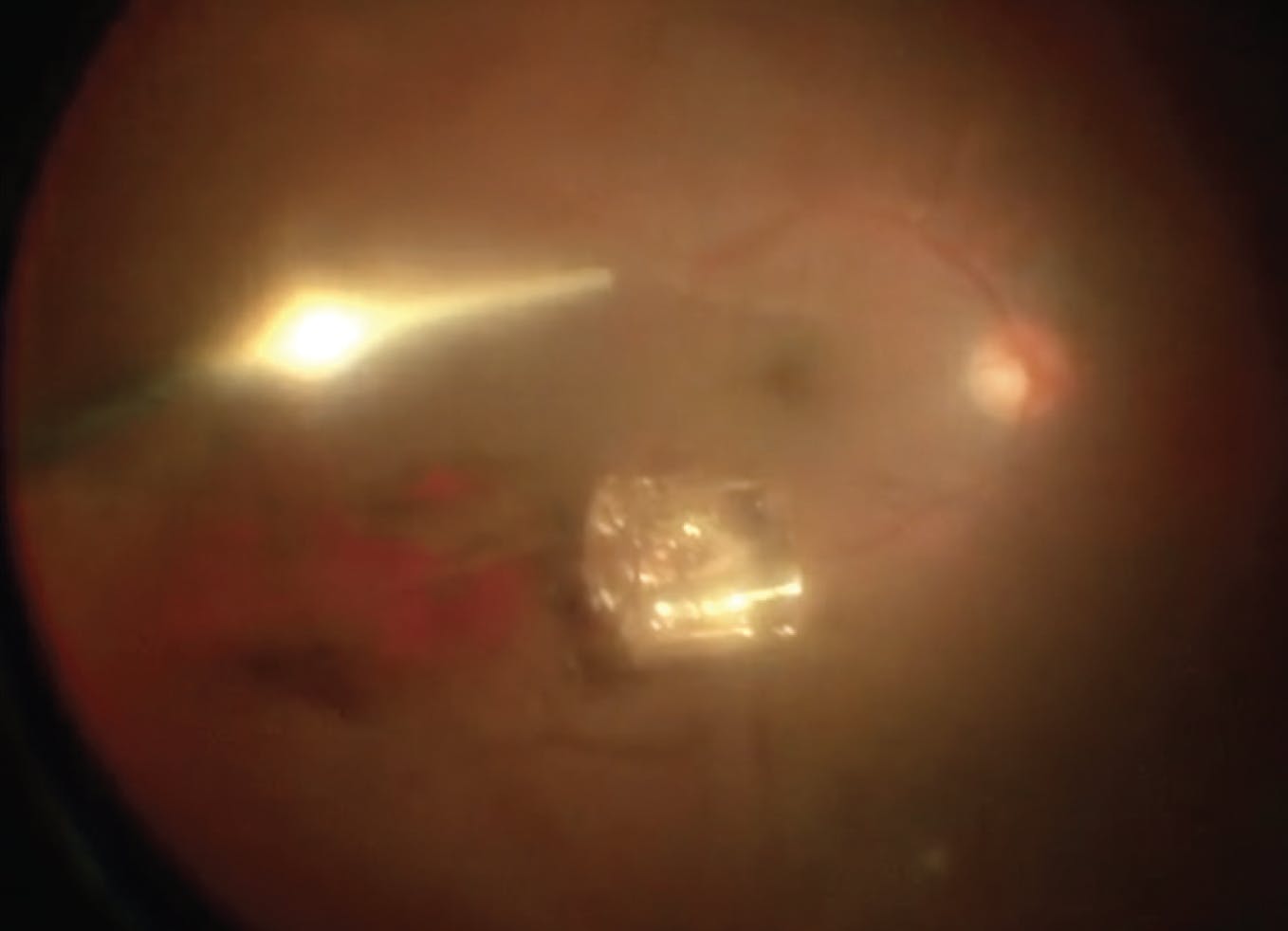
Figure 2. This patient presented with a non-clearing vitreous hemorrhage—and a 0.4 mm tempered glass IOFB—after a car accident and primary scleral wound repair.
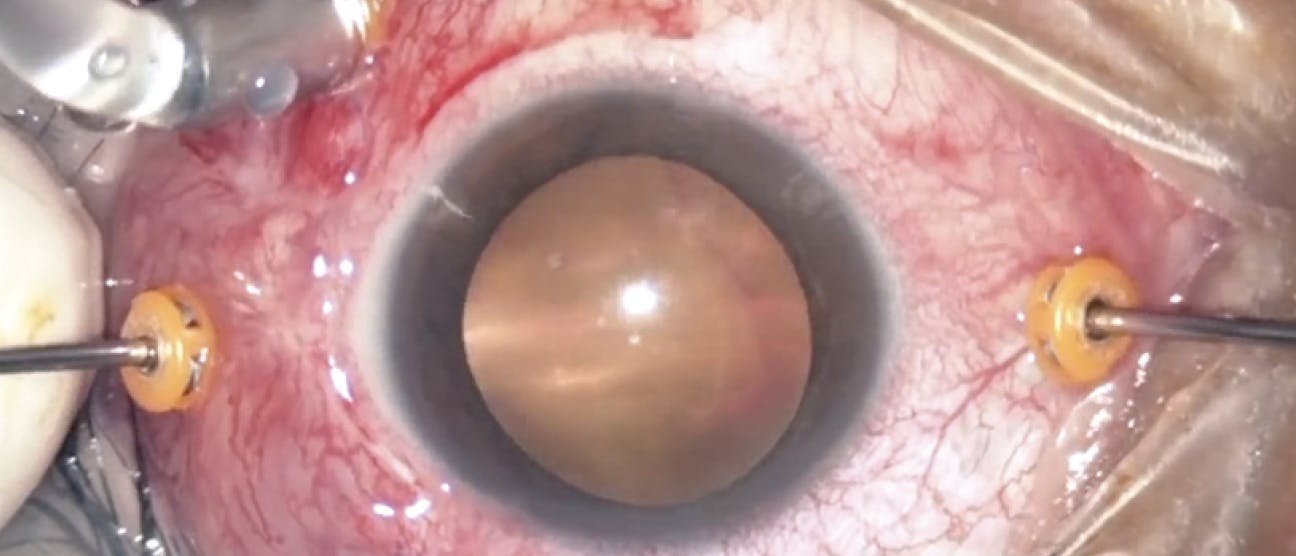
Video 2. Removing Tempered Glass From the Eye
By Juan Carlos Gutierrez Hernandez, MD
At the 9-week postoperative visit, the patient’s VA was 20/40, the anterior chamber was unremarkable with a clear lens, IOP was 12 mm Hg, and the retina was attached with a normal macula.
Discussion
Removal of a tempered glass IOFB is especially challenging because of its non-magnetic nature, square or rectangular shape, smooth surfaces, and relatively large size. Thus, special considerations must be made prior to surgery, including extraction site, protection of the macula from dropout lesions, and instrumentation.
When planning the best extraction site, the lens status is a crucial consideration; if you are attempting to preserve a clear lens, a scleral incision is necessary. The incision must be long enough to allow you to pass a rectangular or square IOFB and the forceps holding it against the resistance of the sclera; generally, an incision 2 mm longer than the longitude of the fragment allows extraction without complications. Surgeons should avoid an incomplete incision in the uveal tissue, which could entangle the IOFB and lead to a drop.
The ideal incision should be tunneled to limit fluid loss and hypotony; nevertheless, when IOFBs are large or have a square or rectangular shape, the edges of the tunnel can be damaged by maneuvering the IOFB to get it angled with the tunnel and then removing it with its asymmetrical edges and large size. In these cases, consider using a linear incision, increasing the pressure of the balanced salt solution infusion, extracting the IOFB quickly, and closing the incision as fast as possible with interrupted stitches.
Protecting the macula from iatrogenic dropout lesions is fundamental. Some authors have used PFCL or viscoelastic to displace the IOFB and attempt to protect the macula from damage if the IOFB drops from the forceps, but no evidence suggests these approaches provide any protection.7,8
The nitinol stone basket is an instrument created to extract kidney stones; since its first use described by McCarthy et al,9 others have successfully used this tool to extract intraocular square glass and pellets.7 However, it is an uncommon tool in an ophthalmic OR. Other potentially useful instruments for removing smooth-surface IOFBs include diamond-tipped forceps, lassos, snares, and aspiration cannulas.10,11
1. Jung HC, Lee SY, Yoon CK, Park UC, Heo JW, Lee EK. Intraocular foreign body: diagnostic protocols and treatment strategies in ocular trauma patients. JCM. 2021;10:9:1861.
2. Zhou Y, DiSclafani M, Jeang L, Shah AA. Open globe injuries: Review of evaluation, management, and surgical pearls. Ophthalmology. 2022;16:2545-2559.
3. Kuhn F. Penetrating injuries and IOFB. Ocular Traumatol. 2008:371-390.
4. Yang Y, Yang C, Zhao R, et al. Intraocular foreign body injury in children: clinical characteristics and factors associated with endophthalmitis. Br J Ophthalmol. 2020;104(6):780-784.
5. Keil JM, Zhao PY, Durrani AF, et al. Endophthalmitis, visual outcomes, and management strategies in eyes with intraocular foreign bodies. Clin Ophthalmol. 2022;16:1401-1411.
6. Nanda SK, Mieler WF, Murphy ML. Penetrating ocular injuries secondary to motor vehicle accidents. Ophthalmology. 1993;100(2):201-207.
7. Francis AW, Wu F, Zhu I, de Souza Pereira D, Bhisitkul RB. Glass intraocular foreign body removal with a nitinol stone basket. Am J Ophthalmol Case Rep. 2019;16:100541.
8. Zhang J, Mao H, Zou X, Deng G. Use of medical sodium hyaluronate gel in surgical removal of a glass intraocular foreign body. J Int Med Res. 2020;48(9):300060520956856.
9. McCarthy MJ, Pulido JS, Soukup B. The use of ureter stone forceps to remove a large intraocular foreign body. Am J Ophthalmol. 1990;110(2):208-209.
10. Ghoraba H. Posterior segment glass intraocular foreign bodies following car accident or explosion. Graefes Arch Clin Exp Ophthalmol. 2002;240(7):524-528.
11. Singh R, Kumar A, Gupta V, Dogra MR. 25-gauge active aspiration silicon tip-assisted removal of glass and other intraocular foreign bodies. Can J Ophthalmol. 2016;51(2):97-101.


_1784132761.jpg?auto=compress,format&w=75)





