



AT A GLANCE
- Visual symptoms stemming from the vitreous itself (ie, degenerative vitreous syndrome) can be discrete myodysopsia or diffuse vitreous dysfunction.
- Discrete vitreous opacities may be best treated with low-risk laser vitreolysis, while diffuse vitreous dysfunction typically requires vitrectomy.
- Listen carefully to patients, as details of their complaints typically guide patient selection for maximum efficacy and minimal risk.
Research shows that the vitreous can have a significant negative effect on vision, often in aspects other than Snellen visual acuity.1,2 Visual obscurations within the vitreous that become symptomatic, affecting a patient’s activities of daily living and often prompting them to seek care, are labeled as symptomatic vitreous opacities (SVOs).3 Once thought to be incidental findings with no recommended treatment, SVO is now considered a treatable condition. Data show that 80% of retina specialists perform vitrectomy for SVOs, and more than 40,000 such surgeries are performed annually in the United States.4 It is now standard of care to carefully evaluate SVOs and offer treatments to address the associated vision loss. Here, I describe ways in which patient selection and tailored treatment can help you succeed with the surgical treatment of SVOs.
UNDERSTANDING THE VITREOUS
The term SVO is nonspecific and does not guide treatment, as it can include conditions such as astroid hyalosis and inflammatory cell. Instead, Robert E. Morris, MD, uses the more specific term degenerative vitreous syndrome (DVS) to describe symptomatic visual dysfunction stemming from the vitreous body itself (Figure).5,6 There are at least two different forms of DVS. Myodesopsia (often described by patients as dots, strands, or “flies” in their vision) are discrete opacities, often a Weiss ring, or other vitreous condensations. However, the vitreous body itself, apart from a Weiss ring, clumping, or stranding, can degrade vision in the full visual field and can have profound effects on visual function and especially contrast sensitivity.7 In its detached state, the vitreous is both compressed and mobile, leading to persistent visual symptoms separate from myodesopsia. Patients often describe this as filmy, hazy vision, with reduced quality of vision. Recognition and diagnosis of these two types of DVS is critical.
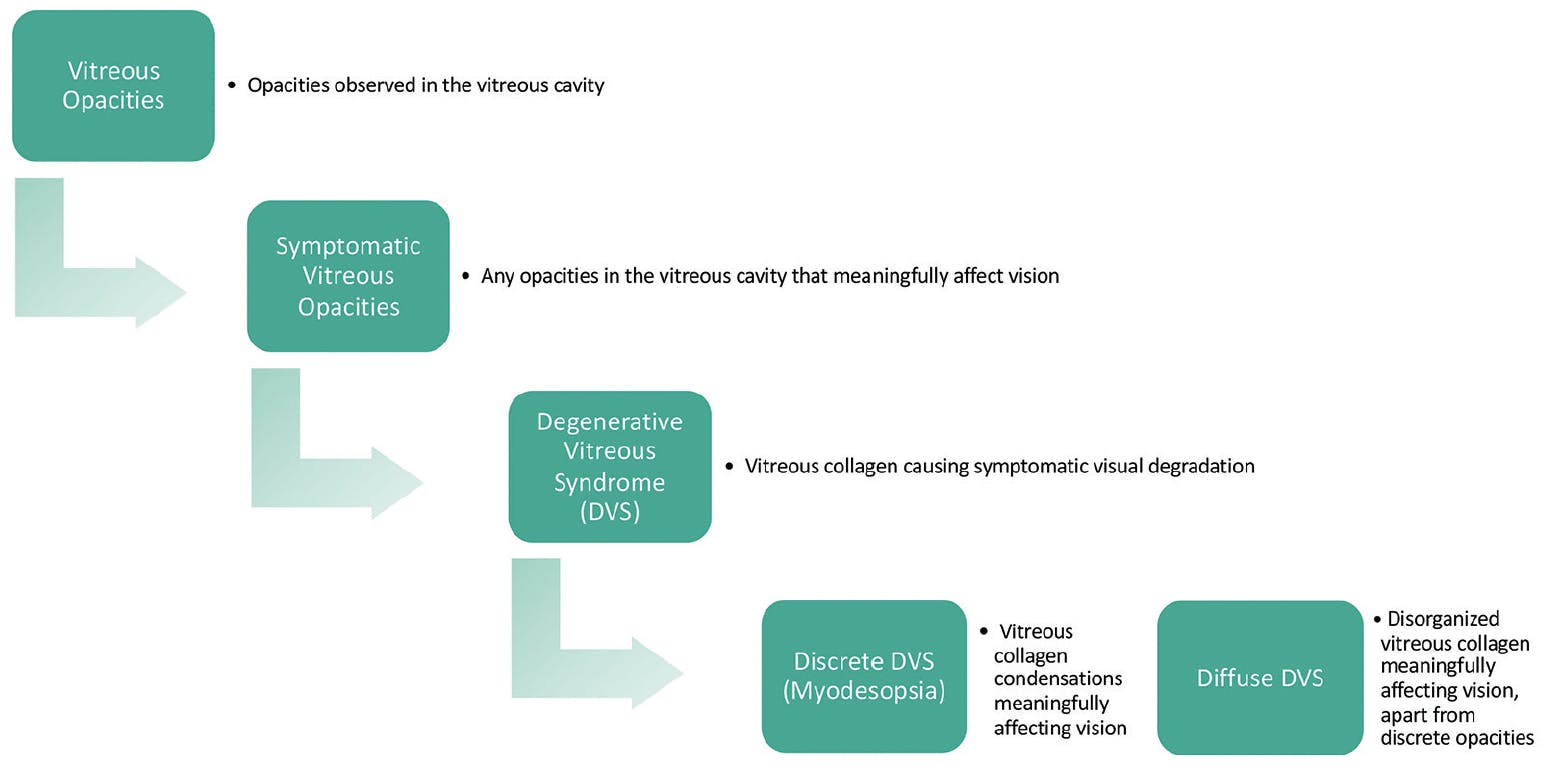
As the vitreous deteriorates with age, it becomes more dysfunctional, with increased DVS. While patients may or may not adapt to discrete opacities, the increasingly dysfunctional vitreous remains in the eye with the potential to decrease visual acuity and reading speed,8,9 reduce contrast sensitivity,10 and even increase anxiety and depression.11,12 Diffuse DVS is also a significant cause of dissatisfaction in the presence of multifocal IOLs.13
TREATING THE PROBLEM
Treatment selection and success depends on each patient’s specific complaints and visual goals. Nd:YAG vitreolysis is proven to be excellent at removing specific discrete SVOs such as a Weiss ring.14 Patients with diffuse DVS, however, may have better postoperative outcomes with vitrectomy to remove all the dysfunctional vitreous. In fact, research shows that treatment with vitrectomy resolves the symptoms listed above in nearly all cases.15,16
PATIENT SELECTION
Our understanding of what constitutes visually significant is still being refined. In fact, researchers in the Netherlands have studied the various VO-specific patient-reported outcome measurements (PROMS) in the literature, and they note that SVOs create unique quality-of-life (QoL) issues that are not properly addressed with our current PROMS.17,18 Instead, clinicians must rely on careful clinical assessment of a patient’s symptoms to determine the level of visual impairment beyond BCVA. I recommend documenting symptoms and their effect on activities of daily living through a patient survey and attestation.
Here, I share several cases that illustrate the critical role of active listening in the patient selection process for the treatment of DVS.
Case No. 1: Vision is More Than BCVA
A 76-year-old man presented with visual complaints in the right eye. His history included vitrectomy with membrane peel for an epiretinal membrane in the left eye a few years ago. He had a posterior vitreous detachment (PVD) in the right eye and was pseudophakic in each eye with standard monofocal IOLs. His BCVA was 20/20- OD and 20/40 OS.
OCT imaging was normal in the right eye and confirmed the PVD; in the left eye, the OCT revealed signs of a traumatic peel with significant nerve fiber layer defects. Stranding and other VOs were present in the right eye. An in-house vitreous-specific visual QoL questionnaire showed significantly reduced quality of vision in the right eye.
The patient confirmed that his right eye bothered him most because of the “hazy, filmy” visual effect. He felt it significantly detracted from his function, as was noted in his visual QoL. He had few discrete opacities in the right eye that did not bother him. I confirmed his visual acuity and asked why he felt his left eye was better even though his visual acuity was worse in that eye. He replied, “I can see letters better in the right eye, but everything is filmy, while my left eye can’t see letters quite as well, but everything is clear!”—a surprising response, given his imaging and BCVA.
Based on his decreased visual QoL in the right eye and the presence of a PVD and vitreous syneresis, I recommended vitrectomy or observation. After a careful discussion of the risks, he chose vitrectomy in the right eye. A 27-gauge vitrectomy was performed with no complications. On his postoperative visits, his symptoms had resolved, and his vision was “the best it’s ever been” in the right eye.
Discussion: This case illustrates that BCVA does not represent visual satisfaction, which is why we have patients who are 20/20 unhappy. Clinicians must listen closely to each patient’s complaints and realize that our methods of examination of the vitreous are currently lacking. Although we may not have imaging modalities or tools to quantify the dysfunction of the vitreous (yet), the issue still exists and is often something we can address.19
Case No. 2: Removing the Bug
A 67-year-old woman presented with complaints of symptomatic VOs in the left eye. She stated that a single large opacity appeared 6 months ago and has remained in her temporal visual field. She had a PVD in the left eye and mild cataracts in each eye. Her VA was 20/20- OD and 20/20 OS. OCT imaging showed normal retinas and confirmed the PVD in the left eye. The posterior examination revealed a Weiss ring in the left eye and no retinal tears or other issues. A visual QoL questionnaire showed a reduction in activities of daily living due to the opacity in the left eye, including difficulty reading, driving, and reduced enjoyment in visual tasks.
During our discussion, she explained that her only problem was the “big bug” in her left-eye vision, and if I could “get the bug out,” she would be satisfied.
I suggested two possible treatment approaches: vitrectomy and Nd:YAG laser vitreolysis. After discussing each procedure, including the possibility of early cataract formation with vitrectomy, she chose laser vitreolysis. The laser procedure was performed with no complications. On her postoperative visit, she noted that the bothersome “bug” was gone and the residual floaters in her vision did not bother her. The posterior examination showed resolution of the Weiss ring and no retinal issues.
Discussion: Listening to the patient’s specific complaints is critical to guide therapy. Not all opacities are the same or are treated in the same way. Laser vitreolysis was an excellent option, with a lower risk and side-effect profile than vitrectomy, in addition to lower cost, with the best outcomes in cases of discrete DVS/myodesopsia.
Case No. 3: Vitreous on the Move
A 64-year-old man presented with complaints of “terrible vision” after laser-assisted cataract surgery and premium multifocal IOL implantation in each eye. His UCVA was 20/20 OU, and he had 0.25 sphere of residual refractive error in the right eye with no astigmatism. He was J2 at near without correction. The posterior examination and imaging were unremarkable other than PVDs in each eye and typical vitreous stranding and opacities. The IOLs appeared well centered.
However, he scored poorly on the visual QoL questionnaire. I asked how he could consider his vision to be so poor with a VA of 20/20. He replied that “everything has a waxy film over it; nothing is clear.” He said that his vision was better before cataract surgery (with a VA of 20/30 and 2+ nuclear sclerosis). He wanted his premium IOLs explanted and his out-of-pocket payments refunded.
I explained that vitreous, commonly in its detached state, can cause significant aberrations, especially in conjunction with multifocal IOLs. The patient admitted that his floaters didn’t bother him but the “filmy vision” did. I explained that the vitreous can cause additional diffuse optical degradation without clumping, and removal of the vitreous body would remove this source of scatter. I explained that vitrectomy would yield the best results in this case.
After a careful discussion of the risks, he chose to undergo vitrectomy in the right eye. A 27-gauge vitrectomy was performed without complication. On his first postoperative visit, he was overjoyed, stating, “My vision is clearer than ever!” He opted for vitrectomy in the left eye, after which his UCVA was 20/20 OU.
Discussion: A key cause of vitreous dysfunction is the light scatter created by the disorganized vitreous body in the detached state,20 and the defractive rings in a multifocal IOL create additional opportunities for light scatter. A complete vitrectomy at the time of a multifocal IOL implantation has been shown to resolve light scatter issues.13,21 In this patient’s case, a second trip to the OR to remove the vitreous solved his visual complaints.
MANAGEMENT PEARLS
- Listen carefully to patients, as their specific complaints will guide patient selection for maximum efficacy and minimal risk.
- Current common imaging modalities are lacking in diagnosis and patient selection; instead, symptomology drives treatment selection.
- Visual QoL assessment is critical for patient selection to prevent unnecessary treatments.
- Discrete SVOs are often treated with low-risk vitreolysis, while diffuse DVS typically require vitrectomy.
- Diffuse DVS may cause significant reduction in QoL and is often more important to the patient’s visual function than a discrete myodesopsia/Weiss ring.
- Treatment of DVS often leads to high patient satisfaction and increased QoL.
1. Castilla-Marti M, van den Berg TJ, de Smet MD. Effect of vitreous opacities on straylight measurements. Retina. 2015;35(6):1240-1246.
2. Hammer M, Muuss M, Schickhardt S, et al. Forward light scattering of the vitreous gel after enzymatic aging: an in vitro model to study vitreous opacification. Invest Ophthalmol Vis Sci. 2024;65(3):36.
3. Paniagua-Diaz AM, Nguyen JH, Artal P, Gui W, Sebag J. Light scattering by vitreous of humans with vision degrading myodesopsia from floaters. Invest Ophthalmol Vis Sci. 2024;65(5):20.
4. Marketscope. Ophthalmic comprehensive reports. 2024 retinal surgical device market report: global analysis for 2023 to 2029, February, 2024. Accessed September 9, 2024. www.market-scope.com/pages/reports/430/2024-retinal-surgical-device-market-report-global-analysis-for-2023-to-2029-february-2024
5. Morris RE. Vitreous opacity vitrectomy (VOV): safest possible removal of “floaters”. Clin Ophthalmol. 2022;16:1653-1663.
6. Morris RE. Floater stories: assessing the potential benefits of vitrectomy. Clin Ophthalmol. 2024;18:1651-1654.
7. Garcia GA, Khoshnevis M, Yee KMP, Nguyen-Cuu J, Nguyen JH, Sebag J. Degradation of contrast sensitivity function following posterior vitreous detachment. Am J Ophthalmol. 2016;172:7-12.
8. Dysager DD, Koren SF, Grauslund J, Wied J, Subhi Y. Efficacy and safety of pars plana vitrectomy for primary symptomatic floaters: A systematic review with meta-analyses. Ophthalmol Ther. 2022;11(6):2225-2242.
9. Ryan EH, Lam LA, Pulido CM, Bennett SR, Calabrèse A. Reading speed as an objective measure of improvement following vitrectomy for symptomatic vitreous opacities. Ophthalmic Surg Lasers Imaging Retina. 2020;51(8):456-466.
10. Dysager DD, Koren SF, Grauslund J, Wied J, Subhi Y. Efficacy and safety of pars plana vitrectomy for primary symptomatic floaters: a systematic review with meta-analyses. Ophthalmol Ther. 2022;11(6):2225-2242.
11. Gouliopoulos N, Oikonomou D, Karygianni F, Rouvas A, Kympouropoulos S, Moschos MM. The association of symptomatic vitreous floaters with depression and anxiety. Int Ophthalmol. 2024;44(1):218.
12. Wu RH, Jiang JH, Gu YF, Moonasar N, Lin Z. Pars plana vitrectomy relieves the depression in patients with symptomatic vitreous floaters. Int J Ophthalmol. 2020;13(3):412-416.
13. Nguyen JH, Yee KMP, Nguyen-Cuu J, Mamou J, Sebag J. Vitrectomy improves contrast sensitivity in multifocal pseudophakia with vision degrading myodesopsia. Am J Ophthalmol. 2022;244:196-204.
14. Shah CP, Heier JS. Long-term follow-up of efficacy and safety of YAG vitreolysis for symptomatic Weiss ring floaters. Ophthalmic Surg Lasers Imaging Retina. 2020;51(2):85-88.
15. Sommerville DN. Vitrectomy for vitreous floaters: analysis of the benefits and risks. Curr Opin Ophthalmol. 2015;26(3):173-176.
16. Wagle AM, Lim WY, Yap TP, Neelam K, Au Eong KG. Utility values associated with vitreous floaters. Am J Ophthalmol. 2011;152(1):60-65.e1.
17. Woudstra-de Jong JE, Manning-Charalampidou SS, Vingerling H, Busschbach JJ, Pesudovs K. Patient-reported outcomes in patients with vitreous floaters: A systematic literature review. Surv Ophthalmol. 2023;68(5):875-888.
18. Woudstra-de Jong JE, Manning-Charalampidou SS, Vingerling JR, Busschbach JJ, Pesudovs K. The impact of vitreous floaters on quality of life. Invest Ophthalmol Vis Sci. 2024;65:1848.
19. Mason JO 3rd, Neimkin MG, Mason JO 4th, et al. Safety, efficacy, and quality of life following sutureless vitrectomy for symptomatic vitreous floaters. Retina. 2014;34(6):1055-1061.
20. Harmer SW, Luff AJ, Gini G. Optical scattering from vitreous floaters. Bioelectromagnetics. 2022;43(2):90-105.
21. Mano F, LoBue SA, Eno A, Chang KC, Mano T. Impact of posterior vitreous detachment on contrast sensitivity in patients with multifocal intraocular lens. Graefes Arch Clin Exp Ophthalmol. 2020;258(8):1709-1716.


_1773249222.png?auto=compress,format&w=75)





