


Treating patients with endophthalmitis is common in retina practices. When injecting antibiotics, most likely vancomycin and ceftazidime, the coding can be daunting, and ensuring proper reimbursement is often a challenge. Let’s review various clinical scenarios, the correct coding for each, and any additional claim requirements.
MEDICATION PACKAGING
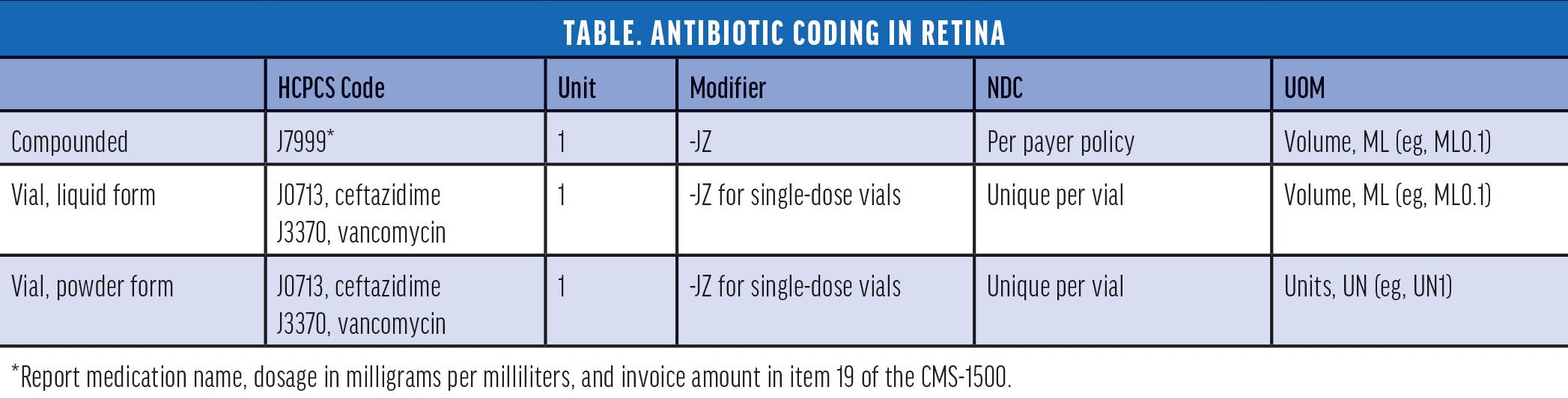
The form of the medication—whether it is compounded, a liquid vial, or a powdered vial requiring reconstitution—will guide the coding and claim submission process (Table).
Compounded
Compounded antibiotics are often preferred and should be reported using HCPCS code J7999, compounded drug, not otherwise classified. Modifier -JZ should be appended to J7999, as there is no waste. Additionally, report the name of the drug(s), dosage(s) in milligrams per milliliters, and the invoice amount(s) in item 19 of the CMS-1500.1
Report the NDC in item 24a of the CMS-1500 per the payer policy. Some payers require the NDC of the original ingredient(s) and all drug NDCs if the compounded medication consists of more than one drug.2 Medicare, however, does not associate compounded medications with an NDC.1
The unit of measure (UOM) should be reported following the NDC in item 24a of the CMS-1500. Report the volume injected in milliliters; for example, a volume of 0.1 ml (liquid form) would be reported as ML0.1.
Liquid Vial
When the medication is packaged as a liquid vial, report the HCPCS code for the medication injected. For example:
J0713 injection, ceftazidime, per 500 mg
J3370 injection, vancomycin, per 500 mg
Based on the HCPCS descriptor, one unit should be reported when 500 mg or less is injected. Modifier -JZ should be appended to the appropriate HCPCS code, as there is no waste, 1 unit or greater. Make sure to document the amount of medication in milligrams per milliliters injected.
Report the NDC as indicated on the vial in item 24a of the CMS-1500, followed by the UOM in ML.
Powdered Vial
If the medication used was reconstituted from a powder form, report the appropriate HCPCS code and unit, along with modifier -JZ. Document the dosage in milligrams per milliliters. Note that the NDC will vary by medication, as will the UOM. Vial quantity should be reported in units; when one powdered vial is used, report the UOM as UN1.3
For an overview of antibiotic coding, visit the following AAO sites:
COVER YOUR BASES
Confirm that your chart documentation and inventory system are tracking each patient’s medication and its packaging so that both match your claim submission. In the event of an audit, the reviewer may also request your documentation and inventory to confirm the appropriate HCPCS code/modifier, unit, NDC, and UOM were reported.
Want to learn more about the -JZ modifier?
Check out How to Implement the -JZ Modifier From the October 2023 issue of Retina Today.
1. Billing and coding: approved drugs and biologicals; includes cancer chemotherapeutic agents. Centers for Medicare & Medicaid Services. Revised November 2, 2023. Accessed December 5, 2024. www.cms.gov/medicare-coverage-database/view/article.aspx?articleId=53049
2. National Drug Code: frequently asked questions. Anthem. December 2017. Accessed December 5, 2024. providers.anthem.com/docs/gpp/NV_CAID_NationalDrugCodeFAQs.pdf
3. Billing instructions: reporting the National Drug Code. Blue Cross Blue Shield. Revised January 2023. Accessed December 5, 2024. ereferrals.bcbsm.com/docs/common/common-billing-national-drug-code.pdf


_1784132761.jpg?auto=compress,format&w=75)




