


AT A GLANCE
- Placement of a human amniotic membrane graft has been shown to promote closure of refractory macular holes.
- In the case presented here, a greater than 1,600 µm macular hole was treated with a human amniotic membrane graft held in place during surgery with a PFO bubble.
- The authors postulate that waiting at least 2 minutes with the graft under PFO allows for displacement of fluid from underneath the graft and promotes adhesion to the macular surface.
Refractory macular holes (MHs), for which standard techniques have failed, pose a unique challenge in vitreoretinal surgery. Reasons for nonclosure of MHs can include large size (> 500 µm), coexisting neurosensory retinal detachment (RD), high degree of myopia, and other causes of retinal pigment epithelial changes.1-3 There is no consensus on how these MHs should be treated, and the strategy differs based on each case and the surgeon’s experience. Techniques for addressing refractory holes include subretinal internal limiting membrane (ILM) patch with gas or oil, macular detachment, autologous retinal transplantation,4 and human amniotic (hAM) graft placement.
Various techniques have been developed for repairing refractory MHs using amniotic membranes. Subretinal placement of a hAM graft has been shown to promote closure of refractory MHs.5 Additionally, intraoperative PFO or 5,000 centistokes of silicone oil has been shown to improve graft adhesion to the macular surface and prevent graft dislocation.6-8 In this article, we discuss a case in which we placed a large epiretinal hAM graft onto a giant MH (> 1,000 µm) using a combination of PFO to aid in macular adhesion, a Tano brush to mobilize the edges of the hole, and C3F8 gas for postoperative tamponade (Video).
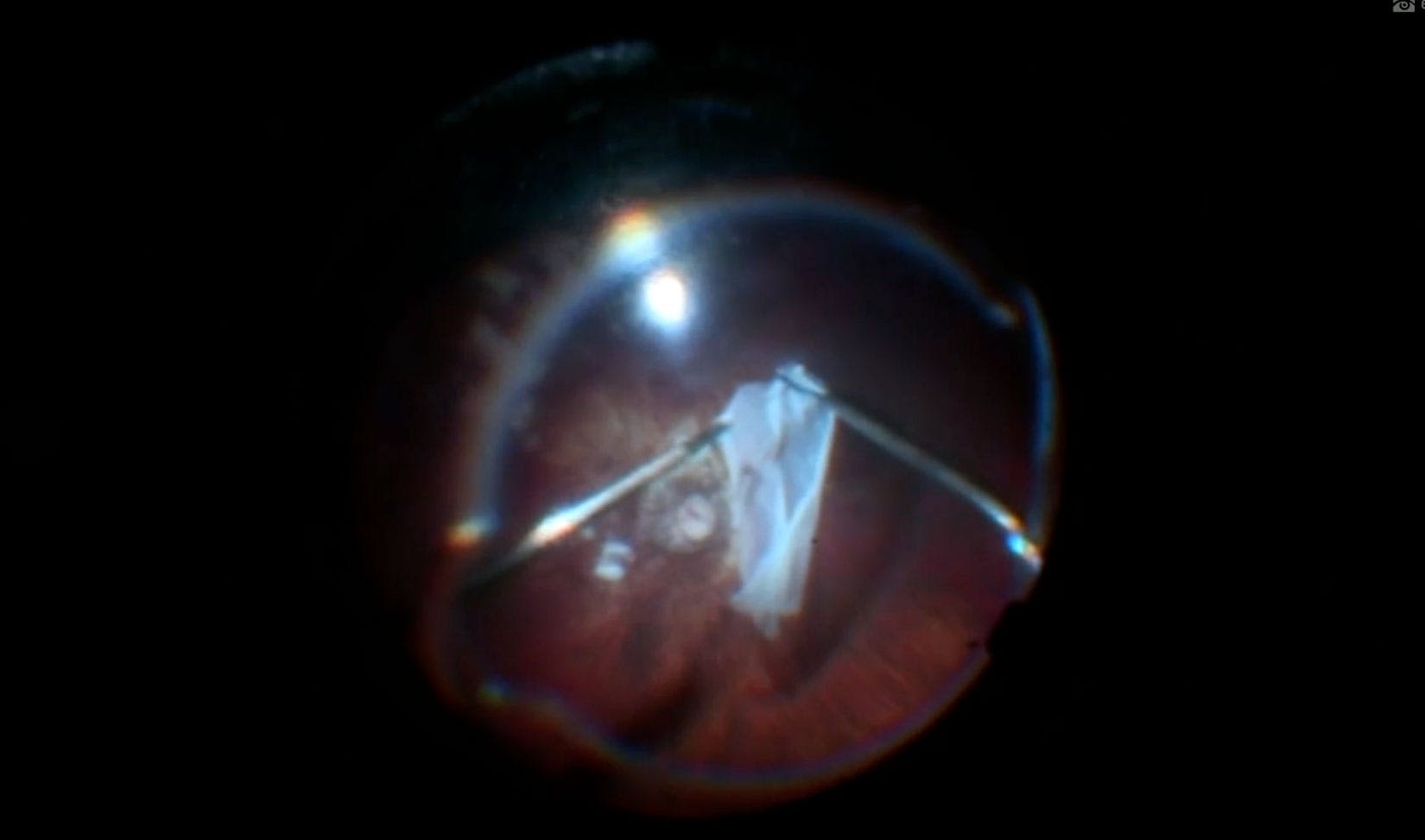
Video. Addressing a Refractory Macular Hole With an Amniotic Membrane Graft and PFO.
THE TECHNIQUE
Our case involved a 50-year-old woman with a giant (> 1,000 µm) traumatic MH in the right eye. The patient endorsed a remote history of facial trauma that resulted in a decrease in vision. At that time, she presented to an outside physician who performed a vitrectomy with membrane peel and, per the operative note, an ILM flap. The surgeon lasered the peripheral lattice and a second full-thickness retinal defect in the superotemporal macula. She was left with 14% C3F8 gas. When she presented to our clinic 10 months later, she had a persistent MH and a VA of counting fingers.
After extensive discussion about her limited visual potential, the patient elected to proceed with a second vitrectomy, which was performed 14 months after the first. The residual ILM nasal to the hole was peeled, and gentle reapproximation of the edges of the hole was performed with a DDMS Tano diamond-dusted membrane scraper (Bausch + Lomb). The patient was again left with 14% C3F8 gas. Postoperatively, her VA improved to 20/300 with a residual scotoma that she found subjectively bothersome.
Over the course of the next year, she repeatedly requested additional intervention. The nasal retina began to elevate, and the hole enlarged to greater than 1,600 µm, leading to concern for possible RD. The decision was made to return to the OR for placement of a hAM graft.
We used a standard 25-gauge vitrectomy setup with a small superotemporal peritomy in anticipation of the placement of the hAM graft. A posterior capsulotomy was performed to improve visualization. The extent of the previous ILM peeling was confirmed using brilliant blue G, and scleral depression was performed to rule out peripheral pathology. A Tano brush was used to massage the edges of the MH to mobilize the hole and promote closure. A chandelier was placed inferiorly to allow for illumination of this bimanual technique, and a 20-gauge sclerotomy was made in the superotemporal quadrant. A 9 mm x 9 mm graft was measured and cut, and ILM forceps were used to insert the graft into the eye and place it basement membrane-side down onto the macula (Figure). At the outset, the edges of the graft curled inward, away from the retina. PFO was then placed over the graft to stabilize it.
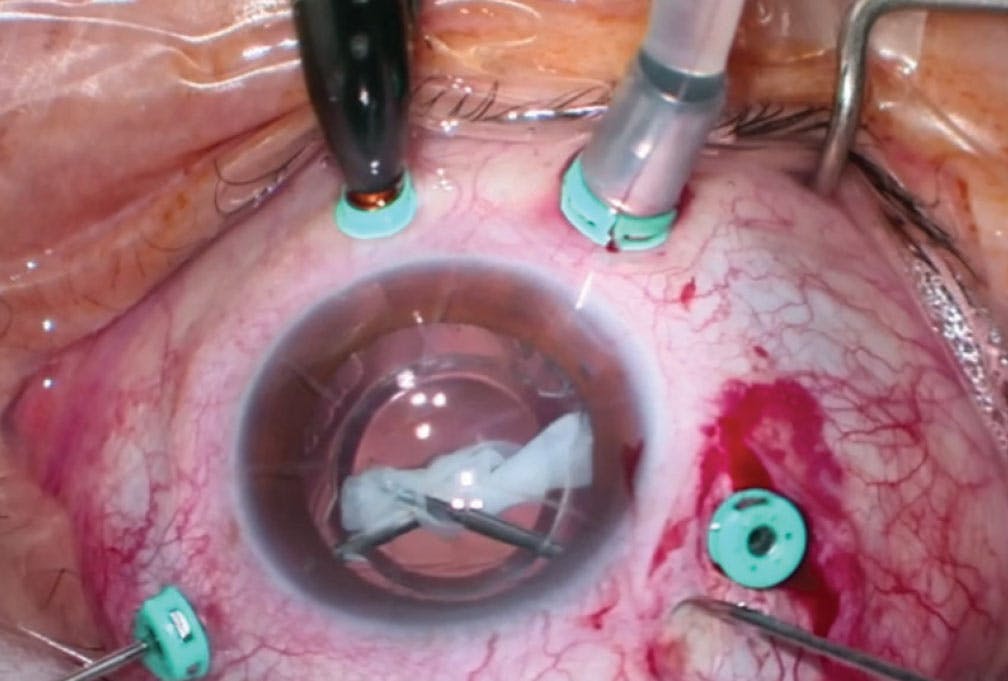
Figure. Use ILM forceps to insert the hAM graft into the eye and place it basement membrane-side down onto the macula.
At this time, small adjustments were made to the graft’s position using the Tano brush. Given the intent to promote the egress of fluid from beneath the graft, the PFO bubble was enlarged to cover the entire graft. It was left in the eye while the additional sclerotomy was sutured, allowing the graft to settle under the PFO for approximately 5 minutes. A bimanual fluid-air exchange was then performed while holding the graft in place with the Tano brush. Once the PFO was removed from the eye, further curling and dislocation of the graft were no longer observed. An air-gas exchange with 14% C3F8 gas was then performed.
Postoperatively, the patient was placed in a supine position for 1 hour prior to assuming face-down positioning. At postoperative month 9, the graft remained in place, the hole was closed, VA had improved to 20/150 with refraction, and the patient was satisfied with the outcome.
DISCUSSION
Prior studies have shown closure of large refractory MHs using hAM, placed after fluid-air exchange with gas tamponade.7 However, this technique does not always result in anatomic success.9 In one systemic review of eight studies with 103 eyes that underwent hAM graft placement after failed vitrectomy and ILM peeling, the graft dislocation/contracture rate was 6%.10 In studies using cryopreserved hAM grafts, the graft dislocation/contracture rate was lower, at 3%.10
There are reports of hAM for MHs with coexisting rhegmatogenous RD that used PFO to push the subretinal fluid through peripheral breaks and flatten the macula to facilitate hAM membrane insertion into the MH, with closure of all MHs seen at 6 months.6 There are also data showing that hAM placed under PFO in the case of myopic MHs associated with RD resulted in MH closure in all patients.11 However, none of these cases specified the amount of time that the PFO was left in the eye. There are fewer reported cases of hAM positioned under PFO to treat refractory MHs without RD.12 Our case supports the idea that allowing hAM to remain under PFO for several minutes may improve graft adhesion and help prevent graft dislocation in the case of a refractory MH.
A NOVEL APPROACH TO TRY
We postulate that using a larger graft and waiting for at least 2 minutes with the graft under PFO allows for displacement of fluid from underneath the graft and promotes adhesion to the macular surface, thereby decreasing postoperative graft dislocation.
1. Ch’ng SW, Patton N, Ahmed M, et al. The Manchester Large Macular Hole Study: is it time to reclassify large macular holes? Am J Ophthalmol. 2018;195:36-42.
2. Steel DH, Donachie PHJ, Aylward GW, et al. Factors affecting anatomical and visual outcome after macular hole surgery: findings from a large prospective UK cohort. Eye. 2021;35(1):316-325.
3. Moinuddin OM, Mahmoud TH. The modern management of challenging macular holes. Retina Today. 2024;19(7):26-29.
4. Grewal DS, Mahmoud TH. Autologous neurosensory retinal free flap for closure of refractory myopic macular holes. JAMA Ophthalmol. 2016;134(2):229-230.
5. Rizzo S, Caporossi T, Tartaro R, et al. A human amniotic membrane plug to promote retinal breaks repair and recurrent macular hole closure. Retina. 2019;39:S95-S103.
6. Abouhussein MA, Elbaha SM, Aboushousha M. Human amniotic membrane plug for macular holes coexisting with rhegmatogenous retinal detachment. Clin Ophthalmol. 2020;14:2411-2416.
7. Khaqan HA, Sahyoun JY, Haider MA, Buksh HM. Amniotic membrane graft for the treatment of large refractory macular hole. Retina. 2022;42(8):1479-1483.
8. Abdelhakim AH, Tezel TH. Human amniotic membrane for macular hole surgery. Retina Specialist. 2020;6(6):18-21.
9. Quiroz-Reyes MA, Quiroz-Gonzalez EA, Quiroz-Gonzalez MA, Lima-Gomez V. Safety and efficacy of human amniotic membrane plug transplantation in cases of macular hole. A scoping review. Int J Retina Vitreous. 2024;10(1):82.
10. Zhang H, Li Y, Chen G, Han F, Jiang W. Human amniotic membrane graft for refractory macular hole: A single-arm meta-analysis and systematic review. J Fr Ophthalmol. 2023;46(3):276-286.
11. Caporossi T, De Angelis L, Pacini B, et al. A human amniotic membrane plug to manage high myopic macular hole associated with retinal detachment. Acta Ophthalmol. 2020;98(2):e252-e256.
12. Proenca H, Magro P. Cryopreserved human amniotic membrane transplant in refractory macular hole. Ophthalmol Retina. 2020;4(7):688.


_1784132761.jpg?auto=compress,format&w=75)





