


AT A GLANCE
- Suturing to the iris is an excellent approach for a patient with a thin sclera or conjunctiva.
- Double-needle scleral fixation is useful for patients with healthy conjunctiva superiorly and inferiorly.
- Gore-Tex IOL fixation is ideal for dislocated IOLs or aphakia cases with a healthy and mobile conjunctiva.
- The modified Yamane technique is a good approach for eyes without capsular support that are aphakic or eyes that have a dislocated one-piece IOL.
When a patient walks into the clinic with a dislocated IOL, we have myriad surgical approaches to manage the case, depending on the patient’s need. Which technique you choose is often a blend of the particulars of the case itself and surgeon preference. Here, we share our favorite approaches to secondary IOLs and our tips for optimizing the surgery.
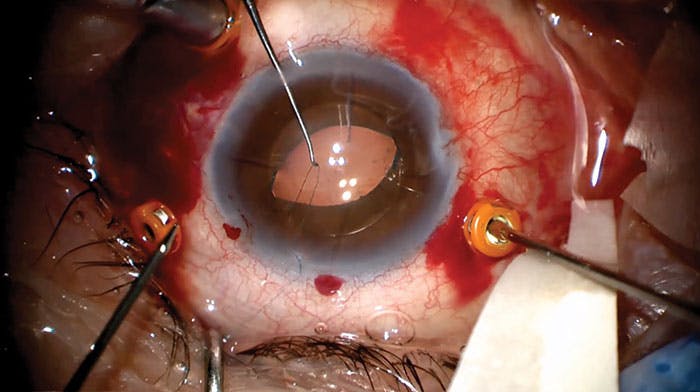
Video 1. Iris Fixation of an IOL With McCannel Sutures. By Ninel Z. Gregori, MD
IRIS FIXATION
By Ninel Z. Gregori, MD
Suturing to the iris is an excellent approach for a subluxed three-piece lOL in a patient with a thin sclera or conjunctiva. All sutures are contained within the eye, and there is no conduit for infectious organisms. I have used the MA60AC lens (Alcon) for years, but other three-piece IOLs should also work well.
For this technique, surgeons can use either McCannel sutures (throw and tie the sutures outside the eye) or Siepser knots (throw the sutures outside but tie them inside the eye) to secure the IOL to the iris. I prefer to use the McCannel suture with 9-0 or 10-0 prolene suture and a CIF-4 long-curved needle because it does not tear the iris (Video 1). The technique has three major steps to master:
Prolapse the optic over the iris and visualize the haptic, then pass the suture through the cornea, down to the iris, under the IOL haptic, back up through the iris, and out of the cornea.
Externalize the free ends of the suture through a paracentesis positioned over the haptic.
Tie the externalized ends with a square knot. I prefer to use 3-1-1-1 square knots—I add an extra throw to ensure the knot is stable.
I like to put two McCannel sutures around each haptic because doing so has led to zero dislocations. Consider passing the needle and suture close to the periphery of the iris to reduce the risk of creating the cat-eye look. When done correctly, this technique can provide stable optics with little risk of dislocation and an aesthetically round pupil.
THE YAMANE TECHNIQUE
By Allison J. Chen, MD, MPH
Double-needle scleral fixation is an elegant surgery that requires less tissue manipulation than IOL suturing. Scleral maneuvering is minimized with only two tunneled sclerotomies; with a 30-gauge TSK needle, the tunneled sclerotomies automatically seal upon needle externalization.
I prefer to use this approach for any patient who has healthy conjunctiva superiorly and inferiorly so that there is adequate conjunctival coverage over the flanged terminal bulbs—this decreases the risk of haptic exposure and infection. I also look at the patient’s white-to-white corneal diameter to ensure it is less than 15 mm to decrease the risk of high torque at the optic-haptic junction.
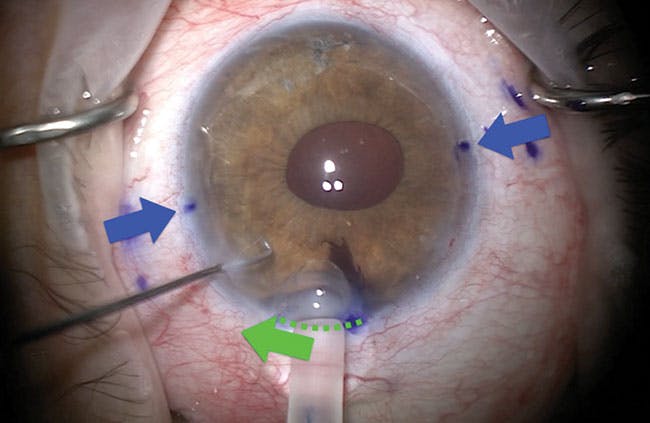
Figure 1. During the classic Yamane technique, place limbal marks 180° apart (blue arrows), and shift the main incision toward the surgeon’s left (green arrow).
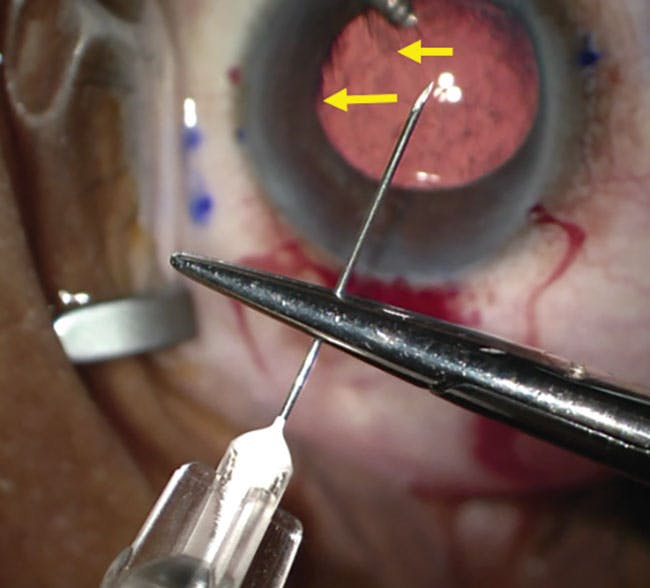
Figure 2. Turn the needle bevel toward the left (arrows) before bending the needle 45° to facilitate haptic docking.
I would like to share these surgical pearls:
- The optimal three-piece IOLs to thread (due to the angles at the optic-haptic junction) include the Sensar AR40 series (polymethylmethacrylate [PMMA] haptics, Johnson & Johnson Vision), Tecnis ZA9003 (PMMA haptics, Johnson & Johnson Vision), and CT Lucia 602 (polyvinylidene fluoride haptic, Carl Zeiss Meditec). PMMA haptics tend to be more brittle and prone to damage if too much force is applied, but these IOLs are reliable. Watch for occasional dislocation or rotation of the optic-haptic junction with the CT Lucia 602 lens.
- The optimal tunneling needle for this technique is the TSK 30-gauge x 1/2” because it has a larger internal lumen than a usual 30-gauge needle, so there is more space for haptics to pass through. If the fit is quite snug (especially with the AR40 series), I occasionally switch to a 27-gauge needle with a larger lumen.
- My preference is to sit temporally and tunnel superiorly and inferiorly because the vertical diameter of the cornea is smaller than the horizontal diameter, and this position minimizes the torque on the haptics.
- I shift the main incision to the left (clockwise) to facilitate docking of the trailing haptic (Figure 1).
- I turn the needle bevel toward the left before bending the needle upwards approximately 45° (Figure 2). This facilitates intraocular docking of the haptics because the needle bevel acts as a platform and provides countertraction against the haptic during docking.
- Balanced salt solution is placed in the syringe attached to the needle to prevent air bubbles from entering the anterior chamber during haptic threading. During scleral tunneling, the needle should enter the globe planar (or at a slightly more posterior angle) to the iris; try not to enter too anteriorly to avoid IOL-iris touch and future uveitis-glaucoma-hyphema syndrome. Tunnel symmetrically on both sides.
- I place a peripheral iridotomy (PI) as insurance against pupillary block in the setting of potential reverse iris capture in the future.
SUTURED GORE-TEX IOL FIXATION
By Omesh P. Gupta, MD, MBA
Scleral fixation of a secondary IOL with polytetrafluoroethylene (Gore-Tex, W.L. Gore) uses a lens that is foldable through a small clear corneal incision (Video 2). The suture has a high tensile strength and, due its porous nature, promotes cellular ingrowth within 6 to 12 months. There is no permanent foreign body left underneath the conjunctiva.
The EnVista MX60 (Bausch + Lomb) is one of my favorite IOLs for this technique due to the hydrophilic material; it does not opacify with air or gas tamponade and has predictable refractive outcomes. In one study, eyes with Gore-Tex sutures were statistically closer to the refractive target compared with eyes treated with the Yamane technique.1
The procedure is ideal for any dislocated IOL or aphakia case with a healthy and mobile conjunctiva. I avoid eyes with atopic or cicatricial conjunctival disease. Relative contraindications include patients with significant conjunctival scarring secondary to trauma or previous ocular surgery. Patients with a history of a trabeculectomy, tube shunt, scleral buckle, or ruptured globe are all potential candidates.
The refractive outcome depends on fixating precisely 3 mm posterior to the limbus for an in-the-bag calculation. To improve efficiency, I try to perform these procedures from the same orientation. I sit superiorly and scleral fixate at the 3 and 9 clock hours. Meticulous hemostasis is crucial. Spending extra seconds cauterizing the scleral beds saves minutes during the case. Try to eliminate suture slack when threading the Gore-Tex in the eye to minimize the possibility of tangling the suture and twisting the IOL. Do not place any instruments through the eyelet of the lens and refrain from overtightening the suture—these missteps can affect the integrity of the eyelet, leading to fracture and dislocation. When reapproximating the conjunctiva, place the suture and scleral anchor away from the Gore-Tex. I prefer to close the conjunctiva inferotemporal and inferonasal, which ensures only intact conjunctiva is over the Gore-Tex without any conjunctival edges. Lastly, advising patients on the recovery time can help manage postoperative expectations. While these patients can recover significant vision within the first 1 to 2 weeks, most patients reach the ultimate vision approximately 4 to 6 weeks postoperatively. In addition, patients should also be advised that a refraction may be necessary.
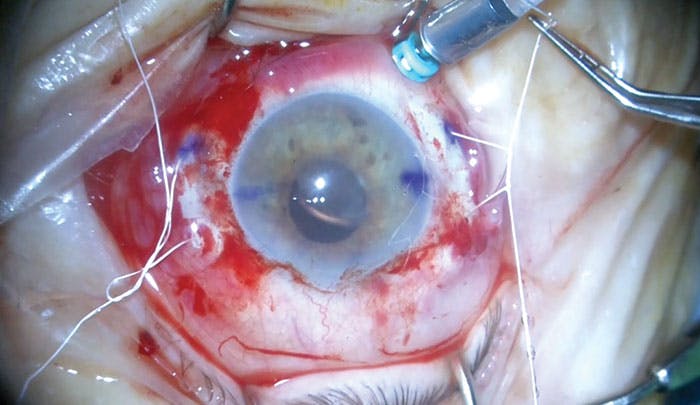
Video 2. Scleral Fixation of an IOL With Gore-Tex. By Omesh P. Gupta, MD, MBA
TROCAR-ASSISTED MODIFIED YAMANE
By María H. Berrocal, MD
My go-to technique for secondary IOLs without capsular support is the trocar-assisted modified Yamane using the three trocars available in the vitrectomy pack (Video 3). This approach has two main advantages over the classic Yamane technique. First, the length and angle of the scleral tunnels are more reproducible when performed with the 27-gauge trocar cannulas than with the 30-gauge needles, thus reducing the possibility of tilt. Second, grasping the tip of the haptic with forceps is easier than feeding them into the needle hub. I use only three trocars and change the infusion as needed. This streamlines the procedure because it does not require extra trocars and does not add cost.
I use this approach for eyes without capsular support that are aphakic or eyes that have a dislocated one-piece IOL that needs exchange. I use the CT Lucia 602 lens because the polyvinylidene fluoride haptics are sturdier than prolene haptics. I do not use this technique in highly myopic eyes with thin sclera because it is difficult to create a good tunnel. In those cases, my go-to technique is Gore-Tex fixation of an EnVista MX60 lens. There are several surgical pearls to keep in mind with the modified Yamane technique, including:
- Measure and mark 180° apart for the placement of the cannulas 2.5 mm to 3 mm from the limbus.
- Choose the areas of sclera that have no calcifications.
- Displace the conjunctiva as you enter the trocars, and enter in opposing directions.
- Grab the tip of the haptic and withdraw the cannula; as the forceps grasping the haptic moves out of the eye, cauterize the tip of the haptic to prevent migration into the eye when the second haptic is grasped.
- Reintroduce the removed cannula in another location.
- Move the infusion to another cannula if the initial infusion cannula will be used to remove the second haptic
- Pull on both haptics to ensure proper centration, and trim and cauterize if needed.
- Bury the cauterized tip into the sclera and perform a PI.
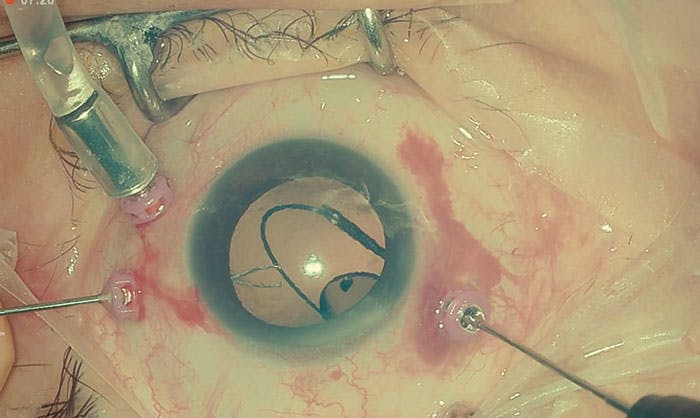
Video 3. Modified Yamane for Dislocated Three-Piece PMMA IOL. By María H. Berrocal, MD
LASER-LOCK
By Jeremy D. Wolfe, MD, MS
The laser-lock technique is my go-to approach for cases in which the haptics are properly fixated in the sclera but the lens is tilted as a result of rotation at the optic-haptic junction. It is especially useful in eyes where an IOL exchange would be challenging due to scarring or other abnormalities of the cornea, sclera, or conjunctiva.
To optimize this new approach, visualization is key. Thus, I do not hesitate to use iris hooks to mechanically dilate the iris and improve visualization of the target. I prefer to use a curved laser probe to more effectively target the optic-haptic junction. In addition, I find longer laser duration to be most effective in this scenario.
TIPS FOR TACKLING NEOCORTEX
By Steve Charles, MD, and Adam Pflugrath, MD
Dislocated IOLs are often accompanied by a large amount of neocortex (Sommering ring), making forceps purchase of the IOL difficult and requiring a larger incision, thereby increasing the risk of corneal endothelial damage during removal. Removal of neocortex from the haptics with a vitreous cutter is challenging, time consuming, and can result in IOL drops, increasing the risk of retinal damage. Often, it is not possible to remove any or all the neocortex with the vitreous cutter. We have found it useful to use the fragmenter to remove neocortex from the haptics. We perform a careful and complete pars plana vitrectomy with wide-angle visualization. We grasp the IOL haptic with textured end-grasping forceps and move the IOL to just posterior to the iris plane. We then remove the endoilluminator and enlarge the sclerotomy to accommodate the fragmenter; you could also create an additional sclerotomy with a 20-gauge MVR blade. We remove all neocortex and capsule from the haptics before moving the IOL through the pupil to the anterior chamber for explantation.
SO MANY OPTIONS, SO LITTLE TIME
With myriad techniques at your fingertips for managing dislocated lenses, the true key to success is confidence in the approach. While it is useful to be proficient with several secondary IOL techniques, consider finding one that works best for you and mastering that approach. Just remember to be flexible when a patient requires a different technique to ensure lens stability and optimal visual outcomes.
1. Oh G, et al. Surgical outcomes of combined pars plana vitrectomy and scleral fixation of intraocular lenses: comparison of Gore-tex suture vs intrascleral haptic fixation. In Press.


_1784132761.jpg?auto=compress,format&w=75)





