


AT A GLANCE
- Studies show that Black and Hispanic/Latino patients are underrepresented in clinical trials compared with the expected disease burden.
- New research found an under-enrollment of Black, Asian, and Hispanic/Latino patients across the United States, with regional variance in the degree of under-enrollment.
- The author suggests focusing on individual geographies may help tailor strategies to overcome barriers to recruitment.
The 1993 National Institutes of Health Revitalization Act sought to improve recruitment and inclusion of minority populations in clinical research.1 Despite this, ongoing disparities exist between retinal disease burden in the US population and the demographic makeup of clinical trial participants.2 As clinical trials are designed to assess efficacy and safety, with the ultimate goal of FDA approval, it is critically important that clinical trial data are generalizable to diverse populations in the real world.
Recent analyses have confirmed that specific demographic subgroups remain consistently underrepresented in US clinical trials. For example, in a recent cohort study, Berkowitz et al analyzed recruitment data from 31 ophthalmology clinical trials from 2000 to 2020.3 The authors found that Black and Hispanic/Latino patients were underrepresented in clinical trials compared with the expected disease burden. Conversely, there was an overrepresentation of White patients compared with the expected disease burden, which is expected to increase by 2050 if trends are not corrected.3 For diabetic macular edema (DME) specifically, additional studies have confirmed a discordance between trial enrollment of underrepresented populations and the expected enrollment based on US Census data in 2010 and 2021, as well as demographic data of patients treated for DME in the IRIS Registry.2,4,5
Efforts to improve clinical trial enrollment require a better understanding of current processes, including geographic considerations and more granular information regarding current DME disease prevalence in the United States. With this aim, a recent study evaluated regional trends in the enrollment of underrepresented subgroups in DME using data from five phase 3 clinical trials.6
STUDY DESIGN
The objective was to evaluate the geographic variance in the enrollment of underrepresented patients in DME clinical trials. Specifically, enrollment was analyzed in DRCR.net Protocols I (NCT00444600), S (NCT01489189), and T (NCT01627249) and RIDE/RISE (NCT00473382/NCT00473330). The subgroups of interest for this study included Black, Asian, Hispanic/Latino, and female patients.6
The primary outcome measure was a metric termed the enrollment ratio, which was defined as the proportion of underrepresented patients enrolled in the trials divided by the expected recruitment rate. The expected recruitment rate was based on two factors:
- the prevalence of DME in each subgroup in the United States, as determined by the TriNetX consolidated electronic health record database, and
- the proportion of people from each subgroup residing within 25 miles of each clinical trial recruitment site, as determined by US Census data.
An enrollment ratio less than 1.0 indicates under-enrollment compared with the expected DME patient population residing within 25 miles of each clinical trial recruitment site.
THE RESULTS
Clinical trial recruitment sites from each of the included trials were grouped into four US regions: West (43 sites), Midwest (35 sites), South (68 sites), and Northeast (40 sites). The enrollment ratio was calculated for each underrepresented subgroup in each region.
For each region—West, Midwest, South, and Northeast, respectively—the ratios were the following for each underrepresented group (Table):
- Asian patients: 0.9, 0.5, 0.4, and 0.1
- Black patients: 0.9, 0.4, 0.7, and 0.9
- Hispanic/Latino patients: 0.8, 0.3, 0.5, and 0.5
- Female patients: 1.0, 0.9, 1.0, and 0.9
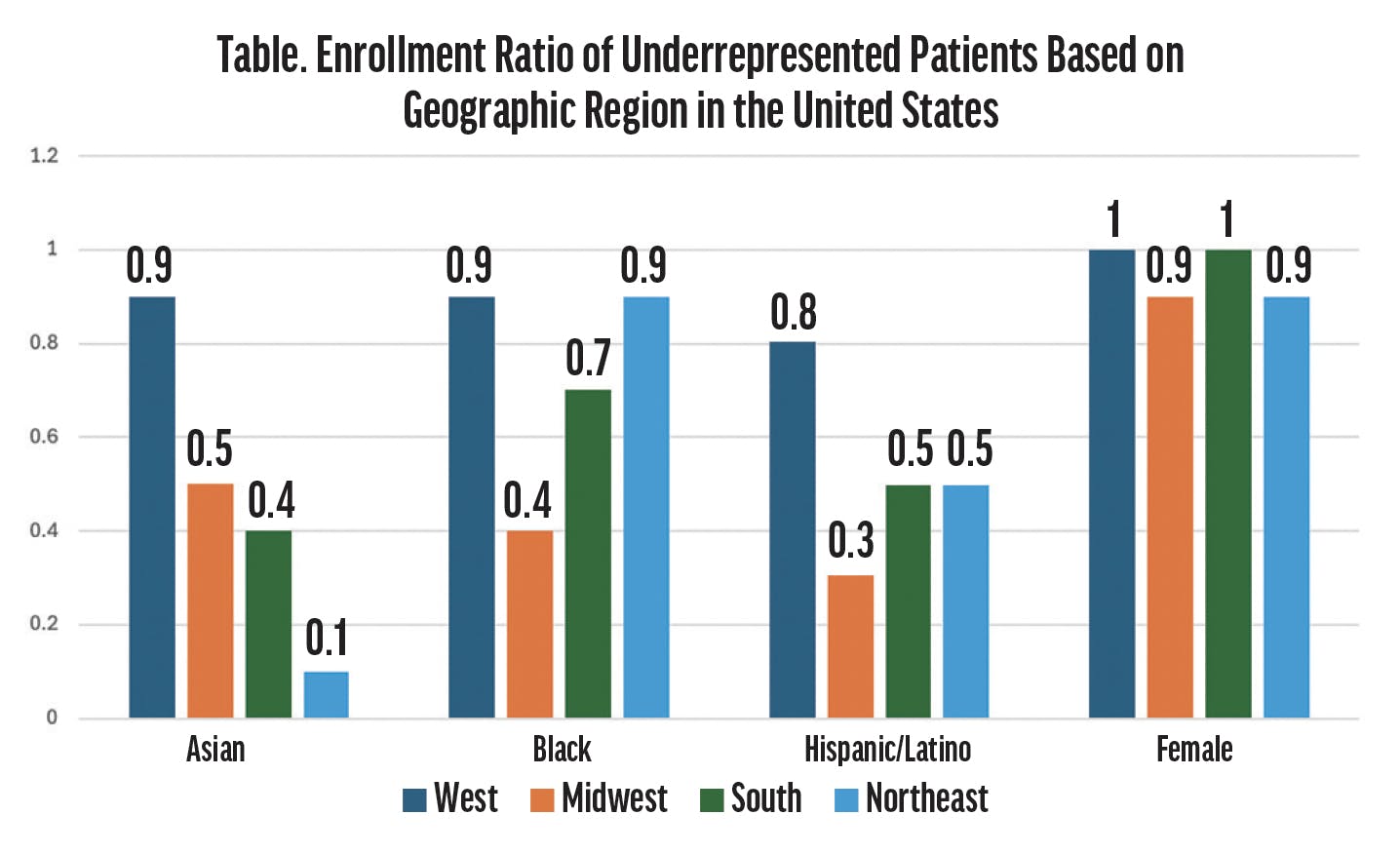
These enrollment ratios reveal an under-enrollment of Black, Asian, and Hispanic/Latino patients across the United States, with regional variances. This relative under-enrollment was most notable in the Midwest region for Black (0.4) and Hispanic/Latino (0.3) populations and in the Northeast region for Asian patients (0.1). Enrollment of female patients was at or near expected levels of recruitment, with ratios hovering near 1.0 in all regions.
IMPLICATIONS FOR FUTURE CLINICAL TRIALS
The study findings may offer insights and strategies to improve enrollment of underrepresented subgroups in future trials. For instance, developing trial recruitment sites in geographies with low enrollment ratios may offer the best opportunities to make meaningful increases in enrollment. Moreover, focusing on individual geographies may help tailor strategies to overcome barriers to recruitment, as efforts can be more specific to the subgroup populations of interest. For instance, Asian and Hispanic/Latino populations in one US geography may be entirely different than those in other geographies based on nationality, language, and cultural beliefs, among other reasons. Working to address barriers to recruitment will require a multifaceted approach, and the study results suggest geography-specific strategies may be helpful.
The study analysis comes with several limitations. The racial and ethnic subgroups assessed were limited to those included in the five clinical trials and to those available for analysis in US Census data. In addition, the sample size of certain subgroups, particularly Asian patients, was small in the available clinical trials.
COLLABORATE TO IMPROVE
Analysis of recruitment data from five phase 3 clinical trials revealed an under-enrollment of Black, Asian, and Hispanic/Latino patients across the United States, with regional variance in the degree of under-enrollment. Efforts to understand why such variances exist may help improve future clinical trial enrollment, offering insights into specific US geographies where improved efforts may be most successful. Collaboration to share strategies and best practices is welcome.
1. Oh SS, Galanter J, Thakur N, et al. Diversity in clinical and biomedical research: a promise yet to be fulfilled. PLoS Med. 2015;12(12):e1001918.
2. Bowe T, Salabati M, Soares RR, et al. Racial, ethnic, and gender disparities in diabetic macular edema clinical trials. Ophthalmol Retina. 2022;6(6):531-533.
3. Berkowitz ST, Groth SL, Gangaputra S, Patel S. Racial/ethnic disparities in ophthalmology clinical trials resulting in US Food and Drug Administration drug approvals from 2000 to 2020. JAMA Ophthalmol. 2021;139(6):629-637.
4. Kaakour A-H, Hua H-U, Rachitskaya A. Representation of race and ethnicity in randomized clinical trials of diabetic macular edema and retinal vein occlusion compared to 2010 US Census data. JAMA Ophthalmol. 2022;140(11):1096-1102.
5. Yu AJ, Masalkhi M, Brown R, Chen B, Chhablani J. Racial and ethnic distribution in diabetic macular edema clinical trials in the United States (2002–2021). Ophthalmol Retina. 2023;7(12):1035-1041.
6. Khan MA. Regional variance in the enrollment of underrepresented patients in US clinical trials of diabetic macular edema. Presented at: AAO Annual Meeting; November 4, 2023; San Francisco, CA.


_1784132761.jpg?auto=compress,format&w=75)





