


As of the beginning of 2025, the family of codes for OCT imaging saw some changes. In this article, I provide an overview of these modifications so that you and your office staff can keep up with coding best practices.
DESCRIPTOR CHANGES
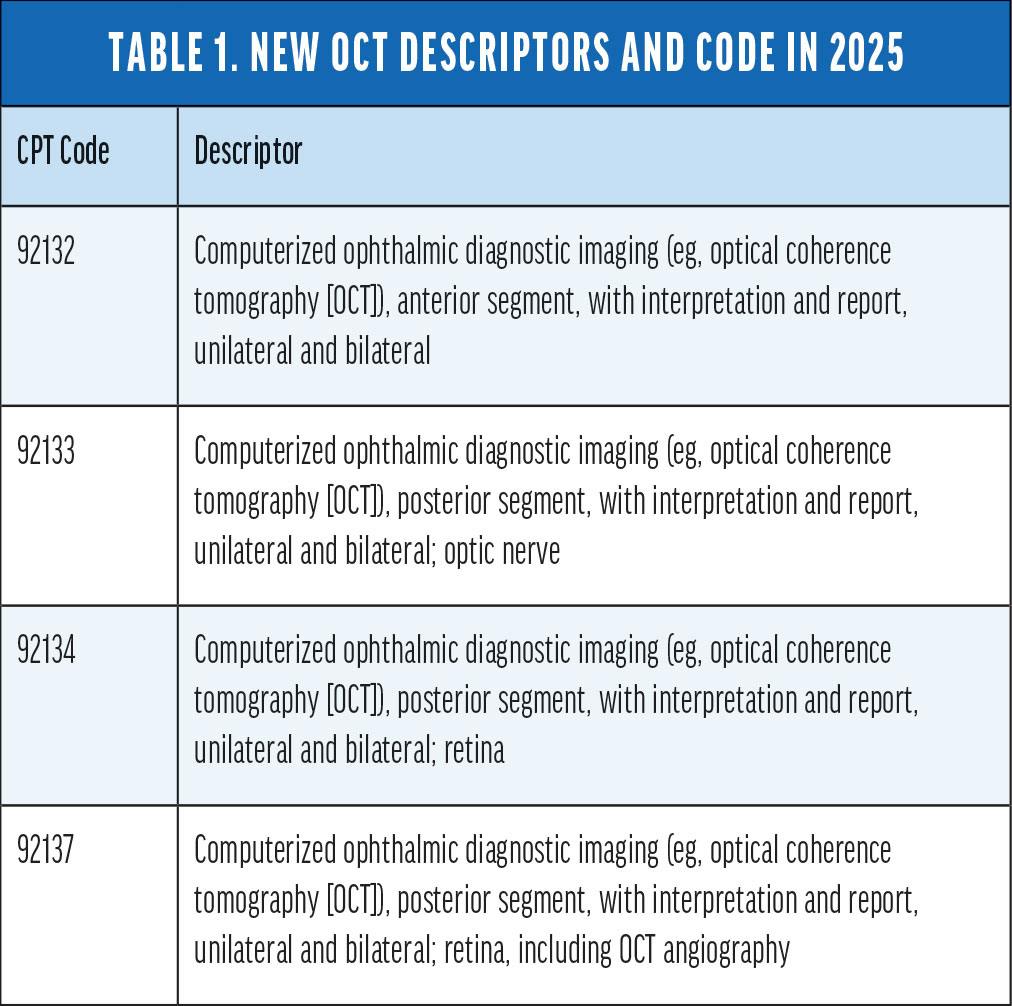
Prior to the new year, OCT was defined by CPT as scanning computerized ophthalmic diagnostic imaging. The new descriptor removed the word scanning, affecting CPT codes 92132, 92133, and 92134 (Table 1).
A New CODE
Effective January 1, a new CPT code, 92137, is available for OCT angiography that does not require an injection of dye like fluorescein angiography (CPT code 92235) and is noninvasive and infusion-free.
NATIONAL CORRECT CODING INITIATIVE CHANGES
CPT code 92133 has been bundled with 92134 since 2011 with a mutually exclusive edit, indicator of 0, which means these tests cannot be billed on the same day or unbundled with modifier -59. It is expected that this bundling will be expanded in 2025 to include a mutually exclusive edit with 92137. This is due to the AMA CPT parenthetical that states codes 92133, 92134, and 92137 cannot be reported at the same patient encounter.
However, when medically necessary fluorescein angiography (CPT code 92235), ICG angiography (92240), or combined fluorescein angiography/ICG angiography (92242) are performed on the same day as OCT angiography (92137), they can be reported separately.
Looking for more information on OCT imaging? Check out these recent Retina Today articles:
A Reference Guide for OCT Angiography
By Ivy Zhu, MD; Nicole L. Decker, BS; and Amani A. Fawzi, MD
The Utility of En Face OCT for Detecting Neovascularization in DR
By Mizuki Hamada, MD, and Kotaro Tsuboi, MD
RELATIVE VALUE UNIT CHANGES
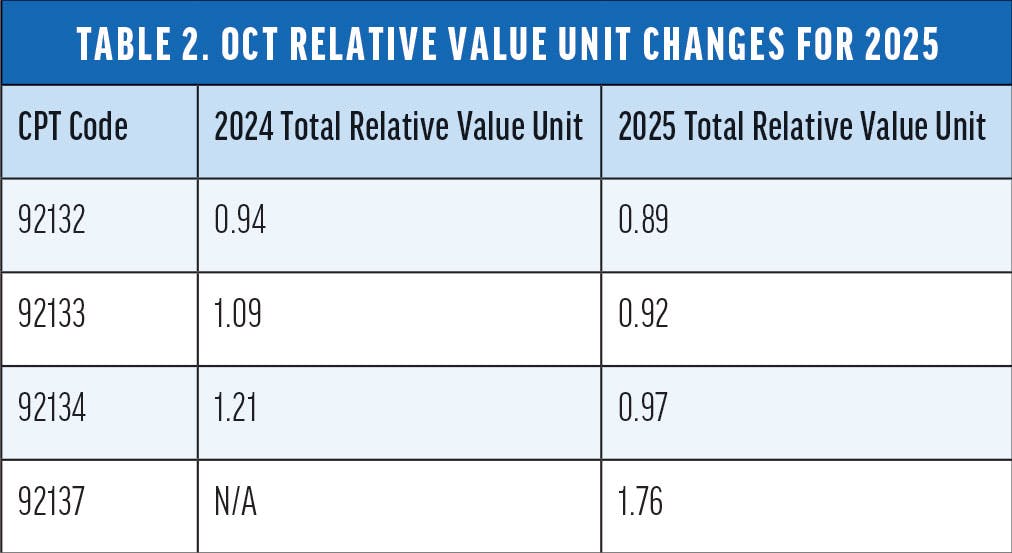
We’ve also seen reductions in the relative value unit (RVU) for each of the existing codes and an assigned RVU for the new CPT code for OCT angiography (Table 2).
DESIGNATED HEALTH SERVICE CHANGES
Certain services are considered a designated health service (DHS) per the physician self-referral law, also known as Stark Law. Under certain circumstances, productivity-based group compensation is prohibited for these services. There are exceptions to this rule, for example, if the services were not delegated and the physician performed them.
Historically, CPT codes 92132, 92133, and 92134 have been considered DHS. In 2025, CPT code 92137 joined the list.
Stark Law and productivity-based compensation in group practices is complex, and physicians and practices should consult with an attorney to ensure ongoing compliance.1
NEW YEAR, NEW CODING TO MASTER
Stay up to date on the CPT code changes and additions regarding OCT with resources such as the AMA’s CPT 2025 and the American Academy of Ophthalmology’s retina coding guide. For a comprehensive review of the 2025 coding changes, attend a Codequest course near you.
1. Woodke J, Shuren AW. The Stark Law and productivity-based compensation in group practices. American Academy of Ophthalmology. August 1, 2022. Accessed January 15, 2022. www.aao.org/eyenet/article/the-stark-law-and-productivity-based-compensation?august-2022


_1784132761.jpg?auto=compress,format&w=75)





