


Retinal detachment (RD), in which the neurosensory retina is separated from the retinal pigment epithelium (RPE), can be classified as rhegmatogenous, exudative, or tractional.1 Rhegmatogenous RD is caused by a retinal break, exudative (or serous) RD is caused by excessive fluid accumulation in the subretinal space from inflammation or a tumor, and tractional RD is caused by preretinal membrane contraction. Distinguishing among the three types of RD is crucial for appropriate management, as each has a distinct pathophysiology and management approach (Figure 1). Differentiating between rhegmatogenous RD and exudative RD can be challenging when media opacities, bullous RD, or an uncooperative patient preclude an adequate fundus examination of the peripheral retina to identify a retinal break. A recent article describes OCT features that can help differentiate the three types of RD.2 Here, we present a case in which OCT helped guide diagnosis and treatment.
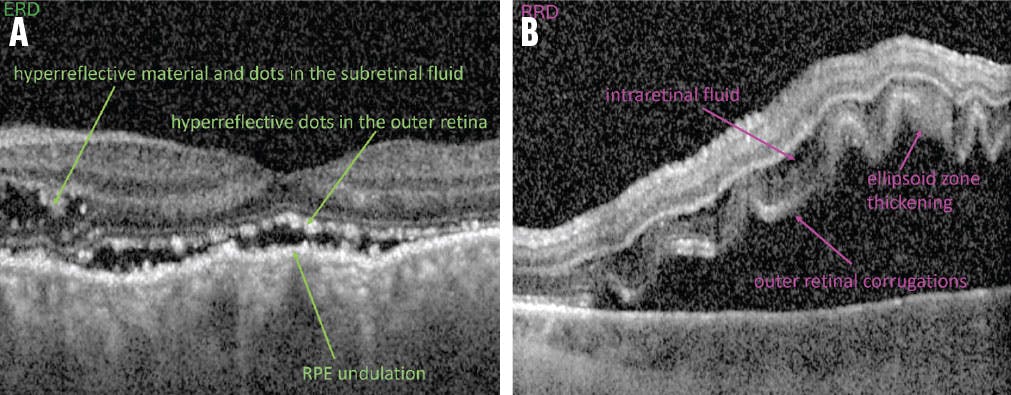
CASE REPORT
A 72-year-old man presented with 7 days of blurry vision in the left eye. He had an ocular history of mild nonproliferative diabetic retinopathy in each eye and a medical history of post-traumatic stress disorder, type 2 diabetes, hypertension, and hyperlipidemia. His VA was 20/20 OD and 20/70 OS. Confrontational visual fields were full in the right eye but restricted in the superior quadrants of the left eye. Anterior segment examination was normal in the right eye but showed 2+ nuclear sclerosis in the left eye.
Dilated fundoscopy revealed several dot-blot hemorrhages in the right eye with an attached retina and inferior RD in the left eye. No visible retinal breaks were found in the left eye. B-scan ultrasonography demonstrated diffuse choroidal thickening in each eye. There was no intraocular mass noted. The axial length of the right eye measured 23.26 mm, and the left eye measured 22.81 mm.
Sequential pseudocolor fundus photography of the left eye demonstrated shifting subretinal fluid with head tilt (Figure 2). OCT of the left eye showed a macula-off RD, hyperreflective dots in the outer retina, and RPE undulation (Figure 3A). Systemic lab work was nonrevealing, except for a borderline T-spot tuberculosis test. MRI of the brainand orbits with and without contrast showed circumferential smooth enhancement of the left globe, suggestive of scleritis.
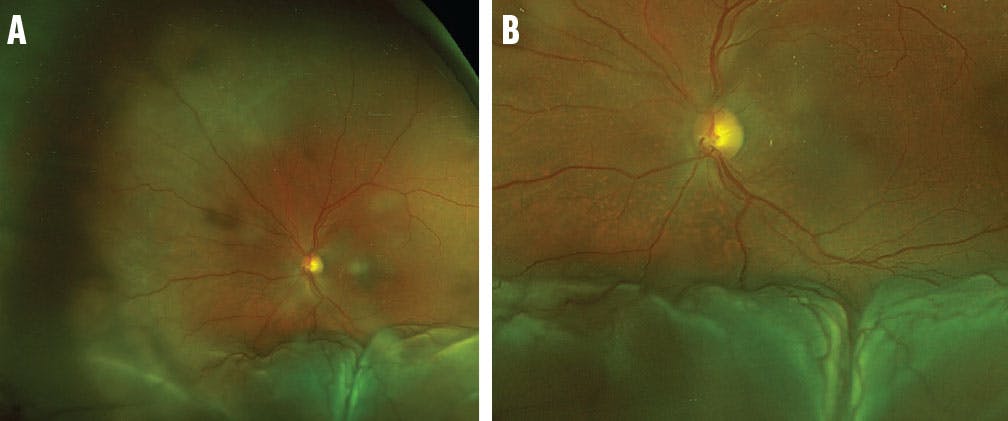
Figure 2. Fundus photography revealed an inferior exudative RD in the left eye (A). Note the fluid shift under the inferior arcade on head tilt (B).
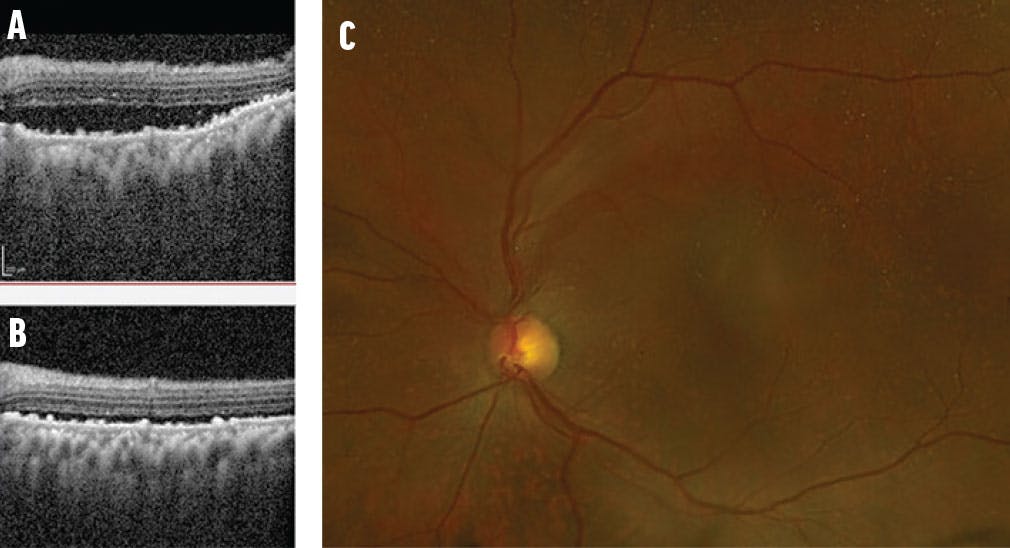
Figure 3. OCT documented the exudative RD (A). One week after scleral window surgery, the subretinal and intraretinal fluid had resolved (B). A 3 months, the retina had reattached (C).
The patient was initially managed with 60 mg prednisone daily. There was some improvement in the subretinal fluid and visual acuity of the left eye, but the prednisone had to be tapered due to high and uncontrolled blood glucose. After the cessation of prednisone, his VA worsened to 20/400 OS. The diagnosis of uveal effusion syndrome was entertained. The decision was made to proceed with surgery to create scleral windows (Video). A 4 mm x 4 mm, 90% depth scleral window was created in each quadrant, 8 mm from the limbus. A Kelly Descemet punch was used to create a full-thickness hole in the bed of the scleral window. OCT of the left eye 1 week later showed improved subretinal and intraretinal fluid (Figure 3B). Subretinal fluid under the fovea had resolved by the 3-month postoperative visit, and his VA had improved to 20/200 OS (Figure 3C).
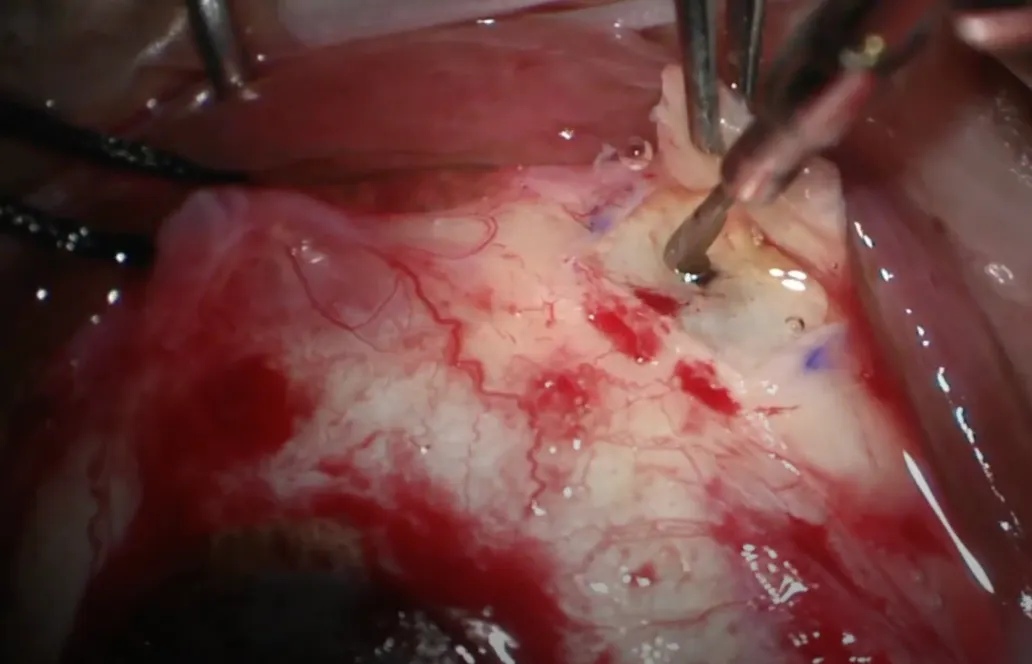
Video. Drs. Uwaydat and Shakarchi perform a scleral window procedure for a patient with an exudative retinal detachment secondary to choroidal effusion.
DISCUSSION
When managing RD, it is vital to differentiate among the three types. Dilated fundus examination provides information on the RD location, the presence or absence of retinal tears, and the appearance of the detached retina. A corrugated inner surface of a detached retina is consistent with rhegmatogenous RD, while a smooth inner retinal surface with shifting subretinal fluid is indicative of exudative RD.3
OCT is a valuable diagnostic tool for differentiating between rhegmatogenous and exudative RD.2 According to a recent study, OCT of the macula is likely to show intraretinal fluid, ellipsoid zone thickening, and outer retinal corrugations in rhegmatogenous RD and hyperreflective material and dots in the subretinal fluid, hyperreflective dots in the outer retina, and RPE undulation in exudative RD.2
Exudative RD occurs when there is accumulation of fluid between the photoreceptors and RPE in the absence of a retinal break. The inner and outer blood-retinal barrier and the RPE keep the potential space between the photoreceptors and RPE free of fluid. Inflammation, infections, neoplasms, and other etiologies can cause exudative RD.4 Nanophathlmic exudative RD is seen in patients with a short axial length (20 mm or less) in the absence of an infection or inflammatory etiology.5 Management options for nanophthalmic-related exudative RD include focal laser photocoagulation or scleral window surgery.5 Management of exudative RD in an eye with average axial length consists of medical management of the underlying infectious or inflammatory condition. In the event of a normophalmic eye with exudative RD and no identifiable etiology, surgical intervention with a scleral window should be considered.6
GUIDE THE WAY
Characteristic features on macular OCT can help differentiate exudative RD from rhegmatogenous RD. Exudative RD that is unresponsive to medical treatments may be successfully managed with scleral window surgery.
1. Lin JB, Narayanan R, Philippakis E, Yonekawa Y, Apte RS. Retinal detachment. Nat Rev Dis Primers. 2024;10(1):18.
2. Oquendo PL, Sodhi GS, Naidu SC, et al. Optical coherence tomography features in fovea-off exudative vs rhegmatogenous retinal detachment. Am J Ophthalmol. 2024;268:212-221.
3. Maruko I, Iida T, Sekiryu T, Saito M. Morphologic changes in the outer layer of the detached retina in rhegmatogenous retinal detachment and central serous chorioretinopathy. Am J Ophthalmol. 2009;147(3):489-494.
4. Amer R, Nalcı H, Yalçındağ N. Exudative retinal detachment. Surv Ophthalmol. 2017;62(6):723-769.
5. Kumar V, Azad SV, Vohra R, Venkatesh P. Serous macular detachment in nanophthalmos: A manifestation of pachychoroid spectrum. Am J Ophthalmol Case Rep. 2019;15:100522.
6. Ozbek M, Aydin R, Artunay O. Management of persistent exudative retinal detachment: exploring etiology and surgical outcomes. BMC Ophthalmol. 2024;24(1):493.


_1784132761.jpg?auto=compress,format&w=75)





