


AT A GLANCE
- Advances in robotic control, intraoperative imaging, and microsurgical instrumentation have begun to redefine what is possible in retinal surgery.
- The Preceyes Surgical System (Carl Zeiss Meditec), OQrimo (Riverfield), ORYOM (Forsight Robotics), and others have shown promise for automating membrane peeling, subretinal injection, and vascular cannulation.
- Limitations to the adoption of robotics in retina include high upfront and ongoing costs, limited commercial availability, and lack of differentiated reimbursement.
Robotic technology is reshaping the landscape of vitreoretinal surgery, driven by the need for micrometer-scale precision and stability that often exceed the limits of human dexterity.1,2 The retina’s fragile anatomy and the technical demands of vitreoretinal procedures such as membrane peeling, subretinal injection, and vascular cannulation have led to the development of specialized robotic platforms.3-8
Advances in robotic control, intraoperative imaging, and microsurgical instrumentation have begun to redefine what is possible in retinal surgery.5,9 In this article, we highlight several innovations that mark a transition from proof-of-concept engineering to clinical tools, offering stability, precision, and safety for the most delicate retinal procedures.
PRECEYES SURGICAL SYSTEM: FIRST-IN-HUMAN EXPERIENCE
One of the earliest robots to enter the retinal space, the Preceyes Surgical System (Carl Zeiss Meditec), demonstrated precision better than 20 μm and tremor-free control, proving robotic microsurgery feasible and safe.6,7,10,11 In 2018, this system became the first remotely controlled robotic platform to successfully perform surgery inside the human eye.6 The device has received CE marking in Europe,12 and New York Eye and Ear is collaborating with Preceyes/Carl Zeiss Meditec to pursue FDA approval.13
In practice, the surgeon is positioned at the usual surgical site and operates from a console equipped with a joystick-style controller, which translates hand movements to the robotic arm holding the intraocular instruments positioned at the ocular entry site through standard 23-, 25-, or 27-gauge sclerotomies (Figure 1).12
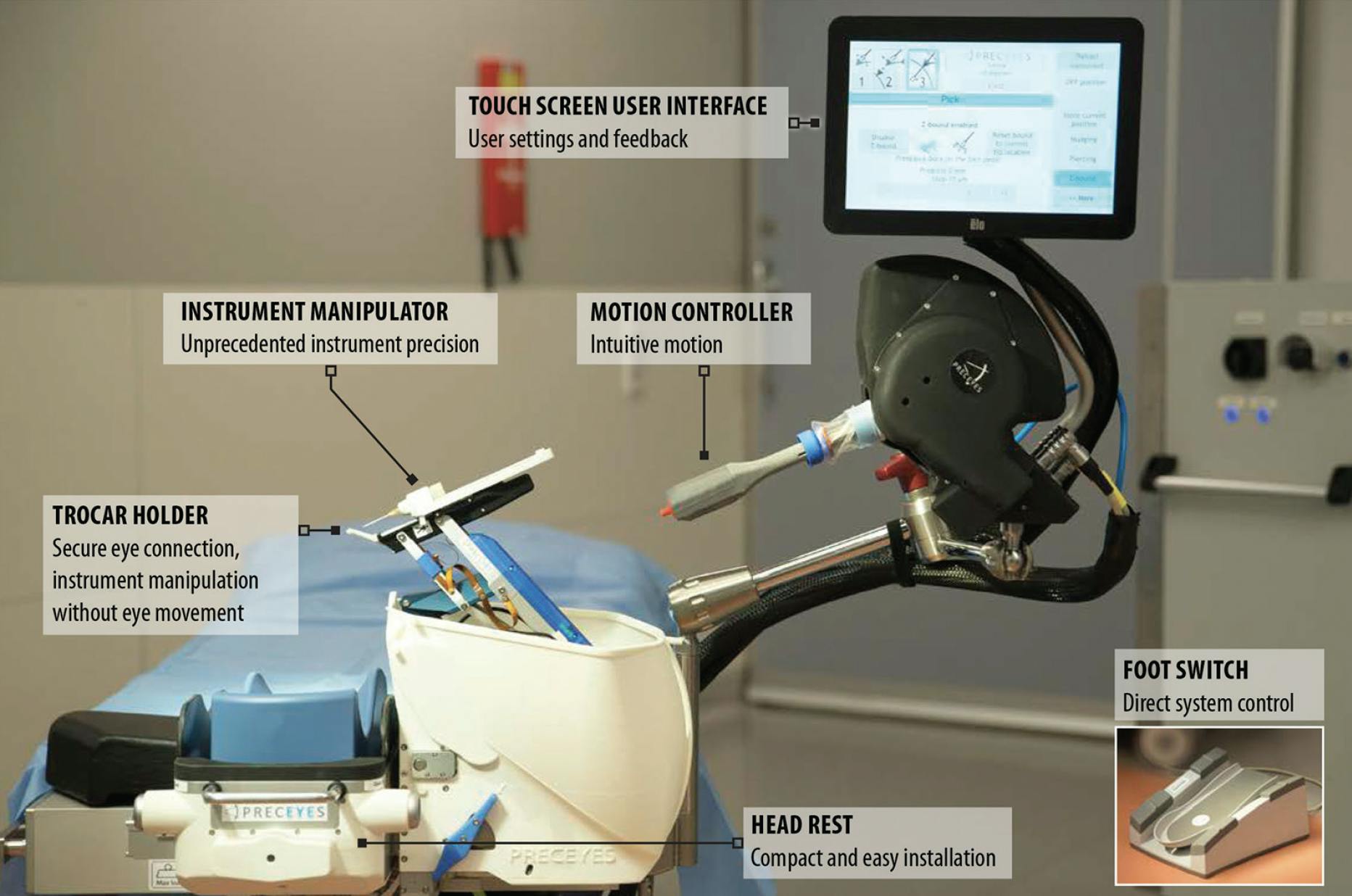
Figure 1. The Preceyes Surgical System, a telemanipulation robotic platform designed for intraocular microsurgery, includes a robotic arm that holds intraocular instruments. Image courtesy of Carl Zeiss Meditec.
Randomized and first-in-human trials demonstrated successful robot-assisted membrane peeling and subretinal injections, achieving anatomic and functional outcomes comparable with manual surgery.3,6-8,14,15
Robot assistance also enabled stable cannulation and controlled subretinal drug delivery without increasing microtrauma or adverse events.6,7,14 Integration of intraoperative OCT-based distance sensors further enhanced depth control and safety.14 Experimental animal studies showed consistent retinal vein cannulation and targeted delivery of agents such as ocriplasmin for retinal vein occlusion.10 Surgeons reported reduced fatigue and improved precision with experience, although procedures took longer during the learning phase.16
OQRIMO: A ROBOTIC ENDOSCOPE HOLDER
Visualization challenges, particularly in eyes with corneal opacity, small pupils, or intraocular tumors, have long limited surgical efficiency. In 2021, researchers in Japan created the Eye Explorer robotic system to stabilize and manipulate an endoscope, allowing for bimanual surgery. The device balances its own weight to prevent accidental drops and provides a wide intraocular field of view (horizontal 118°, vertical 97°). By reducing external force on the eye by more than 15% compared with manual handling, the Eye Explorer may also reduce the risk of iatrogenic injury.17
Building on this success, OQrimo (Riverfield) became the first clinically approved ophthalmic endoscope-holding robot in Japan in 2023 (Figure 2).5 OQrimo is designed to enhance stability through a gimballed structure that allows the endoscope to pivot smoothly while remaining steady and properly oriented. The endoscope can be positioned at the desired surgical site using a foot pedal control, and it comes with automatic safety withdrawal.5,18

Figure 2. OQrimo, approved for use in Japan in 2023, uses a robotic arm to maneuver and stabilize an endoscope, allowing for bimanual surgery. Image courtesy of Riverfield.
In a prospective study of seven eyes undergoing vitrectomy, the OQrimo endoscope-holding robot assisted trocar placement in eyes with long axial lengths. Two trocars were placed 3.5 mm to 4.0 mm from the limbus at the 2 and 8 clock positions.19 The OQrimo-stabilized endoscope, inserted through the 2 clock hour port, allowed direct visualization of the contralateral pars plana for precise third trocar insertion near the ora serrata. No clinically significant complications occurred, supporting the system’s short-term safety for intraocular use.19 Ongoing work in Japan is exploring its integration into complex vitreoretinal procedures.5
HEAD-MOUNTED ROBOT FOR SUBRETINAL INJECTION
A 2025 study by Posselli et al introduced a head-mounted robot designed to improve the safety and precision of subretinal injections. The lightweight device (0.8 kg) attaches to a custom-fitted headpiece that moves with the patient’s head to keep the eye and robot perfectly aligned during small movements or breathing.20
Using a hybrid ex vivo/in situ model with enucleated porcine eyes mounted on human volunteers, investigators demonstrated < 1 µm positioning accuracy and consistent cannula placement even with simulated head motion. In 21 subretinal injections performed at a low flow rate (0.18 mL/min), the system achieved 100% bleb formation success, compared with an approximately 64% success rate with manual techniques.20,21 These results suggest head-mounted robotic assistance could enable safer, more reproducible subretinal injections under conscious sedation.20,21
OTHER PLATFORMS ON THE HORIZON
The ORYOM system (Forsight Robotics) introduces a remote, 3D-based control to ophthalmic surgery. Surgeons operate through a console while the robot performs precise, tremor-free maneuvers. Although its first target is cataract surgery, its core technology could migrate to vitreoretinal procedures requiring similar precision.22,23
The Intraocular Robotic Interventional and Surgical System, designed by researchers at the University of California Los Angeles, uses dual robotic arms that handle standard microsurgical instruments for anterior and posterior segment procedures. The system, which uses joystick bimanual control and integrates OCT for semiautomated precision, is designed to allow quick instrument exchange using conventional intraocular tools.24 Early studies demonstrated successful performance of capsulorhexis, lens removal, and retinal vein cannulation in ex vivo porcine eyes.25,26 Notably, it was the first robot to complete an entire cataract surgery mechanically.24
Ophthorobotics is a company targeting one of the most common retinal interventions: intravitreal injections. The device mounts on the patient’s head, identifies the pupil, and performs automated pars plana injections under supervision. Animal studies demonstrated accurate placement, suggesting automation may one day feasibly reduce clinician workload in high-volume injection clinics.5,24,27
Weighing just 306 g, RAM!S (Technical University of Munich) is a palm-sized robot that is designed to deliver 5 µm positional accuracy and has successfully executed subretinal injections in experimental models.5,24,28 Its compact design could make robotic assistance practical even in small surgical suites.
Unlike the mechanical actuation used for most robots, OctoMag (ETH) employs magnetic fields to steer a wireless microrobot inside the eye, which has achieved vein cannulation in animal models.29,30
The Acusurgical Luca robot uses two robotic arms controlled by the surgeon from a pilot station (Figure 3). The system is designed to provide precision up to 10 µm for full vitreoretinal surgeries such as vitrectomy.
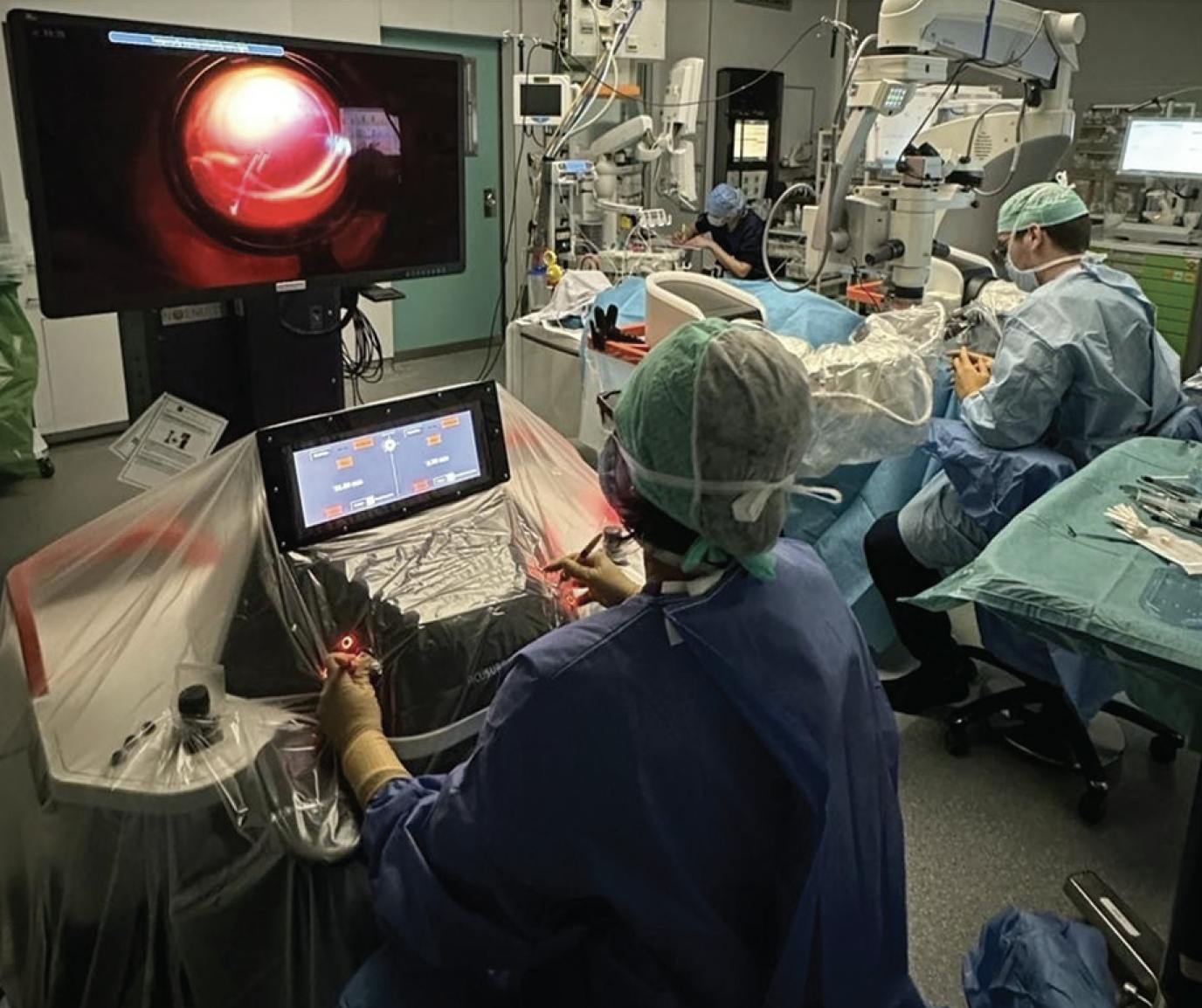
Figure 3. Dr. Nerinchkx uses the Luca robot during retinal surgery at the Ghent University Hospital in Belgium. Image courtesy of Acusurgical.
At the 2025 Retina World Congress, Fanny Nerinckx, MD, presented early results from six patients who underwent robotic surgery for macular pathology. The procedures—vitrectomy with the induction of a posterior vitreous detachment—were successful with no device-related adverse events.31 A European trial (NCT06294613) is recruiting up to 15 patients undergoing vitreoretinal surgery for macular pucker.
LIMITATIONS OF CURRENT ROBOTIC PLATFORMS
The costs, limited commercial availability, and lack of differentiated reimbursement make adoption of robotic systems financially challenging. If reimbursement remains equivalent to manual surgery, robotic procedures are not currently cost-effective. Existing cost-utility analyses in retinal surgery still focus solely on traditional procedures such as pars plana vitrectomy, scleral buckle, and pneumatic retinopexy, excluding robotic platforms.32-34
In addition, technical and workflow challenges hinder integration. Robotic systems often introduce longer operative times and require a steep learning curve.6,15,35,36 The need for specialized training, standardized credentialing, and integration into the workflow adds logistical complexity.9,37-39 Space constraints in the OR are also a consideration; the Preceyes system, for instance, requires an additional foot pedal, adding to the existing microscope, laser, and vitrector pedals.
Ergonomically, the surgeon’s hand position is offset while maintaining visualization through the microscope, which may be less intuitive than conventional manipulation. Many surgeons are accustomed to tactile feedback and may be reluctant to adopt robotic systems that alter hand-eye coordination.
Institutional investment decisions likely depend on cost savings, safety benefits, and clear workflow compatibility.
THE ROAD AHEAD
Ophthalmic robotics have moved rapidly from experimentation to real-world feasibility. The next phase will require addressing economic and logistical hurdles, including workflow integration, training, and cost. As technology continues to miniaturize and integrate with intraoperative OCT and imaging guidance, robotic platforms may soon extend the limits of human dexterity, enabling safer, more reproducible procedures for complex vitreoretinal and subretinal therapies. The promise of the coming decade is not to replace the surgeon, but to enhance the surgeon’s precision, endurance, and confidence in the most delicate corners of the eye.
1. Channa R, Iordachita I, Handa JT. Robotic vitreoretinal surgery. Retina. 2017;37(7):1220-1228.
2. Iordachita II, De Smet MD, Naus G, Mitsuishi M, Riviere CN. Robotic assistance for intraocular microsurgery: challenges and perspectives. Proc IEEE Inst Electr Electron Eng. 2022;110(7):893-908.
3. Ladha R, Meenink T, Smit J, de Smet MD. Advantages of robotic assistance over a manual approach in simulated subretinal injections and its relevance for gene therapy. Gene Ther. 2023;30(3-4):264-270.
4. Rana MM, Akter J, Hanif MA. Next-gen vision: a systematic review on robotics transforming ophthalmic surgery. J Robot Surg. 2025;19(1).
5. Nakao S, Tadano K, Sonoda KH. Advancements in robotic surgery for vitreoretinal diseases: current trends and the future. Jpn J Ophthalmol. 2025;69(4):483-494.
6. Edwards TL, Xue K, Meenink HCM, et al. First-in-human study of the safety and viability of intraocular robotic surgery. Nat Biomed Eng. 2018;2(9):649-656.
7. Cehajic-Kapetanovic J, Xue K, Edwards TL, et al. First-in-human robot-assisted subretinal drug delivery under local anesthesia. Am J Ophthalmol. 2022;237:104-113.
8. Faridpooya K, van Romunde SHM, Manning SS, et al. Randomised controlled trial on robot-assisted versus manual surgery for pucker peeling. Clin Exp Ophthalmol. 2022;50(9):1057-1064.
9. Ahronovich EZ, Simaan N, Joos KM. A review of robotic and OCT-aided systems for vitreoretinal surgery. Adv Ther. 2021;38(5):2114-2129.
10. De Smet MD, Stassen JM, Meenink TCM, et al. Release of experimental retinal vein occlusions by direct intraluminal injection of ocriplasmin. Br J Ophthalmol. 2016;100(12):1742.
11. Preceyes BV. High-precision assistance for eye surgery. Accessed October 3, 2025. www.preceyes.nl
12. Preceyes. Eindhoven University of Technology. Accessed October 3, 2025. tinyurl.com/5xvh752x
13. First micro-interventional robot for ophthalmic surgery in US [press release]. New York Eye & Ear. Accessed October 10, 2025. www.nyee.edu/research/ophthalmic-innovation-technology/robot
14. Cereda MG, Parrulli S, Douven YGM, et al. Clinical evaluation of an instrument-integrated OCT-based distance sensor for robotic vitreoretinal surgery. Ophthalmol Sci. 2021;1(4):100085.
15. Maberley DAL, Beelen M, Smit J, et al. A comparison of robotic and manual surgery for internal limiting membrane peeling. Graefes Arch Clin Exp Ophthalmol. 2020;258(4):773-778.
16. Turgut F, Somfai GM, Heussen FM, et al. Robot-assisted epiretinal membrane peeling: a prospective assessment of pre- and intra-operative times and of surgeons’ subjective perceptions. J Clin Med. 2023;12(8):2768.
17. Zhou D, Kimura S, Takeyama H, et al. Eye Explorer: A robotic endoscope holder for eye surgery. Int J Med Robot. 2021;17(1):e2195.
18. OQrimo. Riverfield. Accessed October 3, 2025. riverfieldinc.com/en/products/p03
19. Ashikaga K, Sakanishi Y, Hirakata T, et al. Trocar insertion into the pars plana using an intraocular endoscope-holding robot [published online ahead of print July 22, 2025]. Retina.
20. Posselli NR, Hwang ES, Olson ZJ, et al. Head-mounted surgical robots are an enabling technology for subretinal injections. Sci Robot. 2025;10(99):eadp7700.
21. Head-mounted robotics device offers a look at the future of eye surgery | John A. Moran Eye Center | University of Utah Health. February 18, 2025. Accessed October 3, 2025. tinyurl.com/2vsf2tdu
22. Forsight Robotics. Accessed October 3, 2025. www.forsightrobotics.com
23. Robotic cataract surgery using ForSight Robotics’ ORYOM platform presented for the first time at the ASCRS Annual Meeting [press release]. FirstWord HealthTech. April 12, 2024. Accessed October 3, 2025. firstwordhealthtech.com/story/5846609
24. Gerber MJ, Hubschman JP. Intraocular robotic surgical systems. Curr Robot Rep. 2022;3(1):1-7.
25. Rahimy E, Wilson J, Tsao TC, et al. Robot-assisted intraocular surgery: development of the IRISS and feasibility studies in an animal model. Eye (Lond). 2013;27(8):972-978.
26. Wilson JT, Gerber MJ, Prince SW, et al. Intraocular robotic interventional surgical system (IRISS): mechanical design, evaluation, and master-slave manipulation. Int J Med Robot. 2018;14(1):e1856.
27. Ullrich F, Michels S, Lehmann D, et al. Assistive device for efficient intravitreal injections. Ophthalmic Surg Lasers Imaging Retina. 2016;47(8):752-762.
28. Zhou M, Yu Q, Huang K, et al. Towards robotic-assisted subretinal injection: a hybrid parallel-serial robot system design and preliminary evaluation. IEEE Trans Ind Electron. 2020;67(8):6617-6628.
29. Kummer MP, Abbott JJ, Kratochvil BE, et al. OctoMag: an electromagnetic system for 5-DOF wireless micromanipulation. In: Proceedings of the IEEE International Conference on Robotics and Automation (ICRA); 2010:1610-1616.
30. Ergeneman O, Pokki J, Počepcová V, et al. Characterization of puncture forces for retinal vein cannulation. J Med Device. 2011;5(4).
31. Nerinchkx F. The LUCA telemanipulation system for robotic vitreoretinal surgery: results of the first-in-human (safety and feasibility study). Presented at Retina World Congress; May 9, 2025; Fort Lauderdale, Florida.
32. Felfeli T, Teja B, Miranda RN, et al. Cost-utility of rhegmatogenous retinal detachment repair with pars plana vitrectomy, scleral buckle, and pneumatic retinopexy: a microsimulation model. Am J Ophthalmol. 2023;255:141-154.
33. Chang JS, Smiddy WE. Cost evaluation of surgical and pharmaceutical options in treatment for vitreomacular adhesions and macular holes. Ophthalmology. 2014;121(9):1720-1726.
34. Brown MM, Brown GC, Lieske HB, Lieske PA. Preference-based comparative effectiveness and cost-effectiveness: a review and relevance of value-based medicine for vitreoretinal interventions. Curr Opin Ophthalmol. 2012;23(3):163-174.
35. Jacobsen MF, Konge L, la Cour M, et al. The learning curve of robot-assisted vitreoretinal surgery: a randomized trial in a simulated setting. Acta Ophthalmol. 2021;99(8):e1509-e1516.
36. Forslund Jacobsen M, Konge L, Alberti M, et al. Robot-assisted vitreoretinal surgery improves surgical accuracy compared with manual surgery: a randomized trial in a simulated setting. Retina. 2020;40(11):2091-2098.
37. Chatzimichail E, Feltgen N, Motta L, et al. Transforming the future of ophthalmology: artificial intelligence and robotics’ breakthrough role in surgical and medical retina advances: a mini review. Front Med (Lausanne). 2024;11:39076760.
38. De Smet MD, Naus GJL, Faridpooya K, Mura M. Robotic-assisted surgery in ophthalmology. Curr Opin Ophthalmol. 2018;29(3):248-253.
39. Pandey S, Sharma V. Robotics and ophthalmology: are we there yet? Indian J Ophthalmol. 2019;67(7):988-994.


_1784132761.jpg?auto=compress,format&w=75)





