




Intraocular gases and silicone oil, while instrumental in the evolution of retinal detachment repair, have remained largely unchanged since their introduction in the 1970s; aside from certain refinements in formulation and delivery, no significant innovations in intraocular tamponade agents have emerged.1-3
During the Euretina Special Focus Meeting on Ocular Endotamponades, held in Athens on March 15, 2025, international experts gathered to discuss the limitations of current tamponade agents and the critical need for innovation in this space. With evolving surgical techniques, new government restrictions on the use of fluorinated greenhouse gases (F-gases) due to environment concerns, and increasing patient expectations, the call for new tamponade solutions has never been more urgent.
This article reviews the limitations of current agents and explores some of the innovations on the horizon.
CHALLENGES WITH CURRENT ENDOTAMPONADE AGENTS
While gases and oils provide mechanical closure of retinal breaks, their clinical drawbacks are significant. With endotamponades, patients are often required to maintain strict, uncomfortable positioning for days or even weeks, depending on the location of the break. Consequently, quality of life can be significantly affected during recovery. For example, for some patients, any preexisting musculoskeletal disease may be exacerbated, leading to inherent compliance challenges and, potentially, reduced surgical success. In addition, air travel and altitude exposure are strictly limited with gas endotamponades, which may present a limitation for certain patients.
Surgeons also experience important diagnostic blind spots during critical phases of follow-up due to the refractive properties of endotamponades, as gas-filled eyes preclude quality OCT imaging and hinder the early identification of complications such as epiretinal membrane formation, macular edema, or incipient retinal redetachment (Figure). Moreover, the concentrated fluid meniscus below the gas bubble creates a stratified environment that may concentrate proinflammatory cytokines and fibrogenic growth factors, such as TGF-Β and PDGF, potentially contributing to the development of proliferative vitreoretinopathy.4 In phakic eyes, gas exposure accelerates cataract progression, hastening the need for cataract surgery.5
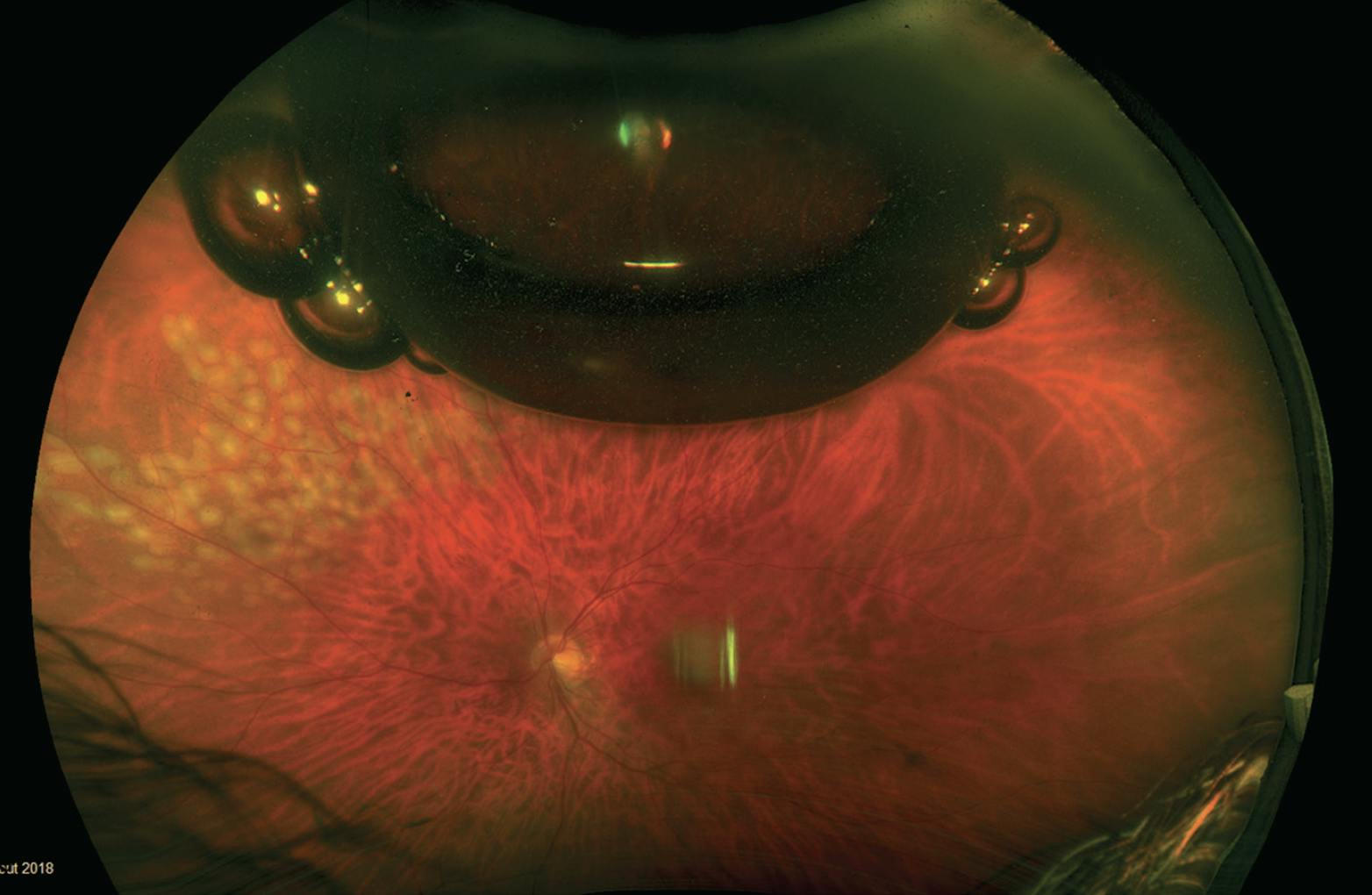
The use of silicone oil, while it does not require as strict positioning as gas, introduces its own set of potential complications, including emulsification, secondary glaucoma, refractive changes, and the need for a second surgery to remove the oil.6
Although gas tamponade is not necessary in all cases of vitrectomy, its common association with retina surgery may deter patients who fear the burdens of postoperative positioning and temporary postoperative vision loss. Such hesitation may compromise patients’ long-term visual outcomes and, in some cases, even lead to permanent vision loss.
In this context, the emergence of new agents that can offer direct sealing of retinal breaks without extensive clinical burdens and with a significantly shortened postoperative rest period would represent a meaningful leap forward for both surgeons and patients.
Lack of Environmental Sustainability
Adding to the unmet clinical need for novel endotamponades is pressure to restrict or abolish the use of F-gases for medical purposes in Europe. As part of a broader climate policy, the European Union passed Regulation 2024/573 to address the use of F-gases; the regulation introduces a quota system in 2030 and an outright ban by 2050.7
In response, some companies have begun to take a proactive approach in reducing reliance on F-gases in medical technology. One example is the initiation of clinical trials to develop asthma inhalers that eliminate fluorinated propellants in anticipation of these changes.8
The proposed regulations on F-gases have raised concern in ophthalmology as well. Euretina has publicly advocated against a complete ban while supporting the overall efforts to minimize the use of F-gases in vitreoretinal surgery and encouraging research on alternative tamponade agents that would minimize greenhouse gas emissions and improve patient outcomes. While patient safety and environmental responsibility are not mutually exclusive, the downstream effects of the stricter F-gas regulations could mean reduced availability and/or rising costs of medical-grade ophthalmic gases, further underscoring the need for viable alternatives.
FURTHER READING
How to Choose the Right Tamponade
By Lucy V. Cobbs, MD, and Vaidehi S. Dedania, MD
Surgeons have several options, and knowing which one will serve the patient best is the key to a successful surgery.
In Retina Today, January/February 2024
NEW FRONTIERS IN TAMPONADE SCIENCE
The concept of developing a vitreous substitute or retinal sealant is not new, but such attempts have historically fallen short. Although hydrogel-based materials have demonstrated promise in early animal models, none have successfully translated into the clinic due to issues such as inflammation, poor biocompatibility, complex manufacturing of biomaterials, or surgical impracticality.9,10
However, at the Euretina Special Focus Meeting, experts discussed novel approaches to the traditional retinal tamponades. One approach under evaluation by various research groups is the concept of a bioadhesive sealant that would replace gas entirely.11,12 By adhering directly to the retina and sealing the localized retinal defect, the bioadhesive sealant could potentially allow for earlier visual recovery, reduce or eliminate strict positioning, and reduce the risk of proliferative vitreoretinopathy by minimizing concentration of potential pathologic cytokines inferiorly and cellular ingress through retinal breaks. It may also decrease the rate of cataract formation.
If the development of such an approach continues, it could represent a paradigm shift in how we manage retinal detachments. It is also worth mentioning that surgeons have used Tisseel glue with some success in the past,13 while others hve explored a gel-based sealant.14
FURTHER READING
Retina OR Potpourri: Five Questions for Five Top Surgeons
By Steve Charles, MD, FACS, FICS; Charles C. Wykoff, MD, PhD, FASRS, FACS; Audina M. Berrocal, MD; Sengul Ozdek, MD, FEBO; and Edward F. Hall, MD
Experts discuss tough surgical scenarios and controversial topics.
In Retina Today, January/February 2025
LET’S GET TO WORK
As clinical and regulatory pressures mount and our tools for diagnosis and intervention continue to grow more refined, we must match that progress with equally thoughtful innovation in how we manage retinal breaks. The future of surgical success in the retina OR will be defined not only by anatomic improvement, but also by our patients’ access to care, recovery experience, and long-term visual outcomes. It’s time to evolve “beyond the bubble” and seek a new solution to the problem of standard gas and oil tamponades.
1. Cibis PA, Becker B, Okun E, Canaan S. The use of liquid silicone in retinal detachment surgery. Arch Ophthalmol. 1962;68:590-599.
2. Lincoff H, Mardirossian J, Lincoff A, Liggett P, Iwamoto T, Jakobiec F. Intravitreal longevity of three perfluorocarbon gases. Arch Ophthalmol. 1980;98(9):1610-1611.
3. Norton EW. Intraocular gas in the management of selected retinal detachments. Trans Am Acad Ophthalmol Otolaryngol. 1973;77(2):OP85-98.
4. Asaria RH, Kon CH, Bunce C, et al. Silicone oil concentrates fibrogenic growth factors in the retro-oil fluid. Br J Ophthalmol. 2004;88(11):1439-1442.
5. Kasetty VM, Monsalve PF, Sethi D, et al. Cataract progression after primary pars plana vitrectomy for uncomplicated rhegmatogenous retinal detachments in young adults. Int J Retina Vitreous. 2024;10(1):19.
6. Valentin-Bravo FJ, Garcia-Onrubia L, Andres-Iglesias C, et al. Complications associated with the use of silicone oil in vitreoretinal surgery: a systemic review and meta-analysis. Acta Ophthalmol. 2002;100(4):e864-e880.
7. European Union. Regulation (EU) 2024/573 of the European Parliament and of the Council. February 7, 2024. Accessed September 30, 2025. eur-lex.europa.eu/eli/reg/2024/573/oj
8. Pharma groups to tackle greenhouse gases from asthma inhalers. Financial Times. Accessed September 29, 2025. www.ft.com/content/9e9dac20-8b22-432c-ab6f-2acc64eadbf6
9. Donati S, Caprani SM, G. Airaghi R. Vitreous substitutes: the present and the future. Biomed Res Int. 2014;351804.
10. Zheng C, Wen D, Xu K, Zhang X, Ren X, Li X. Advances in biomaterials as a retinal patch for the repair of rhegmatogenous retinal detachment. Front Bioeng Biotechnol. 2022;10:997243.
11. Sojdeh S, Panjipour A, Bejandi ZB, et al. Hydrogel-based vitreous substitutes. Int J Mol Sci. 2025;26(17):8406.
12. Desai A, Hansraj S, Tyagi M. Intraocular bioadhesives in vitreoretinal surgeries: a systematic review. Semin Ophthalmol. 2024;39(8):570-576.
13. Desai A, Bhopalka AK, Tyagi M, Sharma SV, Takkar B. Glue-assisted retinopexy for retinal detachments study report 2: fibrin glue as a surgical adjunct in complex rhegmatogenous retinal detachment. J Vitreoretin Dis. 2024;8(4):435-441.
14. Shen C, Jiang Z, Wang X, et al. GelMA-based sealant: an unconventional surgical approach to the management of selected retinal breaks. ACS Biomater Sci Eng. 2025;11(9):5638-5649.


_1784132761.jpg?auto=compress,format&w=75)





