




Ahh, the pipeline issue. This is the one issue each year we break away from our usual mantra of “make sure everything is clinically relevant!” Of course, the investigational therapeutics and tools highlighted in this issue may become clinically relevant, but not quite yet (unless you are an investigator!). Each year, our coverage swells as more therapies move through their investigations and head toward possible FDA approval. Within this issue, our authors mention a whopping 77 therapies for wet or dry AMD, diabetic macular edema, and diabetic retinopathy—and that doesn’t even include therapies for inherited retinal diseases, which were covered in our July/August issue (for more on those, see Further Reading).
Further Reading
THE IRD PIPELINE
More than 30 therapies for inherited retinal disease were highlighted in the July/August issue, which you can read here.
How do you navigate so much information?! Well, for anyone swamped in the clinic and OR with zero time to slog through clinical trial data, here’s the short version: Of the therapeutics discussed in this issue, 15 are in phase 3 (Table)—nine of which are tentatively slated to have a primary completion next year. So, if nothing else, keep an eye on KSI-301 and KSI-501 (Kodiak Sciences), EYE103/MK-3000 (Restoret, EyeBio/Merck), OCS-01 (Oculis), vonaprument (ANX007, Annexon), EYP-1901 (EyePoint), ABBV-RGX-314 (Regenxbio/Abbvie), ADVM-022 (Adverum), and OTX-TKI (Ocular Therapeutix).
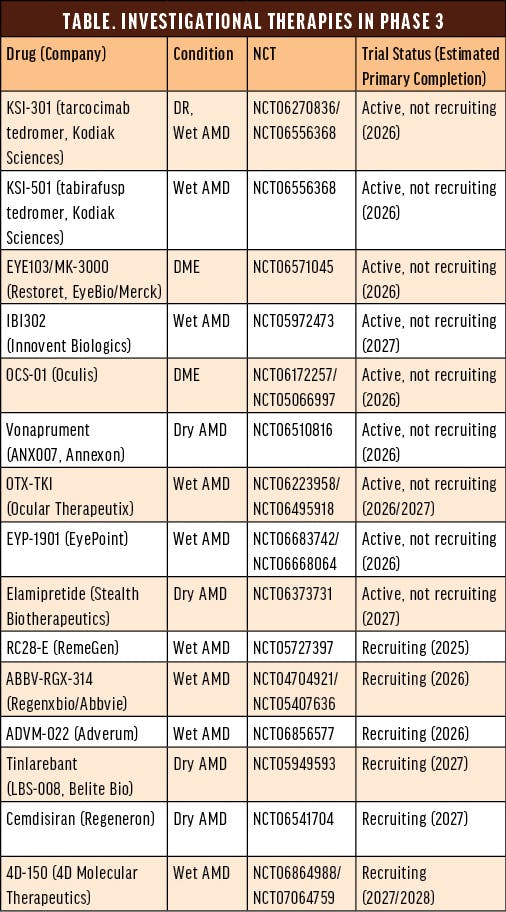
If you do find yourself with a cup of coffee and a free hour or two to read through the articles, the (very helpful) charts read something like a holiday wish list. Wouldn’t it be great to have all these various options to treat our patients? What doesn’t work for one might be a life-changing therapy for another. If the anti-VEGF agent isn’t maintaining efficacy, maybe a tyrosine kinase inhibitor or a gene therapy will. A patient hates injections? Maybe an oral therapy or eye drop will become a viable alternative.
One day, we will have many more options to choose from to treat our chronic disease patients, and then we can start writing editorials complaining about storage space and overly complicated treatment decision trees.
For now, we wait. This issue always fills us with hope for a future that allows more individualized care for our patients with retinal disease—now that would be a miracle.


_1784132761.jpg?auto=compress,format&w=75)





