


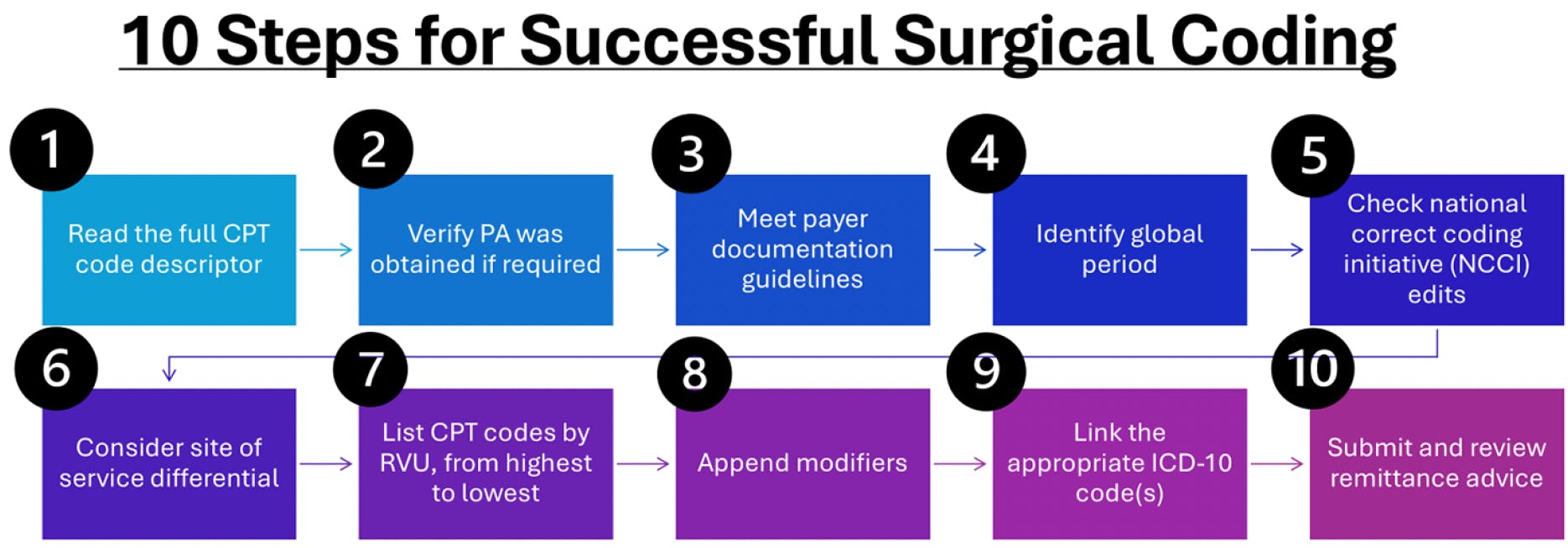
Ensuring proper reimbursement for ophthalmic surgery demands more than simply selecting a CPT code—it requires a structured, methodical approach to coding. A consistent review process helps safeguard against denials, clarify complex billing combinations, and accurately reflect what occurred in the OR. The following example shows how to apply 10 necessary steps for successful surgical coding (Figure).
OPERATIVE SUMMARY
The operative note describes a patient who underwent a pars plana vitrectomy (PPV) to address a dislocated posterior chamber IOL in the left eye. The IOL was split into two fragments, and during surgery, each piece was carefully elevated, cut, and removed through a clear corneal incision under the protection of viscoelastic. After clearing the posterior segment, the surgeon placed a new posterior chamber IOL. A peripheral iridotomy was created to remove residual viscoelastic, and subconjunctival injections of dexamethasone and cefazolin were administered.
Step 1: Identify All Possible CPT Codes and Read Full Descriptors
Using the documentation in the operative report, identify every CPT code that could apply to the documented procedures. In this case, there are several initial possibilities (Table 1). The vitrectomy itself aligns with CPT 67036, which describes a mechanical PPV. The implantation of a new IOL—unrelated to cataract surgery—corresponds to CPT 66985, which covers insertion of a secondary IOL without concurrent cataract removal. CPT 66986, an IOL exchange code, is also a possibility. Finally, CPT 67121, removal of intraocular implanted material, could apply. The iridotomy and subconjunctival injections are considered incidental to the other procedures performed in addition to being bundled.
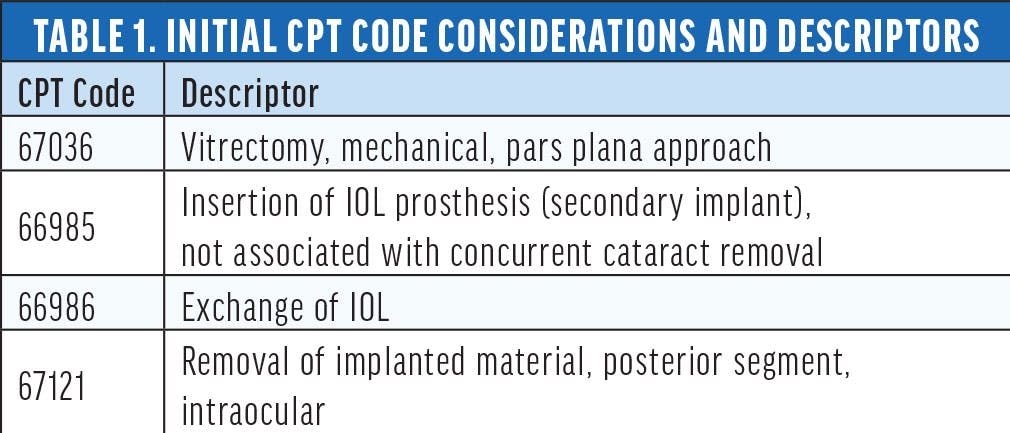
A close reading of the operative note and the full CPT descriptors shows that only 67036 and 66986 accurately describe the work performed. CPT 66985 would not be appropriate, as a lens was already implanted and needed to be removed. CPT 67121 is bundled with 67036 and incorrect, as it is included in the IOL exchange, CPT 66986.
Step 2: Obtain Prior Authorization
Before any surgery is scheduled, it is critical to determine whether the payer requires prior authorization. PPV (CPT 67036) and IOL exchange (CPT 66986) can fall under prior authorization requirements with Medicare Advantage and commercial plans. Confirm authorization requirements during the preoperative process to avoid claim denials.
Step 3: Ensure Payer-Required Preoperative Documentation
Every payer outlines certain documentation expectations that must be met before the surgery is considered medically necessary. For posterior segment procedures such as PPV, the record should clearly demonstrate why surgery was needed. Here, the documentation records a dislocated posterior chamber IOL, a condition that can impair vision, cause patient discomfort, or lead to further complications if left unaddressed. The note also supports the need for secondary IOL implantation by describing the lens removal and subsequent aphakia. For some codes—such as CPT 67036—a specific diagnosis matters because only certain ICD-10 codes are payable under Medicare National Coverage Determination (NCD) policies.1
Step 4: Determine if Surgery Occurred Within a Global Period
In this case, there is no indication of a recent surgery or that this procedure was performed during the global period on the same eye. The surgeon does not need to append a surgical modifier such as -79 for an unrelated procedure, -78 for a return to the OR for a related procedure, or -58 for a staged/related procedure.2 The absence of recent surgical activity simplifies this step; no additional modifier is required in addition to the anatomic modifier.
Step 5: Check NCCI Edits
National Correct Coding Initiative (NCCI) edits play a crucial role in determining which CPT code combinations can be billed on the same day. CPT 67121 is bundled with PPV code 67036 and can't be billed separately. CPT 66985—while related to IOL work—is the wrong code. Importantly, CPT 66986 and CPT 67036 are not bundled and can be billed on the same day. NCCI edits can be reviewed on the CMS website or in the Academy Ophthalmic Coding Coach.3,4
Step 6: Consider Site-of-Service Differential
Both CPT 66986 and CPT 67036 are assigned facility-only relative value units (RVUs), and there is no alternate non-facility value to consider. All payers expect these procedures to be performed commonly in a facility setting. As a result, the site-of-service differential does not affect these codes.
The site-of-service differential applies to procedures that are typically performed in both the clinic or facility. For example, CPT 67110—repair of retinal detachment by injection of air or other gas (eg, pneumatic retinopexy)—has a 2026 RVU of 26.69 in the office and 20.92 when performed in the facility. The office RVU value is higher to cover the additional practice expenses associated with performing the procedure in the office.
Step 7: List CPT Codes From Highest to Lowest RVU
When multiple procedures are billed during the same session, Medicare and most commercial payers reimburse the highest-valued procedure at 100% of its allowable rate, while subsequent codes are typically reduced—often to 50% of their allowable. For this reason, the order of submitted CPT codes matters. Given their respective 2026 RVUs, CPT 66986 (22.87) should be listed first, followed by CPT 67036 (22.72) to appropriately maximize reimbursement. RVUs can be accessed using the CMS Medicare Physician Fee Schedule lookup and in the Academy Ophthalmic Coding Coach.4,5
Step 8: Append Modifier(s)
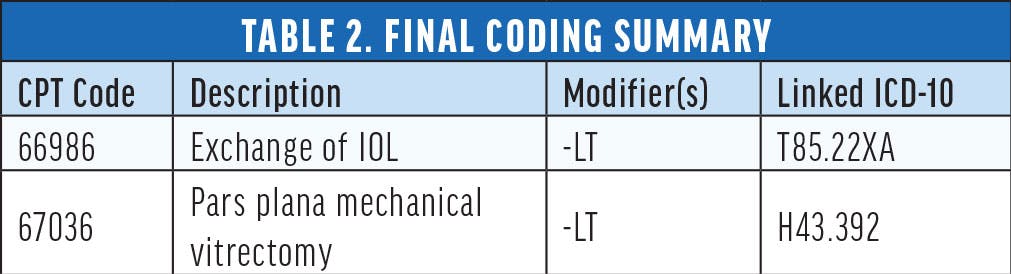
Because the surgery was performed on the left eye, both codes require the anatomic modifier, -LT. No global-period modifier is needed because this case does not fall within another surgical global period. If a global-period modifier was needed, it would go before the anatomic modifier. The final coded procedures therefore appear as CPT 66986-LT and CPT 67036-LT (Table 2).
Step 9: Link to Appropriate Diagnosis Codes
Assigning the proper ICD-10 codes is essential to demonstrate medical necessity. For the lens exchange, CPT 66986, the diagnosis is T85.22XA (dislocation of IOL, initial encounter). For the PPV, CPT 67036, a diagnosis of H43.392 (other vitreous opacities, left eye) is both clinically appropriate and listed as a payable diagnosis under the NCD for this CPT code.1 ICD-10 code T85.22XA is not a payable diagnosis per Medicare’s NCD. Linking each code to its most specific diagnosis ensures clean claim processing.
Step 10: Submit the Claim and Review Remittance Advice
After submission, carefully review the remittance advice to confirm that both procedures were paid correctly and that the multiple procedure reduction was appropriately applied. If either code is denied—whether due to modifier issues, bundling concerns, or diagnosis-linking errors—remittance will help the practice identify the necessary corrections.
ALL PART OF THE PROCESS
Follow this consistent 10-step process to ensure complex ophthalmic surgeries are coded accurately and reimbursed appropriately. By carefully reviewing the operative note, selecting the correct CPT and ICD-10 codes, applying modifiers, and confirming payment, practices can reduce errors, prevent denials, and maintain efficient, compliant billing.
1. Local coverage determination policies. American Academy of Ophthalmology. Accessed December 1, 2025. tinyurl.com/mry9rhvn
2. Woodke J. The impact of global periods on correct coding. Retina Today. 2021; 16(7):45-46.
3. Medicare NCCI procedure to procedure (PTP) edits. CMS. Accessed December 1, 2025. tinyurl.com/3fu2xtv6
4. Ophthalmic Coding Coach. American Academy of Ophthalmology. Accessed December 1, 2025. tinyurl.com/r6ttmz3v
5. PFS look-up tool overview. CMS. Accessed December 1, 2025. tinyurl.com/mpznnpkm


-1%20(1)_1769020986.jpg?auto=compress,format&w=70)


%20FINAL-1_1771612597.jpg?auto=compress,format&w=70)

_1784132761.jpg?auto=compress,format&w=75)





