



New oncologic medications such as small molecule inhibitors and immunotherapies have transformed cancer treatment by offering targeted approaches and improving patient survival rates. However, these novel agents are associated with various side effects, notably class-specific ocular toxicities ranging from mild, reversible symptoms to serious, vision-threatening conditions, which are more common with combination therapies.
The mechanisms underlying ocular toxicity with newer oncology agents are broadly classified as direct (affecting neuronal and/or glial cells) or indirect (resulting from inflammation or a compromised blood-retinal barrier). It is crucial to establish a definitive connection between the specific medication and adverse event, for which tools such as the World Health Organization classification or the Naranjo criteria can be useful.1
This article reviews the commonly reported drug-induced retinal and uveitis-related toxicities linked to modern oncology treatments and describes a multidisciplinary management strategy.
SMALL MOLECULE INHIBITORS
Dysregulation of the mitogen-activated protein kinase (MAPK) pathway is a factor in several cancers. MAPK kinase (MEK) and BRAF gene inhibitors interfere with this signaling pathway, limiting the proliferation, differentiation, and survival of cancer cells. Activation of fibroblast growth factor receptor (FGFR) signaling triggers the MAPK cascade, thereby accounting for the overlapping retinal adverse effects observed with FGFR inhibitors.
MEK inhibitors
MEK inhibitors are used to treat various cancers as monotherapy and in combination with other targeted drugs, such as BRAF inhibitors.2,3 Despite their high efficacy, these inhibitors are linked to a specific class-effect retinopathy known as MEK-associated retinopathy (MEKAR), which causes self-limiting serous detachments of the neurosensory retina.4-7 This condition is highly prevalent, affecting up to 90% of patients receiving these drugs, and is generally asymptomatic and reversible.3 Symptomatic patients may report blurred vision, halos around lights, and colorful spots in their vision.
The toxicity is thought to affect the retinal pigment epithelium (RPE) cells, causing dysfunction by inhibiting the MAPK pathway. This pathway is downstream of the FGFR that is vital for the maintenance, repair, and survival of the RPE.3,8 Inhibition leads to the buildup of subretinal fluid (SRF), and, as such, MEKAR presents with characteristic patterns of fluid accumulation on OCT, including dome, caterpillar, waves, and splitting.6
While these SRF findings resemble those seen in central serous chorioretinopathy (CSC), key differences exist: The fluid’s location in MEKAR is between the photoreceptors and an intact RPE, it is typically multifocal and bilateral, and, unlike with CSC, pigment epithelial detachments (PEDs) and fluorescein leakage are absent. Furthermore, MEKAR is not associated with changes in choroidal thickness, and visual acuity is maintained in most cases.6
Less commonly, MEK inhibitors may also cause retinal vein occlusion (RVO), which suggests a possible toxicity to endothelial cells.9,10 Although the prevalence of RVO in patients undergoing MEK inhibition is low (0.5%), it exceeds the 0.1% prevalence in the general population.11
There is no current recommendation for routine ocular screening for patients on MEK inhibitors; however, a baseline examination is advised to distinguish preexisting conditions from MEKAR. Management of MEKAR usually involves observation, given its reversible nature. However, in cases of RVO, discontinuing the MEK inhibitor is necessary to prevent sight-threatening bilateralization, alongside standard-of-care treatment for the occlusion.
BRAF Inhibitors
BRAF inhibitors operate upstream of MEK inhibitors, triggering significant apoptosis in cancer cells. This process can provoke an inflammatory response leading to ocular side effects. The suggested mechanism is mimicry, in which the immune system, activated by dying cancer cells, attacks healthy tissues. Therefore, uveitis is the most common ocular adverse event associated with this drug class, affecting about 4% of patients, although the frequency may vary by the specific drug.12,13 Anterior, intermediate, posterior, and/or panuveitis can occur, and macular edema may accompany it. Additionally, Vogt-Koyanagi-Harada (VKH)-like syndromes may develop, possibly due to mimicry involving melanomatous cancer cells.14 Other potential complications include dry eye, conjunctivitis, and subretinal detachment (SRD); SRD is most commonly associated with combined use of BRAF and MEK inhibitors.
The prognosis for BRAF inhibitor-induced uveitis is generally good, with most cases responding well to local corticosteroids.15 It is important to avoid systemic steroids and immunosuppressants to prevent interference with the anti-cancer immune response. Discontinuation of the drug is reserved for severe, uncontrolled inflammation that becomes sight-threatening.
FGFR Inhibitors
FGFR inhibitors are a class of tyrosine kinase inhibitors that may cause toxicity of the retina and ocular surface. Typical manifestations include:
- Trichiasis, trichomegaly, increased eyelash curling, and changes in hair texture
- Dry eye, blepharitis, and conjunctivitis
- Corneal deposits, keratitis, and limbal stem cell deficiency
- FGFR inhibitor-associated retinopathy
Retinal adverse events have been documented with nearly all FGFR inhibitors, including erdafitinib, infigratinib, pemigatinib, futibatinib, and rogaratinib.16 The primary mechanism appears to be direct toxicity to RPE cells, as the FGFR pathway is critical for RPE maintenance and survival.3,8 OCT imaging may show SRF mainly in the form of SRDs; lesions are often bilateral and can be unifocal or multifocal (Figure 1).
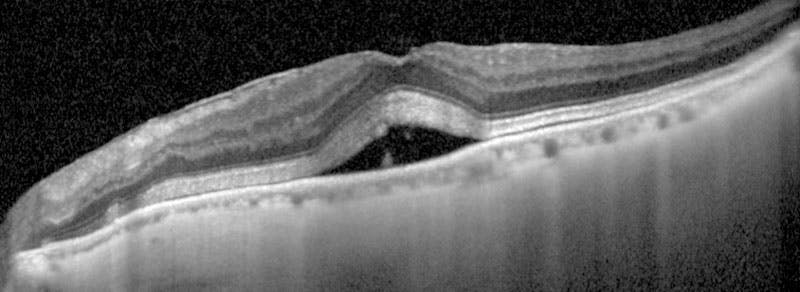
Figure 1. This OCT B-scan shows the left eye of an 81-year-old man being treated with erdafitinib, an FGFR inhibitor, for urothelial carcinoma. The scan reveals a distinct foveal SRD, elongation of the photoreceptor outer segments with subretinal debris, and a surrounding area where SRF appears to separate the retina from the RPE (ie, splitting). The noted lesions were bilateral. Importantly, the choroid appears thin, in contrast to the thickened choroid typically observed in CSC.
In contrast to CSC, FGFR-associated retinopathy features intact, hyperreflective photoreceptor and RPE layers with sensory retinal detachments but no true PEDs or choroidal thickening, and the condition is most frequently reversible. However, cases of inner/outer retinal atrophy, ellipsoid zone disruption, interdigitation zone thickening, and/or hyperreflectivity near the affected ellipsoid/interdigitation zones corresponding to subretinal deposits have also been described.16 Management rarely involves drug withdrawal, depending on the agent used, especially if the condition becomes chronic and severely affects vision16,17; however, the utility of discontinuing the drug is unclear, given the high rate of spontaneous resolution in such cases.
IMMUNOTHERAPY: CHECKPOINT INHIBITORS
Checkpoint inhibitors (CPIs) are a form of immunotherapy that functions by blocking proteins such as CTLA-4 and PD-1/PD-L1, which normally suppress the immune system. These proteins are also used by cancerous cells to evade the immune response. Thus, CPIs regulate T-cell activation and are effective against many malignancies, including metastatic melanoma, small-cell lung cancer, colon cancer, renal cell carcinoma, and more. However, this broad immune activation can cause immune-related adverse events (irAEs) anywhere in the body, including the eye.13 Furthermore, some of the inhibited molecules, such as PD-L1, are expressed on the cornea, iris-ciliary body, and RPE, where they contribute to the eye’s immune privilege; blocking them can thus cause significant ocular inflammation.
Ocular irAEs affect 0.4% to 1% of patients on CPIs,18 although incidences as high as 4.3% have been reported, suggesting events may be under-documented.19 Timing of manifestations may vary but usually occurs within 6 months of exposure to the drug. Clinical signs may involve intra-, extra-, and/or periocular structures, with symptoms ranging from dry eye and keratitis to more severe conditions such as orbital inflammation, cranial nerve palsies, optic neuropathy, and myasthenia gravis.13 When uveitis occurs, it is often anterior, and posterior segment involvement may include vitritis, immune retinopathy, papillitis, vasculitis, and/or choroiditis (Figure 2). Similar to BRAF inhibitors, VKH-like syndromes have also been reported, especially in patients treated for metastatic melanoma.

Figure 2. Ultra-widefield fundus imaging shows the left eye of a 72-year-old patient undergoing treatment with nivolumab, a CPI, for metastatic melanoma and demonstrates blurred optic disc margins and vitritis, particularly in the inferior retina (A). An OCT B-scan reveals intraretinal cysts in the macula and interpapillomacular region (B). Note the choroid appears markedly thickened, consistent with diffuse inflammatory infiltration. Bilateral anterior chamber cells were observed on the anterior segment examination.
MULTIDISCIPLINARY MANAGEMENT
The management of ocular toxicities from these cancer drugs requires close collaboration between oncologists and ophthalmologists. The first step is to exclude other potential causes, as oncology patients may have confounding factors such as corticosteroid-induced CSC, immunosuppression-related intraocular infections, or metastatic disease.
For FGFR- and MEK-inhibitor associated retinopathies, observation is the typical approach, with drug withdrawal considered only for chronic cases with severe vision impairment. For MEK inhibitor-associated RVO, the drug must be stopped and the occlusion treated. For uveitis due to BRAF or checkpoint inhibitors, a stepwise strategy is best, starting with local corticosteroids and progressing to systemic corticosteroids or other immunosuppressants. However, this approach should be avoided whenever possible, as it can promote cancer progression. Withdrawing the cancer drug is a last resort. Continued research and strong collaboration are crucial to optimize both visual and oncologic outcomes.
Author’s note: Gemini Pro 2.5 was used for English language editing and article formatting.
1. Naranjo CA, Busto U, Sellers EM, et al. A method for estimating the probability of adverse drug reactions. Clin Pharmacol Ther. 1981;30(2):239-245.
2. Ram T, Singh AK, Kumar A, et al. MEK inhibitors in cancer treatment: structural insights, regulation, recent advances and future perspectives. RSC Med Chem. 14(10):1837-1857.
3. Jeng-Miller KW, Miller MA, Heier JS. Ocular effects of MEK inhibitor therapy: literature review, clinical presentation, and best practices for mitigation. Oncologist. 2024;29(5):e616-e621.
4. Urner-Bloch U, Urner M, Jaberg-Bentele N, Frauchiger AL, Dummer R, Goldinger SM. MEK inhibitor-associated retinopathy (MEKAR) in metastatic melanoma: long-term ophthalmic effects. Eur J Cancer. 2016;65:130-138.
5. Urner-Bloch U, Urner M, Stieger P, et al. Transient MEK inhibitor-associated retinopathy in metastatic melanoma. Ann Oncol. 2014;25(7):1437-1441.
6. Francis JH, Habib LA, Abramson DH, et al. Clinical and morphologic characteristics of MEK inhibitor-associated retinopathy: differences from central serous chorioretinopathy. Ophthalmology. 2017;124(12):1788-1798.
7. Duncan KE, Chang LY, Patronas M. MEK inhibitors: a new class of chemotherapeutic agents with ocular toxicity. Eye (Lond). 2015;29(8):1003-1012.
8. van der Noll R, Leijen S, Neuteboom GHG, Beijnen JH, Schellens JHM. Effect of inhibition of the FGFR-MAPK signaling pathway on the development of ocular toxicities. Cancer Treat Rev. 2013;39(6):664-672.
9. Ricard N, Scott RP, Booth CJ, et al. Endothelial ERK1/2 signaling maintains integrity of the quiescent endothelium. J Exp Med. 2019;216(8):1874-1890.
10. Huang W, Yang AH, Matsumoto D, et al. PD0325901, a mitogen-activated protein kinase kinase inhibitor, produces ocular toxicity in a rabbit animal model of retinal vein occlusion. J Ocul Pharmacol Ther. 2009;25(6):519-530.
11. Francis JH, Diamond EL, Chi P, Jaben K, Hyman DM, Abramson DH. MEK inhibitor-associated central retinal vein occlusion associated with hyperhomocysteinemia and MTHFR variants. Ocul Oncol Pathol. 2020;6(3):159-163.
12. Choe CH, McArthur GA, Caro I, Kempen JH, Amaravadi RK. Ocular toxicity in BRAF mutant cutaneous melanoma patients treated with vemurafenib. Am J Ophthalmol. 2014;158(4):831-837.e2.
13. Touhami S, Audo I, Terrada C, et al. Neoplasia and intraocular inflammation: from masquerade syndromes to immunotherapy-induced uveitis. Prog Retin Eye Res. 2019;72:100761.
14. Nakajima I, Yoshino K, Tsuji H. Incidence and management of retinopathy and uveitis in patients receiving BRAF/MEK inhibitor therapy. [published online ahead of print February 24, 2025]. Semin Ophthalmol.
15. Castillejo Becerra CM, Smith WM, Dalvin LA. Ophthalmic adverse effects of BRAF inhibitors. [published online ahead of print October 11, 2022]. Eur J Ophthalmol.
16. Hsu J, Francis JH, Ahmad S. Ocular toxicities of fibroblast growth factor receptor inhibitors: a review. Surv Ophthalmol. 2024;69(1):34-41.
17. Paris A, Bodaghi B, Touhami S. Pan fibroblast growth factor receptor inhibitor associated retinopathy. Eur J Ophthalmol. 2024;34(3):NP66-NP71.
18. Bitton K, Michot JM, Barreau E, et al. Prevalence and clinical patterns of ocular complications associated with anti-PD-1/PD-L1 anticancer immunotherapy. Am J Ophthalmol. 2019;202:109-117.
19. Wu KY, Yakobi Y, Gueorguieva DD, Mazerolle É. Emerging ocular side effects of immune checkpoint inhibitors: a comprehensive review. Biomedicines. 2024;12(11):2547.


-1%20(1)_1769020986.jpg?auto=compress,format&w=70)


_1773249222.png?auto=compress,format&w=75)





