



January/February Spotlight: Retinal Detachment (RD) Repair
In Retina Today’s (RT) inaugural issue, which published in March 2006, Donald J. D’Amico, MD, penned an article on the Changing Surgical Approaches for Retinal Detachment. The primary surgical options he focused on were pneumatic retinopexy, scleral buckling, and vitrectomy. Rarely used (but still mentioned) approaches included observation, laser delimitation, and the Lincoff balloon.
At the time, Dr. D’Amico noted that a substantial percentage of primary detachments in the United States were managed with pneumatic retinopexy. Is that still the case today? RT sat down with Dr. D’Amico to discuss the evolution in RD repair surgery over the past 20 years. Here’s what he had to say.
– Rebecca Hepp, MA, Editor-in-Chief
RT: WHAT WAS YOUR GO-TO APPROACH TO RD REPAIR IN 2006?
Dr. D’Amico: By 2006, I was already in the group (certainly still a minority at the time) that had shifted to vitrectomy as the go-to approach for most primary RDs. That would include virtually all pseudophakic cases and the majority of phakic cases. The few buckles I did back then included phakic cases with inferior breaks and very young patients without a posterior vitreous detachment (Figure).
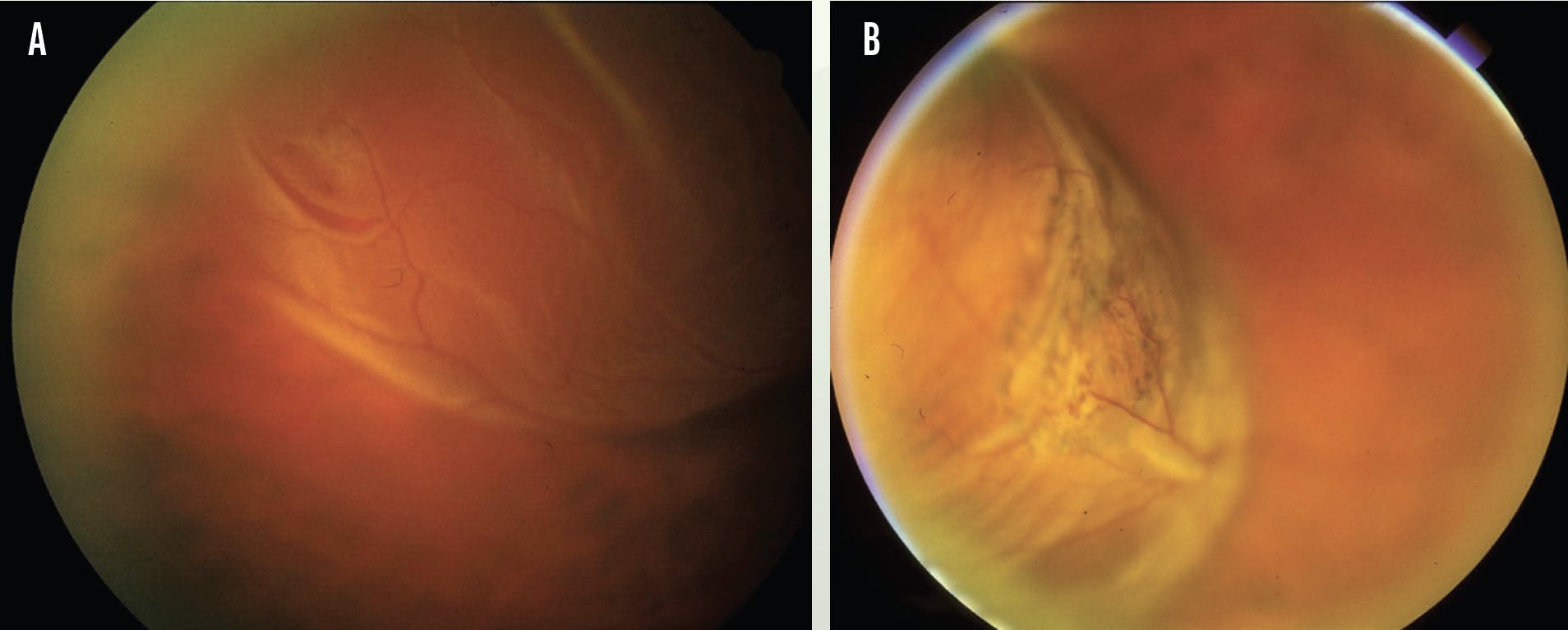
Figure. In 2006, this 43-year-old phakic patient with a bullous detachment and a single superotemporal horseshoe tear (A) was successfully treated with a scleral buckle (B). Although still a good option, Dr. D'Amico's choice in 2026 would be a vitrectomy, cryotherapy to the break, and air or short-acting gas.
RT: HOW HAS YOUR TREATMENT APPROACH CHANGED?
Dr. D’Amico: I have continued to expand my use of vitrectomy for primary RD, and now I do less than a handful of buckles every year; I am frequently teased for being a “buckle basher” by my colleagues. Once, while speaking at a conference, I mentioned that my first case after the meeting was a straight buckle; several friends stood up in the audience and offered to be available for a phone call from the OR if I had forgotten how to perform it!
RT: WHAT TOOLS HAVE HELPED RESHAPE YOUR APPROACH TO RD REPAIR?
Dr. D’Amico: Several breakthrough technologies have revolutionized vitreoretinal surgery. Small-gauge/transconjunctival approaches have greatly reduced operative trauma and inflammation while also offering new approaches to vitreous and membrane removal. Wide-angle intraoperative viewing, now coupled with 3D digital imaging, has given us more control of the operative field while offering a range of digital tricks to improve our view.
Vitreous cutters have become more capable with faster cutting speeds, more stable fluidics with valved cannulas, and better port placement on the probe. Even the newest stains and colorants for membranes and internal limiting membranes now allow for more complete relief of traction in complicated cases. There is even a “retro” tool; I use cryotherapy for treating breaks during vitrectomy in phakic patients because I feel it is safer for the lens.
RT: WHAT CLINICAL/SURGICAL ADVANCES ARE ON THE HORIZON?
Dr. D’Amico: First, I hope we can bring some of the power of pharmacology, such as we brought with anti-VEGF agents, to RD. Currently, all we can do is reattach a detached retina and hope for the best, but there is the possibility that adjuvant drugs, such as neurotrophic growth factors, might improve retinal recovery.
Second, in a complementary approach, we need to work on transplantation of critical cells—retinal pigment epithelium, photoreceptors, even whole blocks of retina. Researchers have done this in goldfish for a long time, and we shouldn’t just throw up our hands and say it can’t ever be done in humans.
-1%20(1)_1769020986.jpg?auto=compress,format&w=70)

%20FINAL-1_1771612597.jpg?auto=compress,format&w=70)


_1784132761.jpg?auto=compress,format&w=75)





