


What led you to choose retina as a specialty?
My priority is my patients and how to improve their quality of life. My mission is to help solve unmet needs of the retinal diseases that lead to blindness around the world, such as macular edema, diabetic retinopathy, retinal vascular disorders, AMD, etc.
You were instrumental in the creation of the International Retina Group (IRG). Can you tell us about the goals of this organization?
I am flattered, delighted, and grateful to be part of the IRG, a program for young retina specialists with research interests. The IRG is a collaborative network of 25 members from 14 countries—12 retina surgeons and 13 medical retina specialists with expertise in uveitis, imaging, and epidemiology. Our aims are to deliver educational and scientific value to our delegates, to give them opportunities to develop their own personal skills, and to build an international collaborative research network with colleagues from other countries.
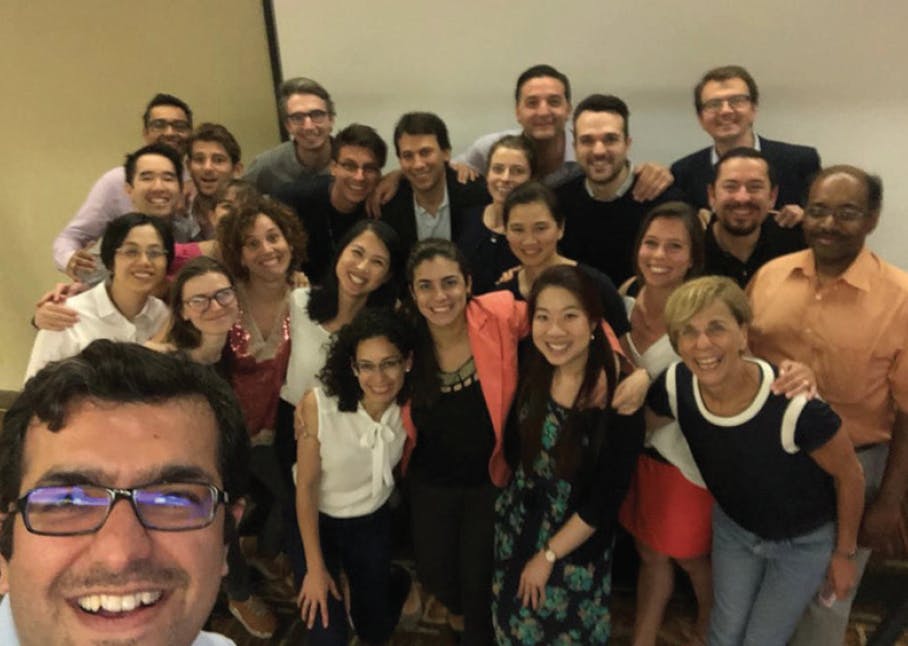
Dr. Iglicki and the other members of the International Retina Group enjoying a nice time with mentors Anat Loewenstein, MD, MHA, and Jay Ambati, MD.
The IRG operates without private funding. Our focus is on improving patients’ lives, not our own careers. If we could offer advice to other researchers hoping to do something similar, let it be this: Don’t do research for research’s sake, do it for a purpose. Believe that what you are doing matters, and have a mentor. I am more than grateful to have Anat Loewenstein, MD, MHA, as our mentor and Dinah Zur, MD, as a coauthor. Without them our achievements would not have been possible.
In 2019, you received the ICO-Allergan Advanced Research Fellowship Award for your work in early diagnosis of diabetic retinopathy lesions using telemedicine. What interested you in this topic?
Diabetic retinopathy is the most frequent cause of blindness in young adults in industrialized countries and one of the most serious complications of diabetes. The diabetic pandemic now affects 7% of the adult population, a prevalence that promises to double in the coming decades.
Because of the importance of timely diagnosis and follow-up in the prevention of blindness due to diabetic eye disease, it would be useful to develop tools that allow retinal examinations in individuals with diabetes in situations where examination by a qualified professional is not possible. There are few, if any, telemedicine programs in developing countries. Our project will be the first of its type, opening a huge potential market that has not yet been explored.
The objective of our project, led by myself and Dr. Zur with the academic and wisdom support from Dr. Loewenstein, is to offer our network telemedicine service to health insurance companies and governments in developing countries. Our pitch is that prevention of complications of diabetic retinopathy through early diagnosis using screening examinations can save costs and reduce the need for advanced treatments and surgeries.
What advice would you give to young ophthalmologists interested in research in retina?
Focus on your research initiatives. Choose a mentor who can guide and support you. Get feedback on educational programs in your field. Put your skills into action by participating in workshops on presentations, speaker training, and media training. Find colleagues who are as enthusiastic as you are, whom you trust, and with whom you can share your ideas, concerns, and unanswered questions. Most important, do what you love and love what you do.
What is an interesting fact that most people might not know about you?
I love playing the violin and listening to classical music. I went to the Superior Conservatory of Music “Manuel de Falla,” where I learned not only how to read music but also how to play the violin. That’s where I completed my degree as a master of music with specialty in violin.


_1784132761.jpg?auto=compress,format&w=75)





