



AT A GLANCE
- With advances in digital image processing and communications, the authors believe telemedicine can become a viable screening tool for patients at risk for developing diabetic retinopathy (DR).
- A deep-learning telemedicine platform designed by the authors achieved statistically significant sensitivities, specificities, and positive predictive values for both referrable and vision-threatening DR.
- A follow-up study is planned to further assess the system’s ability to automatically detect hard exudates and hemorrhages compared with traditional examination techniques.
Diabetic retinopathy (DR) is the most frequent cause of blindness in working-age adults in industrialized countries, and its incidence continues to increase.1 Diabetes affects at least 7% of the adult population, and researchers project that the prevalence will double in the coming decades.2,3
Prompt treatment of DR can prevent blindness in more than 90% of cases, but the right treatment depends on a timely diagnosis, and that continues to be a challenge worldwide.4
Researchers estimate that as many as half of all patients with diabetes remain undiagnosed.5 In many cases the diagnosis is made only with the onset of complications.
Regular ophthalmic examinations for patients with diabetes are crucial to detect the earliest signs of DR and begin prompt treatment. However, a multitude of barriers keeps many of these patients from receiving the care they need to reduce the risk of blindness, including a lack of qualified ophthalmologists.
Thus, researchers and clinicians alike have been exploring tools that can facilitate ophthalmic examinations in underserved regions. The utility of telemedicine to screen for referrable and vision-threatening DR remains under investigation, mainly in developed countries. We wished to explore the feasibility of using a telemedicine screening platform to detect DR in patients in developing nations.
With advances in digital image processing and communications, we believe telemedicine can become a viable screening tool for patients at risk for developing DR, no matter their location.
EARLY SUCCESS
We recently participated in a study led by Fangyao Tang, PhD; Rajiv Raman, MS, FRCS; Carol Cheung, PhD; and Sobha Sivaprasad, MBBS, MS, DM, FRCOphth, FRCS. The team created a telemedicine platform that uses deep learning (DL) to detect referable and vision-threatening DR based on ultra-widefield scanning laser ophthalmoscope (UWF-SLO) images.6 In this study we collected 9,392 UWF-SLO images of 1,903 eyes of diabetic patients to assess the DL system’s ability to grade images and detect referable and vision-threatening DR (Figure). Retina specialists determined the presence or absence of referrable or vision-threatening DR based on the International Clinical Diabetic Retinopathy Disease Severity Scale. The system was then trained to grade and detect signs of DR and then tested via external validation on four different datasets.
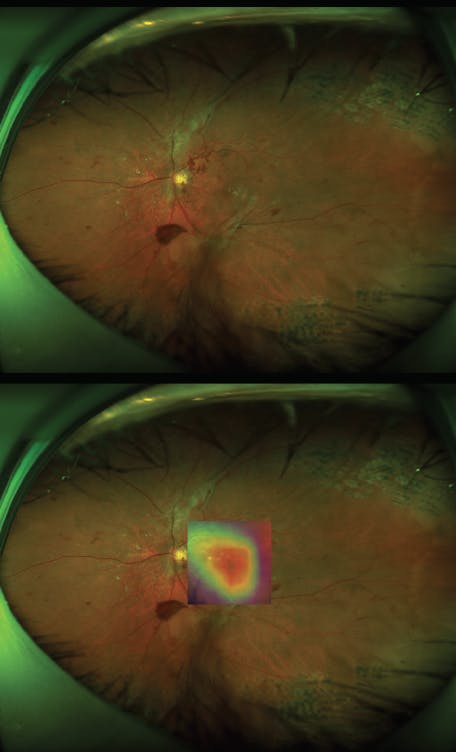
Figure. Using ultra-widefield scanning laser ophthalmoscope images, deep-learning tools can detect diabetic retinopathy. In the bottom image, orange-red indicates a relatively high discriminative power, whereas green-blue indicates a relatively low discriminative power.
For gradeability, the system demonstrated a sensitivity of 86.5% and specificity of 82.1% for the primary validation dataset and > 79.6% sensitivity and > 70.4% specificity for the external validation datasets. As for DR detection in the primary validation dataset, the DL system achieved sensitivities of 94.9% and 87.2%, specificities of 95.1% and 95.8%, and positive predictive values of 98.0% and 91.1% for referrable and vision-threatening DR, respectively.6
We concluded that our DL system could be an efficient and effective tool to screen UWF-SLO images for signs of referrable and vision-threatening DR.
NEXT STEPS
Such positive findings led us to plan further studies within a private retina practice in Buenos Aires, Argentina, affiliated with the University of Buenos Aires, and Tel Aviv Sourasky Medical Center. These affiliates will serve as reading centers for images captured by general practitioners caring for patients in areas with no access to specialized ophthalmic care.
During a single visit, asymptomatic patients will undergo a multidisciplinary examination to confirm the diagnosis and clinical staging of diabetes. General practitioners will obtain widefield retinal images during visits and send these images to the reading centers to form the dataset. We plan to enroll approximately 200 patients with diabetes either with (study group) or without (control group) signs of retinal complications. For the study group, any patient with the presence of significant media opacities, with any signs of another eye disease (eg, glaucoma, cataracts), or with previous treatment for DR will be excluded. Those in the control group cannot have any signs of DR, as well as significant media opacities or another eye disease (eg, glaucoma, cataracts).
Using this dataset, we will assess our DL system’s ability to automatically detect hard exudates and hemorrhages—the initial signs of DR—compared with traditional examination techniques.
We will analyze the images manually, then implement a DL algorithm to locate basic elements of the retina and the optic disc for the identification of false positives and for the classification of pathologies according to their severity and the measurement of lesions—often a time-consuming task for clinicians.7-15 The system will further detect microaneurysms, hard exudates, and hemorrhages.8,10,11,16-23
To avoid discarding low-resolution images, we plan to develop techniques to improve contrast and reduce noise; this will help specialists better interpret the images and allow them to be included in the automated analysis. Contrast enhancement techniques and restoration algorithms have been used to improve poor quality images, usually due to cataracts.24,25 We hope to implement this study at multiple sites around the world, similar to the study previously mentioned.6
FUTURE ASPIRATIONS
If this DL system proves to be as useful in this real-world setting as it was in our initial study, we hope to eventually use it to provide fully automated detection of DR for those most in need.
1. Guariguata L, Whiting DR, Hambleton I, et al. Global estimates of diabetes prevalence for 2013 and projections for 2035. Diabetes Res Clin Pract. 2014;103(2):137-149.
2. Kempen JH, O’Colmain BJ, Leske MC, et al. The prevalence of diabetic retinopathy among adults in the United States. Arch Ophthalmol. 2004;122(4):552-563.
3. Yau JWY, Rogers SL, Kawasaki R, et al. Global prevalence and major risk factors of diabetic retinopathy. Diabetes Care. 2012;35(3):556-564.
4. Fong DS, Aiello L, Gardner TW, et al. Diabetic retinopathy. Diabetes Care. 2003;26(1):226-229.
5. Brook RA, Kleinman NL, Patel S, et al. United States comparative costs and absenteeism of diabetic ophthalmic conditions. Postgrad Med. 2015;127:455-462.
6. Tang F, Luenam P, Ran AR, et al. Detection of diabetic retinopathy from ultra-widefield scanning laser ophthalmoscope images: a multicenter deep learning analysis. Preprint. Posted online February 1, 2021. Ophthalmol Retina.
7. Osareh A, Mirmehdi M, Thomas B, Markham R. Automatic recognition of exudative maculopathy using fuzzy c-means clustering and neural networks. Medical lmage Understanding Analysis. 2001:49-52.
8. Goh KG, Hsu W, Lee ML, Wang H. ADRIS: an automatic diabetic retinal image screening system. Studies in Fuzziness and Soft Computing. Springer-Verlag. 2001;60:181-210.
9. Sinthanayothin C, Boyce JF, Cook HL, Williamson TH. Automated localization of the optic disc, fovea and retinal blood vessels from digital color fundus images. Br J Ophthalmol. 1999;83(8):231-238.
10. Walter T, Klein J-C, Massin P, Erginay A. A contribution of image processing to the diagnosis of diabetic retinopathy - Detection of exudates in color fundus images of the human retina. IEEE Trans Med Imaging. 2002;21(10):1236-1243.
11. Li H, Chutatape O. A model-based approach for automated feature extraction in fundus images. Proceedings of the Ninth IEEE International Conference on Computer Vision. 2003;1:394-399.
12. Pinz A, Prantl M, Datlinger P. Mapping the human retina. IEEE Trans Med Imaging. 1998;17(4):606-619.
13. Wei JC, Valentino DJ, Bell DS, Baker. A web-based telemedicine system for diabetic retinopathy screening using digital fundus photography. Telemed J E Health. 2006;12(1):50-57.
14. Boucher MC, Nguyen QT, Angioi K. Mass community screening for diabetic retinopathy using a nonmydriatic camera with telemedicine. Can J Ophthalmol. 2005;40(6):734-742.
15. Cavallerano J, Aiello LM. Emerging trends in ocular telemedicine: the diabetic retinopathy model. J Telemed Telecare. 2005;11(4):163-166.
16. Frame AJ, Undill PE, Cree MJ, et al. A comparison of computer based classification methods applied to the detection of microaneurysms in ophthalmic fluorescein angiograms. Comput Biol Med. 1998;28(3):225-238.
17. Philips R, Forrester J, Sharp P. Automated detection and quantification of retinal exudates. Graefes Arch Clin Exp Ophthalmol. 1993;231(2):90-94.
18. Zahlmann G, Kochner B, Ugi I, et al. Hybrid fuzzy image processing for situation assessment: A knowledge-based system for early detection of diabetic retinopathy. IEEE Eng Med Biol. 2000;19(1):76-83.
19. Li H, Chutatape O. Fundus image features extraction. Proceeding of the 22nd Annual International Conference of the IEEE Engineering Medicine Biology Society. 2000;4:3071-3073.
20. Wang H, Hsu W, Goh KG, Lee M. An effective approach to detect lesions in c30. olor retinal images. IEEE Conference on Computer Vision and Pattern Recognition. 2000;2:181-186.
21. Gardner G, Keating D, Williamson TH, Elliott AT. Automatic detection of diabetic retinopathy using an artificial neural network: a screening tool. Br J Ophthalmol. 1996;80(11):940-944.
22. Lee SC, Wang Y, Lee E. Computer algorithm for automated detection and quantification of microaneurysms and hemorrhages in color retinal images. SPIE Conference on Image Perception and Performance. 1999;3663:61-71.
23. Berry M, Westerman D. Cluster form analysis techniques for diabetic retinopathy. Proceedings Math Models Med Health Sci. 2000:35-50.
24. Cree MJ, Olson JA, McHardy KC, et al. The preprocessing of retinal images for the detection of fluorescein leakage. Phys Med Biol. 1999;44(1):29-308.
25. Peli E, Peli T. Restoration of retinal images obtained through cataracts. IEEE Trans Med Imaging. 1989;8:401-406.


_1784132761.jpg?auto=compress,format&w=75)




