


AT A GLANCE
- The authors describe their study aiming to measure foveal avascular zone (FAZ) metrics in healthy Latino volunteers using OCTA and to determine any correlations between FAZ metrics and age and sex among the population.
- The area and perimeter of the FAZ were both larger in the female study participants, indicating a dependent relationship between FAZ and sex.
- FAZ acircularity index demonstrated a direct positive correlation with age.
Variation in the morphology of the foveal avascular zone (FAZ), the space located at the center of the macula that lacks capillary plexuses,1,2 has been implicated in numerous pathologies such as diabetic retinopathy, albinism, sickle cell retinopathy, foveal hypoplasia, central serous chorioretinopathy, choroidal melanoma, and other systemic diseases, especially those involving microvasculature disorders.3-5
OCT angiography (OCTA) is a noninvasive modality that can be used to map the capillary network and the FAZ in high resolution without the need for dye injection.6-8 It can rapidly capture 3D images of the choroidal and retinal vasculature.9,10
Furthermore, the OCTA algorithm known as split spectrum amplitude decorrelation angiography (SSADA) can be used to detect erythrocyte movement.11 This novel technology allows study of the normal retinal vasculature in vivo with better depth resolution than was previously possible.9
The main objectives of the study we describe here were to measure FAZ metrics in healthy Latino volunteers using OCTA and to collate and analyze the data obtained to determine any correlation between FAZ metrics and age and sex among the studied population.
METHODS
This observational cross-sectional study included 365 eyes of 185 adult (> 20 years old) Latino volunteers who were recruited over a 3-month period at six Latin American eye centers.
When this study was performed, there were no reports in the literature regarding FAZ metrics in healthy Latino individuals; thus, the sample design was based on the mean superficial FAZ area reported by Coscas et al (0.28 mm2).2 Recently, single-center studies performed in Latin American countries have been published, although they do not encompass as many countries as the study described here.
The inclusion criteria for the present study were healthy adult volunteers older than 20 years who signed the informed consent form. The exclusion criteria were BCVA worse than 40 letters on the ETDRS chart and any refractive error greater than ±3.00 D; a history of ocular diseases such as diabetic retinopathy, glaucoma (average retinal nerve fiber layer thickness outside normal limits), AMD, myopic degeneration, cataract, idiopathic macular hole, uveitis, or central serous chorioretinopathy; intraocular surgery in the past 6 months or laser eye surgery in the past 3 months; presence of systemic diseases or conditions such as pregnancy, diabetes mellitus, smoking, hypertension, carotid and/or cardiovascular disease; and the use of sildenafil, treatment with chloroquine, etc., that could affect OCTA results. The presence of any ocular condition (such as severe dry eye) that could prevent the acquisition of reliable OCTA images was also an exclusion criterion. Furthermore, images with a signal-to-noise ratio (signal strength index [SSI]) worse than 6/10 were excluded.
After it was verified that a volunteer met the inclusion criteria, both pupils were dilated for the OCTA procedure.
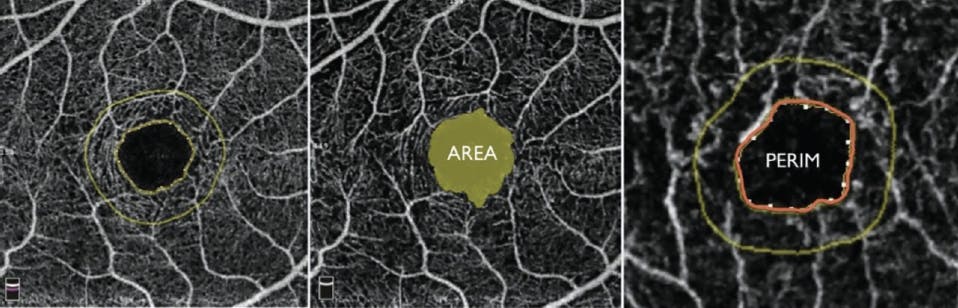
FAZ measurements were done on a full retina slab based on full retinal vasculature. The metric determinations obtained were area, perimeter, and acircularity index (AI; the ratio between the measured perimeter and the perimeter of a circular area of the same size) of the FAZ (Figure 1).
RESULTS
Among the 365 eyes evaluated, 230 (63%) were from female and 135 (37%) were from male volunteers. Mean age was 39 (range, 20–86) years. Demographic data are displayed in Table 1 and FAZ metric distribution is described in Table 2.
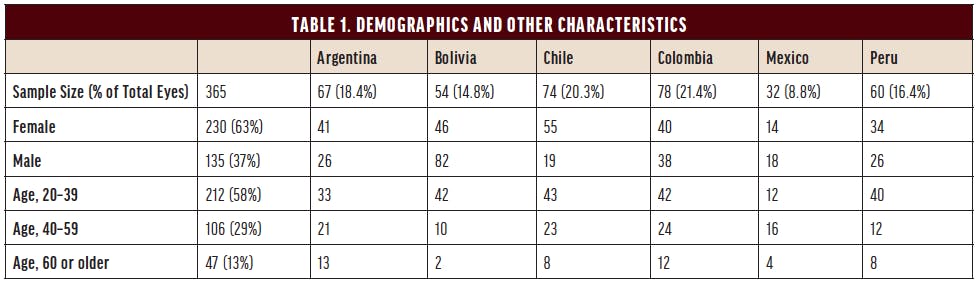
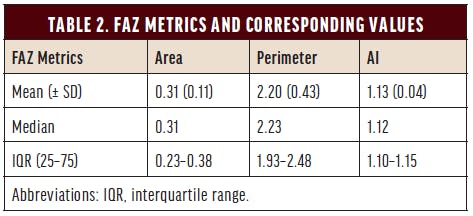
Mean FAZ area (± standard deviation [SD]) in the whole study population was 0.31 (0.11) mm2; mean FAZ perimeter was 2.20 (0.43) mm; and median FAZ AI was 1.12 (1.10–1.15).
Among female participants, the mean FAZ area was 0.34 (0.11) mm2; mean FAZ perimeter was 2.29 (0.41) mm, and median FAZ AI was 1.13 (0.38). Among males, FAZ area was 0.27 (0.11) mm2; mean FAZ perimeter was 2.06 (0.42) mm; and median FAZ AI was 1.13 (0.05).
The area and perimeter of the FAZ were both larger in the female participants, indicating a dependent relationship between FAZ and sex (P = .00). No correlation was found between FAZ area or perimeter and age (Figure 2).
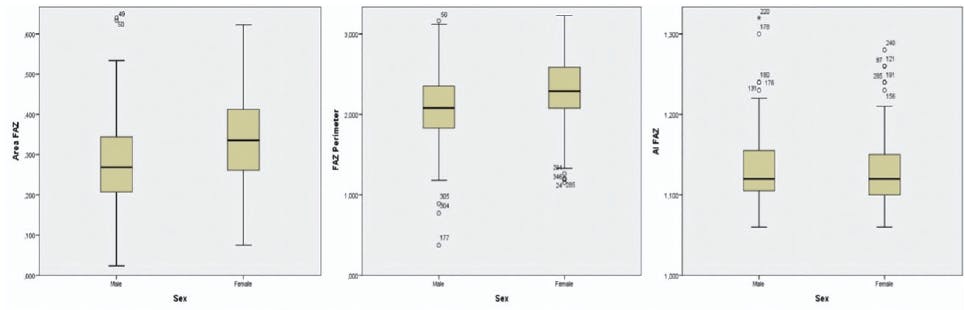
Figure 2. Area and perimeter of the FAZ were both larger in the female participants than in the males. No correlation was found between FAZ area or perimeter and age.
FAZ AI demonstrated a direct positive correlation with age (P = .00, r = .20); however, no correlation was found between FAZ AI and sex (Figure 3).
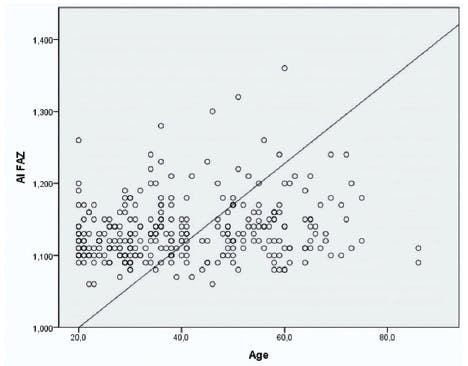
Figure 3. FAZ AI demonstrated a direct positive correlation with age; no correlation was found between FAZ AI and sex.
DISCUSSION
The main objective of our study was to describe the FAZ metrics of a healthy Latino population; however, other important findings were revealed after statistical analysis of the study data. Based on our results, we can conclude that both area and perimeter of the FAZ share a dependent relationship with sex. In our study population, the female group had larger mean FAZ area and perimeter values than the male group. In addition, there was a direct positive correlation between FAZ AI and age, but not between FAZ AI and sex. Interestingly, neither the area nor the perimeter of the FAZ had any statistically significant relationship with age.
We speculate that the variation in the FAZ AIs of the participants was due to loss of the terminal capillaries of the FAZ, which is expected to occur with aging. Furthermore, we theorize that the high natural variability of the FAZ area, due to statistical effects, may mask a possible relationship between area and age, as Morales et al found that FAZ area increases with age in normal individuals.12
Because bad quality images can alter FAZ metrics, images with an SSI value of less than 6 were excluded from our FAZ analysis. After adjusting the SSI, we found that both FAZ area and perimeter conserved their correlations with sex.
Previous studies have demonstrated that FAZ measurements obtained via OCTA were comparable to those obtained using other techniques such as adaptive optics scanning and fluorescein angiography.7,13 Coscas et al and Carpineto et al have already shown that measured FAZ metrics of healthy subjects have excellent reproducibility and repeatability; therefore, we did not deem it necessary to evaluate interobserver variability.2,14
Although our results are in line with those of some similar studies, they differ from those of others. Some studies have reported that the superficial FAZ and deep FAZ are larger in females.15-17 Other authors, however, reached the conclusion that there is no correlation between superficial FAZ or deep FAZ and sex.12,18
In contrast to the results of our analysis, in which no correlation was seen between area and perimeter of the FAZ and age, Rommel et al reported that the size of the FAZ enlarges with increasing age.16 Their findings cannot be fairly compared with those of our study because our data were taken using a full retina slab; hence, we could not differentiate between the superficial and deep plexuses.
Our study addresses a query posed in previous articles that hypothesized that the size of the FAZ may not be related to age.13 Those authors could not confirm their results because of their small sample sizes. Our results definitively showed that age was not correlated with the area or perimeter of the FAZ.
In all previously published articles, the deep and superficial plexuses were measured and reported separately because these measurements were done with experimental or manual software. However, the retina is a 3D structure with four plexuses that converge in the fovea to form the perifoveal capillary network; therefore, we concluded that FAZ measurements should be obtained by considering the structures as a single unit. Accordingly, we measured the FAZ in the present study using a single and complete slab of retina.
Another reason for using our method is that practicing physicians will use automated commercial software that is accessible and practical.
CONCLUSION
Given the fact that variability in FAZ measurements has been reported in many ocular pathologies, it is reasonable to conclude that our research will contribute to the establishment of a normative database that includes a healthy Latino population, which physicians can consult while assessing various pathologies.
The limitations identified in our study are recall bias and the fact that our sample size does not represent the total population of the cities or countries our volunteers came from. Equally important, there are multiple OCTA instruments on the market, including swept-source and spectral-domain devices. Our study was performed using spectral-domain OCT with a scanning rate of 70,000 scans per second, whereas swept-source devices may be capable of 100,000 scans per second. Because spectral-domain OCT can be limited in resolution when compared to swept-source OCT, it can yield different results.
1. Mastropasqua R, Toto L, Mastropasqua A, et al. Foveal avascular zone area and parafoveal vessel density measurements in different stages of diabetic retinopathy by optical coherence tomography angiography. Int J Ophthalmol. 2017;10(10):1545-1551.
2. Coscas F, Sellam A, Glacet-Bernard A, et al. Normative data for vascular density in superficial and deep capillary plexuses of healthy adults assessed by optical coherence tomography angiography. Invest Ophthalmol Vis Sci. 2016;57(9):OCT211-223.
3. Linderman RE, Muthiah MN, Omoba SB, et al. Variability of foveal avascular zone metrics derived from optical coherence tomography angiography images [published correction appears in Transl Vis Sci Technol. 2018;7(6):3]. Transl Vis Sci Technol. 2018;7(5):20.
4. Coffey AM, Hutton EK, Combe L, Bhindi P, Gertig D, Constable PA. Optical coherence tomography angiography in primary eye care. Clin Exp Optom. 2021;104(1):3-13.
5. Yao X, Alam MN, Le D, Toslak D. Quantitative optical coherence tomography angiography: a review. Exp Biol Med (Maywood). 2020;245(4):301-312.
6. Gao SS, Jia Y, Zhang M, et al. Optical coherence tomography angiography. Invest Ophthalmol Vis Sci. 2016;57(9):OCT27-36.
7. Mo S, Krawitz B, Efstathiadis E, et al. Imaging foveal microvasculature: optical coherence tomography angiography versus adaptive optics scanning light ophthalmoscope fluorescein angiography. Invest Ophthalmol Vis Sci. 2016;57(9):OCT130-140.
8. La Mantia A, Kurt RA, Mejor S, et al. Comparing fundus fluorescein angiography and swept-source optical coherence tomography angiography in the evaluation of diabetic macular perfusion. Retina. 2019;39(5):926-937.
9. Campbell J, Zhang M, Hwang T, et al. Detailed vascular anatomy of the human retina by projection-resolved optical coherence tomography angiography. Sci Rep. 2017;7:42201.
10. Kim DY, Fingler J, Zawadzki RJ, et al. Optical imaging of the chorioretinal vasculature in the living human eye. Proc Natl Acad Sci U S A. 2013;110(35):14354-14359.
11. Jia Y, Tan O, Tokayer J, et al. Split-spectrum amplitude-decorrelation angiography with optical coherence tomography. Opt Express. 2012;20(4):4710-4725.
12. Morales D, Wu A, Wu L. The foveal avascular zone area in healthy eyes measured by ocular coherence tomography angiography using a full spectrum probabilistic algorithm. Int Ophthalmol. 2021;41(6):2187-2196.
13. Shahlaee A, Pefkianaki M, Hsu J, Ho AC. Measurement of foveal avascular zone dimensions and its reliability in healthy eyes using optical coherence tomography angiography. Am J Ophthalmol. 2016;161:50-55.e1.
14. Carpineto P, Mastropasqua R, Marchini G, Toto L, Di Nicola M, Di Antonio L. Reproducibility and repeatability of foveal avascular zone measurements in healthy subjects by optical coherence tomography angiography. Br J Ophthalmol. 2016;100(5):671-676.
15. Ghassemi F, Mirshahi R, Bazvand F, Fadakar K, Faghihi H, Sabour S. The quantitative measurements of foveal avascular zone using optical coherence tomography angiography in normal volunteers. J Curr Ophthalmol. 2017;29(4):293-299.
16. Rommel F, Siegfried F, Kurz M, et al. Impact of correct anatomical slab segmentation on foveal avascular zone measurements by optical coherence tomography angiography in healthy adults. J Curr Ophthalmol. 2018;30(2):156-160.
17. Gómez-Ulla F, Cutrin P, Santos P, et al. Age and gender influence on foveal avascular zone in healthy eyes. Exp Eye Res. 2019;189:107856.
18. Samara WA, Say EA, Khoo CT, et al. Correlation of foveal avascular zone size with foveal morphology in normal eyes using optical coherence tomography angiography. Retina. 2015;35(11):2188-2195.


_1784132761.jpg?auto=compress,format&w=75)





