


AT A GLANCE
- In Protocol W, preventive treatment with anti-VEGF injections resulted in a threefold reduction in the development of center-involved diabetic macular edema with vision loss.
- At 2 years, there was no significant difference in mean change in visual acuity between the aflibercept (Eylea, Regeneron) group and the sham group.
- The longer-term outcomes remain unknown for patients receiving preventive aflibercept once they are switched to a prn regimen.
Multicenter studies have demonstrated that therapy with intravitreal anti-VEGF injections is effective in the management of both diabetic macular edema (DME) and proliferative diabetic retinopathy (PDR).1,2 Until recently, it was unknown whether anti-VEGF therapy could be used to prevent these conditions and, if so, whether this strategy would result in long-term visual benefits.
Results from the PANORAMA study, which enrolled eyes with moderate-to-severe and severe nonproliferative diabetic retinopathy (NPDR) with or without DME showed that eyes treated with aflibercept (Eylea, Regeneron) had significantly greater improvement of 2 or more steps in DR severity compared with the sham group.3 As a secondary outcome, the study demonstrated that the anti-VEGF treatment reduced the likelihood of developing vision-threatening complications such as center-involved DME (CI-DME) or PDR.
Protocol W is a prospective multicenter study by the DRCR Retina Network that included eyes with moderate-to-severe NPDR and without baseline CI-DME (Figure).4 The study was designed as a long-term evaluation of intravitreal aflibercept’s ability to prevent PDR and CI-DME in eyes with advanced DR.
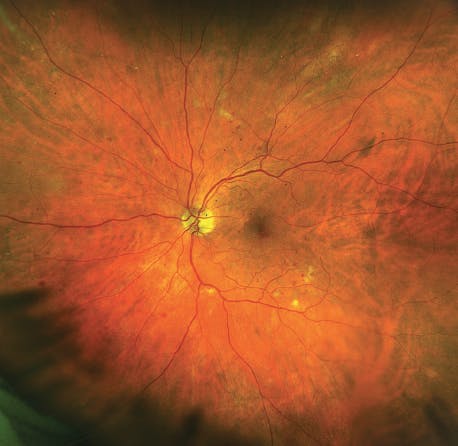
STUDY DETAILS
The primary outcome of the study was either the development of CI-DME (> 10% increase in central subfoveal thickness [CST] from baseline) with vision loss (defined as a 10 letter or more decrease in VA on a single visit or a 5- to 9-letter decrease on two consecutive visits) or the development of PDR. PDR was defined as having neovascularization (NV) within the seven standard Early Treatment Diabetic Retinopathy Study (ETDRS) fields detected on fundus photography or fluorescein angiography (FA), vitreous hemorrhage (VH), preretinal hemorrhage, or neovascular glaucoma. The study also aimed to evaluate whether preventing these complications in patients receiving prophylactic anti-VEGF treatment resulted in visual benefits at 2 and 4 years compared with patients who were followed and treated only if they developed high-risk PDR or CI-DME with vision loss.4
The study included patients with type 1 or type 2 diabetes. Study eyes had NPDR (ranging from moderate to severe), no CI-DME on OCT, and no signs of NV within the seven standard ETDRS fields as detected by FA.
Patients were randomly assigned to either sham or aflibercept intravitreal injections. Eyes received injections at baseline and at months 1, 2, 4, 8, 16, and 20 during the first 2 years of the study. After the 2-year mark, patients were followed and given sham or aflibercept injections every 16 weeks. However, those in the aflibercept group had their injections deferred when DR severity was recorded as mild NPDR or better.
Regardless of the initial randomization group, aflibercept treatment was initiated in eyes with CI-DME if CST increased by 10% or more from baseline, associated with either a 10-letter decrease on a single visit or a 5- to 9-letter decrease on two or more consecutive visits. Aflibercept was also initiated if eyes developed high-risk PDR. DRCR Retina Network treatment algorithms were used after initiation of therapy for either DME or PDR.
INTERPRETING THE RESULTS
The study included 399 eyes of 328 participants, and approximately 80% of participants in each group completed the 2-year visit. Although the study initially aimed to include only eyes with moderate-to-severe (level 47 B-D) and severe (level 53) NPDR, after 9 months of recruitment eyes with moderate NPDR (level 43 and level 47 A) were included. At baseline, 17% of eyes in the study had moderate NPDR (level 43), 60% had moderate-to-severe NPDR (level 47 A-D) and 24% had severe NPDR.
Did preventive treatment reduce vision-threatening complications?
In Protocol W, preventive treatment with aflibercept resulted in a threefold reduction in the development of CI-DME with vision loss (14.8% in the sham group vs 4.1% in the aflibercept group). Treatment was also associated with a nearly twofold reduction in the development of new-onset PDR (33.2% in the sham group vs 13.5% in the aflibercept group).
Significantly more eyes in the aflibercept group had a 2-step or more improvement in DR severity compared with eyes in the sham group (44.8% vs 13.7%). In contrast, more eyes in the sham group had a 2-step worsening in DR severity (12.4%) compared with eyes in the aflibercept group (5.2%) at 2 years.
How many injections did each group require?
Participants in the aflibercept group who completed the 2-year visit received a mean total of eight injections. This included patients who required aflibercept for prevention as part of the protocol and those who required additional treatment for the development of vision-threatening complications (approximately 4.4% of eyes). In eyes that received only preventive treatment, the mean number of injections through 2 years was 7.7. In the sham group, 19.2% of eyes required aflibercept for treatment of PDR or CI-DME and, on average, received 5.7 injections through the 2 years.
Was preventive treatment associated with better vision?
At 2 years, there was no significant difference in the mean change in visual acuity between the aflibercept group and the sham group, with a mean difference of approximately 0.5 letters between the groups. The vast majority of eyes in both groups had a VA of 20/20 or better (75% in the aflibercept group vs 71.7% in the sham group), with few eyes losing 10 or more letters at 2 years (6.9% vs 8.4%). This suggests that initiating treatment after the development of complications achieves similar visual outcomes at 2 years compared with preventive use of anti-VEGF injections.
CLINICAL IMPLICATIONS
The results of this study suggest that early aflibercept treatment in eyes with NPDR results in a reduction in the development of both PDR and CI-DME with decreased vision at 2 years. However, this preventive therapy did not translate to better visual acuity compared with sham injection. It is important to highlight that the sham group was followed closely in a clinical trial setting, and patients received timely intervention as soon as their eyes developed any vision-threatening complications.
Thus, these data suggest that when patients are monitored closely (at least every 4 months) and receive adequate timely therapy at the onset of vision-threatening complications, vision loss can generally be prevented or recovered. However, long-term follow-up is necessary to determine whether visual outcomes will remain similar at 4 years or whether preventing PDR and CI-DME will result in better visual outcomes in eyes treated early with aflibercept.
Notably, 16.3% of eyes in the treatment group still developed either PDR or CI-DME with decreased vision. This suggests that, although preventive therapy works for most patients, some will still develop vision-threatening complications, reinforcing the need for regular visits and evaluation.
UNANSWERED QUESTIONS
Given the similar visual outcomes in the two Protocol W groups, many retina specialists may be unwilling to initiate prophylactic anti-VEGF injections in patients with no vision-threatening complications. In addition, longer-term outcomes remain unknown for patients receiving preventive aflibercept once they are switched to a prn regimen.
Studies using OCT angiography have demonstrated that anti-VEGF therapy does not appear to reverse nonperfusion or ischemia.5 Patients enrolled in Protocol S required a mean of approximately three injections yearly even after 5 years of follow-up.2 Therefore, although anti-VEGF injections can improve the clinical examination results in eyes with DR, the underlying pathology is likely to still exist, raising further questions: Will patients still require injections at 4 years? What percentage of patients will require continued injections? Will there be a rebound effect if preventive injections are stopped?
Protocol W’s longer-term follow-up and 4-year results should help shed light on the answers to many of these questions. Stay tuned.
1. Wells JA, Glassman AR, Ayala AR, et al. Aflibercept, bevacizumab, or ranibizumab for diabetic macular edema: two-year results from a comparative effectiveness randomized clinical trial. Ophthalmology. 2016;123(6):1351-1359.
2. Gross JG, Glassman AR, Liu D, et al. Five-year outcomes of panretinal photocoagulation vs intravitreous ranibizumab for proliferative diabetic retinopathy: a randomized clinical trial. JAMA Ophthalmol. 2018;136(10):1138-1148.
3. Regeneron Pharmaceuticals. Eylea (aflibercept) injection reduced risk of developing vision-threatening events by 75% after two years in patients with diabetic retinopathy [press release]. February 8, 2020. Accessed July 14, 2021.
4. Maturi RK, Glassman AR, Josic K, et al. Effect of intravitreous anti-vascular endothelial growth factor vs sham treatment for prevention of vision-threatening complications of diabetic retinopathy: The Protocol W Randomized Clinical Trial. JAMA Ophthalmol. 2021;139(7):701-712.
5. Couturier A, Rey PA, Erginay A, et al. Widefield OCT-angiography and fluorescein angiography assessments of nonperfusion in diabetic retinopathy and edema treated with anti-vascular endothelial growth factor. Ophthalmology. 2019;126(12):1685-1694.


_1784132761.jpg?auto=compress,format&w=75)




