


AT A GLANCE
- Diabetic macular edema (DME) comes with a high treatment burden, pushing researchers to develop new treatments that provide meaningful visual benefits while minimizing the monitoring and treatment burden.
- Sustained-release formulations of corticosteroids for DME offer a number of potential benefits, including less frequent administration and, potentially, reduced fluctuations in retinal thickness.
- A novel sustained-release steroid formulation of dexamethasone incorporated into biodegradable microspheres can be injected suprachoroidally.
Diabetic macular edema (DME) is the leading cause of vision loss in the working-age population in the developed world.1-3 The average age at diagnosis is just over 50 years, and DME has a significant impact both individually and economically, with a high treatment burden.1,4,5 Consequently, there is a strong rationale for developing treatments for DME that provide meaningful visual benefits while minimizing the monitoring and treatment burden.
INITIAL THERAPY OPTIONS
Anti-VEGF agents are the first-line treatment for visual impairment associated with DME, and they can help patients achieve clinically meaningful BCVA gains of up to 13 letters.6-10 However, not every patient responds to therapy; as many as 40% of participants in pivotal trials do not reach a VA threshold of 20/40.8
A key challenge with current anti-VEGF agents is the treatment frequency required to achieve vision gains. Some phase 3 trials evaluating anti-VEGF agents in DME used continuous monthly dosing, and even the individualized dosing regimen used in the DRCR Retina Network’s Protocol T study required a median of nine to 10 injections in the first year.8,10
Frequent injections may be difficult to maintain, and undertreatment leads to suboptimal outcomes. In a large observational study, DME patients receiving four or fewer injections in the first year of treatment with ranibizumab (Lucentis, Genentech) gained only 0.5 letters, while those receiving five or more injections gained a mean 6.9 letters from baseline.11
Investigational therapies with anti-VEGF activity—eg, faricimab (Roche), a bispecific anti-VEGF and anti-angiopoietin 2 antibody, and KSI-301 (Kodiak Sciences), an anti-VEGF antibody-biopolymer conjugate—aim to address undertreatment by achieving increased durability of action. This results in less frequent treatment in the maintenance phase (up to every 16 weeks with faricimab and every 24 weeks with KSI-301). However, pivotal trials investigating these agents still include three or four initial monthly treatments, resulting in up to six injections in the first year of treatment, even with the longest intervals.12,13
In patients who do not receive adequate benefits from anti-VEGF therapy, alternative treatments such as one or more preparations of corticosteroids may be an option.6,7
CASE STUDY
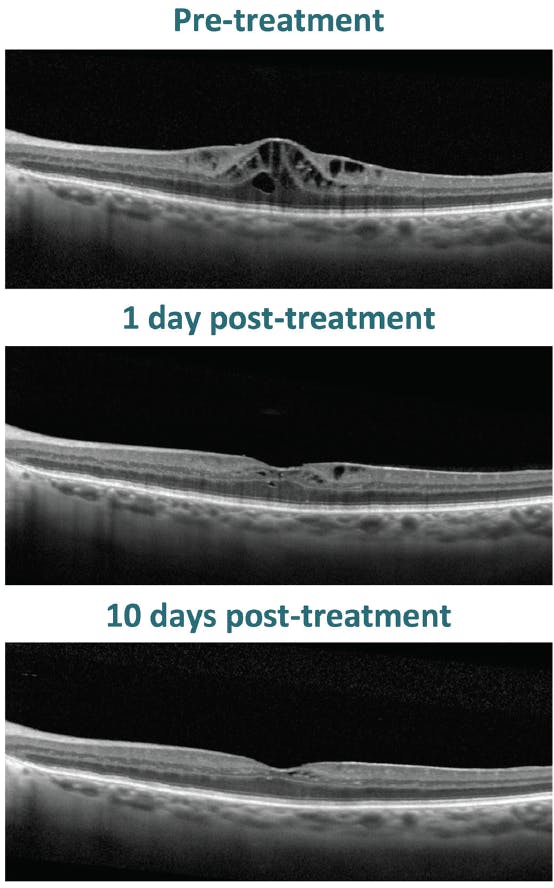
In this 78-year-old woman with chronic macular edema, a dexamethasone intravitreal implant was removed after its migration into the anterior chamber led to significant IOP increase and corneal edema.
Two subsequent monthly sub-Tenon injections of a triamcinolone 40 mg had little effect, and central macular thickness (CMT) remained at 551 µm.
A semiautomated ocular administration device was used to deliver triamcinolone 2.4 mg suspension to the suprachoroidal compartment.
The procedure was successful, with no hemorrhage or reflux, and CMT decreased to 344 µm after 10 days. At 20 days, CMT reductions were maintained, and the patient had gained around 4 lines of vision compared with baseline.

ADJUNCTIVE THERAPY
Corticosteroids have both antiinflammatory and antiedematous properties. They can help to address the pathogenesis of DME by limiting the permeability of the blood-retina barrier to reduce edema, downregulating VEGF expression, acting on inflammatory processes, and inhibiting prostaglandin and proinflammatory cytokine production.14
Sustained-release formulations of corticosteroids for DME offer a number of potential benefits. Less frequent administration reduces the patient’s treatment burden, and consistent, gradual steroid release should reduce fluctuations in retinal thickness and maintain visual benefits.
Two sustained-release steroids are currently approved in the United States and Europe for use in patients with DME: the dexamethasone intravitreal implant 0.7 mg (Ozurdex, Allergan) and the fluocinolone acetonide intravitreal implant 0.19 mg (Iluvien, Alimera Sciences).
In phase 3 trials of the dexamethasone intravitreal implant, patients in the 0.7 mg treatment arm required a mean of 4.1 treatments during the 3-year study, and 22% achieved ≥ 15 letters in BCVA gains compared with 12% of patients treated with sham.15 Patients receiving the implant also experienced a mean reduction in central retinal thickness of -111.6 μm from baseline compared with -41.9 μm in patients in the sham group.
However, rates of complications with the 0.7 mg implant were high: 68% of phakic patients had cataract-related adverse events versus 20% in the sham group, and more than 40% of treated patients required medication to control increases in IOP versus 9% in the sham group.15 In addition, recurrence of edema has been reported 16 to 20 weeks after treatment in some patients.16
In clinical trials of the nonbiodegradable intravitreal fluocinolone acetonide implant, patients with persistent DME treated with a high-dose (0.5 µg/day) or low-dose (0.2 µg/day) implant were more likely to achieve a ≥ 15-letter BCVA improvement compared with those receiving sham treatment (29% and 28% versus 19%, respectively).17 Approximately 70% to 75% of patients required only one treatment during the 3-year study.
However, among individuals who were phakic at baseline, 87% of high-dose patients required cataract surgery compared with 27% in the sham arm. Incisional glaucoma surgery was required in 4.8% of low-dose and 8.1% of high-dose patients.17
INNOVATIONS IN SUSTAINED RELEASE STEROIDS
The feasibility of using a suprachoroidal route of administration is currently being evaluated in trials of small molecules, biotherapeutics, and gene therapies for several ophthalmic indications (Figure).

Figure. Suprachoroidal drug delivery may target the retina, choroid, and retinal pigment epithelium with high bioavailability.
With suprachoroidal delivery, studies show that the choroid, retinal pigment epithelium, and retina are targeted with high bioavailability while low levels of therapeutic agent are maintained elsewhere in the eye (eg, the vitreous or anterior chamber).18,19
OXU-001 (Oxular Limited) is a novel sustained-release steroid formulation of dexamethasone incorporated into biodegradable microspheres. Injected suprachoroidally, the microspheres are designed to deliver a precise daily amount of dexamethasone to retinal and choroidal tissues for up to 12 months.20
A preclinical study of suprachoroidal administration of OXU-001 in rabbits found that therapeutic levels of the drug were maintained for approximately 1 year.20 Levels of steroid in the vitreous and lens throughout the study period were low, which the researchers suspect may translate into a favorable clinical safety profile.
In the clinic, OXU-001 is delivered using a semiautomated ocular administration device with a microcatheter to target the posterior suprachoroidal compartment. The catheter is injected at the pars plana and automatically deploys posteriorly upon reaching the suprachoroidal space. Illumination of the microcatheter provides transscleral visual confirmation of accurate location prior to drug delivery.
The developer is planning a phase 2 randomized clinical study of OXU-001 in patients with DME, to begin later this year. The study will compare suprachoroidally administered OXU-001 with the dexamethasone intravitreal implant.
CONCLUSION
Current anti-VEGF therapies for DME are effective but are associated with high treatment burdens for patients, caregivers, and retina specialists. Corticosteroids can provide benefit in DME due to their antiedematous and antiinflammatory effects, but current intravitreal steroids are limited by modest longevity and frequent adverse events. A novel suprachoroidal delivery option that permitted a yearly dosing regimen would be a welcome addition to our armamentarium for treatment of this growing patient population.
1. Zheng Y, He M, Congdon N. The worldwide epidemic of diabetic retinopathy. Indian J Ophthalmol. 2012;60(5):428-431.
2. Teo ZL, Tham YC, Yan Yu MC, et al. Global prevalence of diabetic retinopathy and projection of burden through 2045: systematic review and meta-analysis. Preprint. Posted online May 1, 2021. Ophthalmology.
3. Yau JW, Rogers SL, Kawasaki R, et al. Global prevalence and major risk factors of diabetic retinopathy. Diabetes Care. 2012;35(3):556-564.
4. Petrella RJ, Blouin J, Davies B, Barbeau M. Prevalence, demographics, and treatment characteristics of visual impairment due to diabetic macular edema in a representative Canadian cohort. J Ophthalmol. 2012;2012:159167.
5. Bhagat N, Grigorian RA, Tutela A, Zarbin MA. Diabetic macular edema: pathogenesis and treatment. Surv Ophthalmol. 2009;54(1):1-32.
6. Amoaku WM, Ghanchi F, Bailey C, et al. Diabetic retinopathy and diabetic macular oedema pathways and management: UK Consensus Working Group. Eye (Lond). 2020;34(Suppl 1):1-51.
7. Schmidt-Erfurth U, Garcia-Arumi J, Bandello F, et al. Guidelines for the management of diabetic macular edema by the European Society of Retina Specialists (EURETINA). Ophthalmologica. 2017;237(4):185-222.
8. Nguyen QD, Brown DM, Marcus DM, et al. Ranibizumab for diabetic macular edema: results from 2 phase III randomized trials: RISE and RIDE. Ophthalmology. 2012;119(4):789-801.
9. Korobelnik JF, Do DV, Schmidt-Erfurth U, et al. Intravitreal aflibercept for diabetic macular edema. Ophthalmology. 2014;121(11):2247-2254.
10. Wells JA, Glassman AR, Ayala AR, et al.; Diabetic Retinopathy Clinical Research Network. Aflibercept, bevacizumab, or ranibizumab for diabetic macular edema. N Engl J Med. 2015;372:1193-203.
11. Mitchell P, Sheidow TG, Farah ME, et al. Effectiveness and safety of ranibizumab 0.5 mg in treatment-naive patients with diabetic macular edema: Results from the real-world global LUMINOUS study. PLoS One. 2020;15(6):e0233595.
12. Roche. Angiogenesis Highlights 2021. February 16, 2021. Accessed June 28, 2021. www.roche.com/dam/jcr:1a6c3f66-3d4f-4d07-8eb6-28e81c7e1cc2/en/angiogenesis-2021.pdf
13. Kodiak Sciences. Kodiak Sciences announces 1-year durability, efficacy and safety data from ongoing phase 1b study of KSI-301 in patients with wet age-related macular degeneration, diabetic macular edema and retinal vein occlusion at the Angiogenesis, Exudation and Degeneration 2021 Annual Meeting [press release]. February 13, 2021. Accessed June 28, 2021. ir.kodiak.com/news-releases/news-release-details/kodiak-sciences-announces-1-year-durability-efficacy-and-safety
14. Whitcup SM, Cidlowski JA, Csaky KG, Ambati J. Pharmacology of corticosteroids for diabetic macular edema. Invest Ophthalmol Vis Sci. 2018;59(1):1-12.
15. Boyer DS, Yoon YH, Belfort R Jr, et al. Three-year, randomized, sham-controlled trial of dexamethasone intravitreal implant in patients with diabetic macular edema. Ophthalmology. 2014;121(10):1904-1914.
16. Mathew R, Pearce E, Muniraju R, Abdel-Hay A, Sivaprasad S. Monthly OCT monitoring of Ozurdex for macular oedema related to retinal vascular diseases: re-treatment strategy (OCTOME Report 1). Eye (Lond). 2014;28(3):318-326.
17. Campochiaro PA, Brown DM, Pearson A, et al. Sustained delivery fluocinolone acetonide vitreous inserts provide benefit for at least 3 years in patients with diabetic macular edema. Ophthalmology. 2012;119(10):2125-2132.
18. Chiang B, Jung JH, Prausnitz MR. The suprachoroidal space as a route of administration to the posterior segment of the eye. Adv Drug Deliv Rev. 2018;126:58-66.
19. Jung JH, Chae JJ, Prausnitz MR. Targeting drug delivery within the suprachoroidal space. Drug Discov Today. 2019;24(8):1654-1659.
20. Oxular Limited. Data on file, 2021.


_1784132761.jpg?auto=compress,format&w=75)





