


AT A GLANCE
- Vitrectomy should no longer be a last resort; instead, we should see it as a long-term solution for diabetic retinopathy.
- Early vitrectomy can prevent the formation of tractional and rhegmatogenous RDs, DME, and vitreous hemorrhage over time.
- Often, patients with type 1 diabetes do poorly with surgical intervention because of their attached hyaloid.
- Although panretinal photocoagulation is an important treatment consideration for diabetic patients with an attached hyaloid, it isn’t a long-term solution.
Diabetes is an epidemic, and type 2 diabetes is increasing at an alarming rate in young patients in the United States. Historically, type 2 diabetes presented in patients older than 40 years; now we see 355,000 new cases yearly in patients between 18 and 44 years.1 Even in children and adolescents, more than 6,000 cases of type 2 diabetes are diagnosed each year.2
This demographic shift creates a challenging management scenario for retina specialists because the eyes of these young patients with type 2 diabetes have an attached hyaloid, and the eyes behave similarly to those of patients with type 1 diabetes. Thus, we need to shift our treatment approach and consider early vitrectomy in these eyes.
DRVS PEARLS
The Diabetic Retinopathy Vitrectomy Study (DRVS) was done in the 1980s, but the important information that it provided remains clinically useful today.3 First, the study included 4 years of follow-up, which is crucial when following a lifelong disease such as diabetes. If patients are managing their diabetes for decades, 1 to 2 years of follow-up isn’t enough to truly understand the long-term implications of treatment for diabetic retinopathy (DR). Second, the DRVS showed that early vitrectomy can provide improved outcomes, particularly for patients with type 1 diabetes.
What’s most remarkable about these findings from the ’80s is that treatment at that time didn’t include intraoperative laser; in fact, the instruments were rudimentary compared with what we use today. In the DRVS, 20% of the patients with DR, irrespective of the intervention, ended with no light perception, an outcome that has fortunately decreased with advances in vitrectomy.
Today, vitrectomy is significantly safer, making it an excellent choice for young patients with DR. Vitrectomy should no longer be a last resort; instead, we should see it as a long-term solution for this chronic disease.
THE REAL ENEMY
Often, patients with type 1 diabetes do poorly with surgical intervention because of their attached hyaloid. Older patients with type 2 diabetes have often already experienced a posterior vitreous detachment (PVD) or get a PVD before they progress to proliferative DR (PDR). However, this clinical picture is changing as younger people and children are increasingly diagnosed with type 2 diabetes.
The attached hyaloid is the enemy because eyes behave quite differently depending on whether they have a PVD, no PVD, or partial PVD. Ono et al4 assessed DR progression at 3 years in more than 400 patients and found that 44% of patients with PDR progressed if they had no PVD. However, all patients who had a partial PVD with a thickened posterior hyaloid progressed during those 3 years. None of the patients with a complete PVD progressed. Not surprisingly, the data show that PVD can be protective and stabilize the diabetic eye in the long term.
In general, eyes that have had vitrectomy don’t develop tractional retinal detachments (RD), and many don’t develop diabetic macular edema (DME) either (Figure 1).
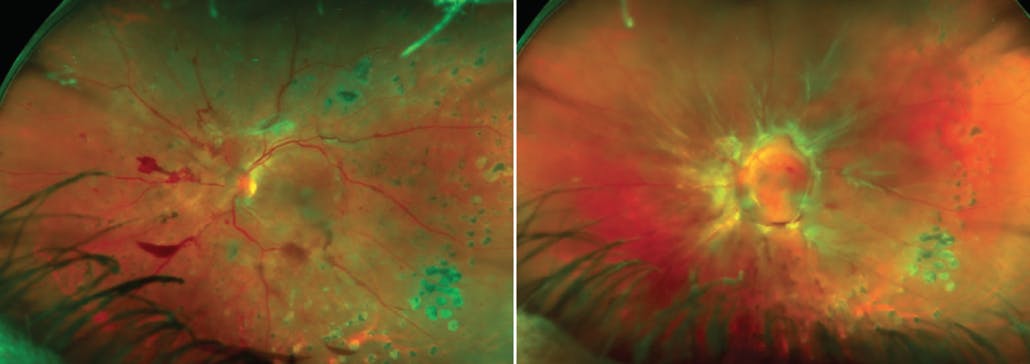
Figure 1. This 45-year-old man progressed in just 2 months from PDR to a combined tractional/rhegmatogenous RD. Had he undergone vitrectomy before the progression, the surgery would have taken maybe 30 minutes; the intervention for RD took significantly more time.
TREATMENT CONSIDERATIONS
Panretinal photocoagulation (PRP) is an important treatment consideration for diabetic patients with an attached hyaloid. However, it isn’t a long-term solution. Based on the DRCR Retina Network (DRCR.net) Protocol S data, at 5 years 51% of patients (mean age, 51) needed more than a single full application of PRP.5 From years 3 to 5, 11% required additional PRP. The mean number of ranibizumab (Lucentis, Genentech) injections needed in addition to the PRP was 5.4, and 46% developed vitreous hemorrhage. Even in this older population (compared with those 18 to 44 years of age), 12% developed tractional RD and 19% required vitrectomy. In the ranibizumab arm, 11% required a vitrectomy.5
PDR TREATMENT COST ANALYSIS
Contrary to what some believe, early vitrectomy is quite cost-effective for the treatment of PDR. It reduces the treatment burden, there is no progression to tractional RD, and it reduces the incidence of DME. A cost-analysis study at Bascom Palmer Eye Institute comparing vitrectomy with PRP found that the cost for each treatment was similar over a span of 2 years;1 however, the DRCR.net Protocol S data showed a significant treatment burden, with 50% of patients treated with PRP requiring supplemental treatment.2 That extra treatment burden is rarely included in cost analyses focused only on the primary treatment.
1. Lin J, Chang JS, Yannuzzi NA, Smiddy WE. Cost evaluation of early vitrectomy versus panretinal photocoagulation and intravitreal ranibizumab for proliferative diabetic retinopathy. Ophthalmology. 2018;125(9):1393-1400.
2. Gross JG, Glassman AR, Liu D, et al; Diabetic Retinopathy Clinical Research Network. Five-year outcomes of panretinal photocoagulation vs intravitreous ranibizumab for proliferative diabetic retinopathy: a randomized clinical trial. JAMA Ophthalmol. 2018;136(10):1138-1148.
Patients in Protocol S were followed perfectly, with monthly injections administered when needed, and 4% developed neovascular glaucoma.5 However, study data and real-world outcomes differ, and compliance comes to the forefront, particularly for patients with diabetes. In the real world, among patients with PDR, 25% to 54% miss appointments because of illness, noncompliance, financial considerations, or age.6 And PRP is not a panacea against noncompliance because more than 40% of eyes treated with PRP in Protocol S developed vitreous hemorrhage.
The DRCR.net Protocol AB has published 2-year follow-up of 205 eyes with DR and vitreous hemorrhage randomly assigned to receive either aflibercept (Eylea, Regeneron) or vitrectomy with PRP.7 Again, the mean age in this study was 57, and only 17% of patients in the aflibercept group and 18% in the vitrectomy group had type 1 diabetes. The researchers noted worse visual acuity results at 1 month with aflibercept, which was expected because the blood doesn’t clear that quickly.
The study reported similar visual acuity results at 2 years, although it was powered to detect only an 8-letter difference and underpowered to detect a benefit of vitrectomy. Also in this study, 42% of the patients in the aflibercept arm and 55% in the vitrectomy arm had had previous PRP. In addition, 22% of the eyes treated with aflibercept developed tractional RD versus 13% in the vitrectomy group. At 2 years, 49% of eyes treated with aflibercept developed recurrent vitreous hemorrhage and 29% had persistent neovascularization compared with 3% in the vitrectomy group.7
The Protocol AB researchers concluded that vitrectomy with PRP remains the standard of care for these patients—a crucial finding that should shape our care of patients with DR and vitreous hemorrhage.
Surgeons should also note that a meta-analysis of the VIVID, VISTA, RISE, and RIDE studies found that patients with diabetes have a threefold increased risk of death with monthly injections of ranibizumab or aflibercept compared with sham over 2 years.8 Thus, anti-VEGF agents should be used with extreme caution as a singular treatment for PDR in patients without a complete PVD, because eyes lost to follow-up do much worse when they are treated with anti-VEGF agents than with PRP. Obeid et al found that 33% of eyes treated with an anti-VEGF agent developed tractional RD versus 2% of PRP-treated eyes.9
CASES DRIVE HOME THE POINT
I recently analyzed results in 60 patients with diabetes followed for 8 years to track the visual outcomes in the worse eye, treated with vitrectomy, and the better-seeing eye, usually treated with PRP as needed.10 In patients who were younger than 50 years, mean postoperative VA was 20/80 in eyes treated with vitrectomy. Eyes treated with PRP initially and then as needed had a mean postoperative VA of 20/400 at 8 years. In the vitrectomized eyes, only 8% had VA of hand motion or light perception compared with 36% in the better-seeing eyes of patients treated conventionally, in part because many were lost to follow-up or presented with complications. At 8 years, 20% of those better-seeing eyes ended with a VA of no light perception.
In addition, 16% of the vitrectomized eyes needed extra laser, 12% needed a reoperation, and 40% had cataract progression over the course of 8 years. Of the eyes treated with PRP, 72% needed extra laser, 60% required vitrectomy, and 72% developed RDs, 16% of which were inoperable.
In another series of 1,267 eyes treated with vitrectomy for vitreous hemorrhage, DME, tractional RDs, or neurovascular glaucoma, 72% had improved visual acuity and 28% stayed the same or decreased; 73% had VA better than 20/200.11 In this series, 25% to 40% of the fellow eyes needed vitrectomy over time.

Diabetic Retinopathy: Treat Them Early
KEY TAKEAWAYS
With 27-gauge tools and high-tech visualization systems such as intraoperative 3D heads-up displays, we should start thinking of vitrectomy more as a preventive measure than as a last resort. Early vitrectomy can prevent the formation of tractional and rhegmatogenous RDs, DME, and vitreous hemorrhage over time (Figure 2). The eyes remain stable, reducing complications and lessening the treatment burden.

Figure 2. This 37-year-old with type 1 diabetes presented with vitreous hemorrhage and was scheduled for vitrectomy. However, due to the COVID-19 pandemic he missed his appointment and presented 8 weeks later with rapid progression of fibrovascular proliferation and tractional RD. This case underscores how quickly severe PDR can progress to tractional RD in eyes with an attached vitreous.
With today’s advances, early vitrectomy may be a panacea for DR in eyes with an attached hyaloid. Although PRP and treatment with anti-VEGF agents can be effective in many eyes, young diabetic eyes will continue to progress when treated with these modalities. As we strive to choose the right treatment, the patient’s age and the status of the hyaloid are crucial factors in our decision-making process.
1. Centers for Disease Control and Prevention. National Diabetes Statistics Report: Estimates of diabetes and its burden in the United States. 2017. Accessed June 3, 2021. www.cdc.gov/diabetes/pdfs/data/statistics/national-diabetes-statistics-report.pdf
2. Centers for Disease Control and Prevention. A snapshot: diabetes in the United States. Accessed June 3, 2021. www.cdc.gov/diabetes/library/socialmedia/infographics/diabetes.html
3. The Diabetic Retinopathy Vitrectomy Study Research Group. Early vitrectomy for severe proliferative diabetic retinopathy in eyes with useful vision. Clinical application of results of a randomized trial--Diabetic Retinopathy Vitrectomy Study Report 4. Ophthalmology. 1988;95(10):1321-1334.
4. Ono R, Kakehashi A, Yamagami H, et al. Prospective assessment of proliferative diabetic retinopathy with observations of posterior vitreous detachment. Int Ophthalmol. 2005;26:15-19.
5. Gross JG, Glassman AR, Liu D, et al; Diabetic Retinopathy Clinical Research Network. Five-year outcomes of panretinal photocoagulation vs intravitreous ranibizumab for proliferative diabetic retinopathy: a randomized clinical trial. JAMA Ophthalmol. 2018;136(10):1138-1148.
6. Obeid A, Gao X, Ali FS, et al. Loss to follow-up in patients with proliferative diabetic retinopathy after panretinal photocoagulation or intravitreal anti-VEGF injections. Ophthalmology. 2018;125(9):1386-1392.
7. Glassman AR, Beaulieu WT, Maguire MG, et al; DRCR Retina Network. Visual acuity, vitreous hemorrhage, and other ocular outcomes after vitrectomy vs aflibercept for vitreous hemorrhage due to diabetic retinopathy: a secondary analysis of a randomized clinical trial. JAMA Ophthalmol. 2021;139(7):725-733.
8. Avery RL, Gordon GM. Systemic safety of prolonged monthly anti-vascular endothelial growth factor therapy for diabetic macular edema: a systematic review and meta-analysis. JAMA Ophthalmol. 2016;134(1):21-29.
9. Obeid A, Su D, Patel SN, et al. Outcomes of eyes lost to follow-up with proliferative diabetic retinopathy that received panretinal photocoagulation versus intravitreal anti-vascular endothelial growth factor. Ophthalmology. 2019;126(3):407-413.
10. Berrocal MH. Early vitrectomy surgical intervention. Presented at: The Aspen Retinal Detachment Society Meeting; March 6-10, 2021; Snowmass, Colorado.
11. Vote BJ, Gamble GD, Polkinghorne PJ. Auckland proliferative diabetic vitrectomy fellow eye study. Clin Exp Ophthalmol. 2004;32(4):397-403.


_1784132761.jpg?auto=compress,format&w=75)





