


AT A GLANCE
- Use of ultra-widefield (UWF) imaging in patients with diabetic retinopathy (DR) allows clinicians to detect intraretinal microvascular abnormalities and capillary nonperfusion, aiding early DR diagnosis.
- UWF imaging allows clinicians to image up to 200° of retinal anatomy in one capture.
- Recent studies have demonstrated a twofold increase in the rate of DR diagnosis with UWF and found that peripheral lesions were associated with a fourfold increase in risk of disease progression in patients with nonproliferative DR.
Imaging plays a critical role in the diagnosis and management of diabetic retinopathy (DR), and seven-standard-field (7SF) imaging, which captures 90° of the retina with a montage of seven 30° images, has long been the standard.1 Advances in imaging have led to ultra-widefield (UWF) imaging technology, which can capture a high-resolution view of the posterior pole and peripheral retina in a single image. Depending on the platform used, up to 200° of the retina can be captured in a single image (Table).
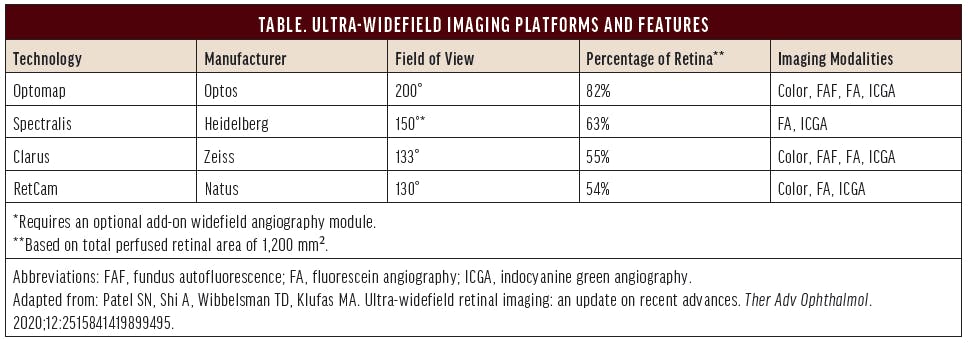
UWF offers several advantages over 7SF: It allows clinicians to assess the retinal periphery for evidence of disease, and, in addition to color fundus photography, UWF platforms feature some combination of multimodal imaging, such as fluorescein angiography (FA), indocyanine green angiography, and fundus autofluorescence.
Because UWF technology collects data with a single capture and does not require dilation, patient discomfort is decreased and clinical efficiency is increased. In contrast, successful montage imaging of the 7SF (or a larger montage that results in a widefield image) requires patients to be compliant with multiple image captures and a skilled technician to edit the images into a single frame.
HOW UWF IMAGING AFFECTS DR DIAGNOSIS
Evidence of retinal capillary nonperfusion is a hallmark of DR. In some patients, atrophic retinal tissue falls within the area captured by the 7SF. In other patients, evidence of DR, including the presence of intraretinal microvascular abnormalities (IRMAs), is apparent only upon examination of the periphery (Figure 1). In these patients, UWF FA imaging can assist in early diagnosis of DR before the disease advances into the area captured by 7SF imaging.
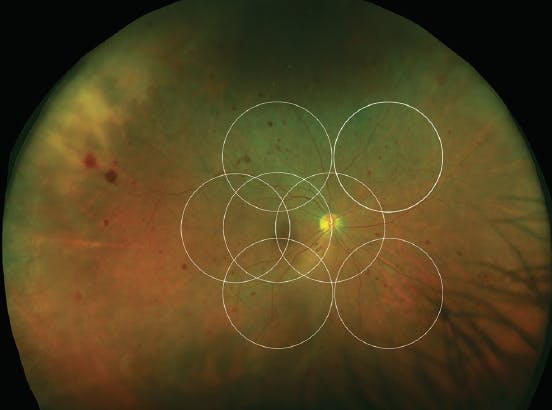
Figure 1. This UWF color fundus photograph of a patient with NPDR shows evidence of disease beyond the area seen in 7SF imaging. The white circles illustrate the area seen with 7SF imaging.
Because it is difficult to predict which patients have peripheral ischemia, screening with UWF or UWF FA imaging is standard for most patients who present to my clinic with symptoms of DR or with long-standing diabetes, even if they have no visual complaints.
If I note IRMAs on UWF color imaging, I then consider performing UWF FA imaging (Figure 2), which helps me determine the severity of disease at diagnosis. The UWF FA is helpful in several ways: It establishes a baseline anatomy, it is useful as a teaching tool during patient education, and it helps me determine whether anti-VEGF therapy, laser photocoagulation, or observation may be the best course of treatment.
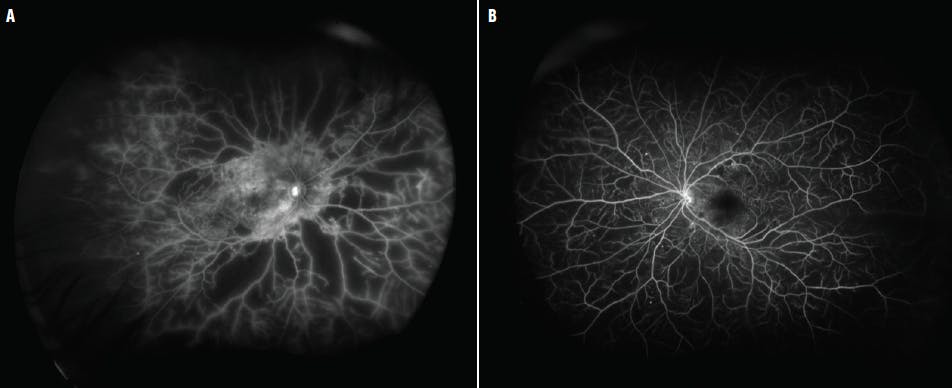
Figure 2. These UWF FA images of a patient with DR show evidence of peripheral activity in the right (A) and left eyes (B).
Given the invasive nature of angiography, I perform this test only when necessary and rarely more than once per patient. In some cases, however, capturing a second UWF FA image during the course of treatment is useful. For example, if a patient undergoing treatment for DR demonstrates evidence of continued leakage, UWF FA could reveal the source of that leakage, allowing me to adjust the treatment strategy.
Educating patients who do not have significant visual disruption is challenging but critical. When I show a UWF image with evidence of peripheral involvement and explain that the diseased area is likely to expand if the condition worsens, patients tend to understand their prognosis better and are more motivated to control their disease.
UPDATES FROM THE LITERATURE
Early diagnosis based on peripheral findings often allows more individualized treatment and monitoring, as just described. In addition, peripheral retinal findings can help to reveal risk of DR progression. Predominantly peripheral lesions in patients with DR have been linked with an increase in retinal nonperfusion area and worsening DR; they have also been associated with a more than fourfold increased risk of disease progression in 4 years in patients with nonproliferative DR (NPDR).2,3
Several peer-reviewed studies have documented substantial agreement between findings from 7SF and UWF color imaging.2,4-6 These studies also found that 41% of imaged eyes had predominantly peripheral DR and that 11% were judged to have more severe disease when peripheral findings were considered.2,5,6
Additionally, a study comparing UWF FA and 7SF color fundus photography in patients with DR showed that UWF FA provided an extended view of the peripheral capillary network and that the area of peripheral capillary nonperfusion increased with DR severity.7 This study also confirmed that use of UWF imaging resulted in a twofold increase in DR diagnosis.
THE FUTURE OF UWF IMAGING
UWF imaging allows doctors to identify disease before symptoms manifest. As artificial intelligence systems improve, developers may wish to leverage UWF images, as they offer the most data.
The more we learn about how peripheral findings impact disease progression in DR, the better we can equip ourselves to identify and treat the patients who are most at risk for vision loss. Clinicians who rely on UWF imaging today are using it to detect disease earlier, monitor at-risk patients more closely, and provide patient-specific care.
1. Falavarjani KG, Wang K, Khadamy, Sadda SR. Ultra-wide-field imaging in diabetic retinopathy; an overview. J Curr Ophthalmol. 2016;28(2):57-60.
2. Silva PS, Dela Cruz AJ, Ledesma MG, et al. Diabetic retinopathy severity and peripheral lesions are associated with nonperfusion on ultrawide field angiography. Ophthalmology. 2015;122(12):2465-2472.
3. Silva PS, Elmasry M, Pisig A, et al. Automated hemorrhage and microaneurysm counts on ultra-widefield images predict increased risk of diabetic retinopathy progression over 4 years. Paper presented at: The Association for Research in Vision and Ophthalmology Annual Conference; April 29-May 3, 2018; Honolulu, HI.
4. Lois N, Cook JA, Wang A, et al. Evaluation of a new model of care for people with complications of diabetic retinopathy: the EMERALD study. Ophthalmology. 2021;128(4):561-573.
5. Aiello LP, Odia I, Glassman AR, et al; Diabetic Retinopathy Clinical Research Network. Comparison of early treatment diabetic retinopathy study standard 7-field imaging with ultrawide-field imaging for determining severity of diabetic retinopathy. JAMA Ophthalmol. 2019;137(1):65-73.
6. Verma A, Alagorie AR, Ramasamy K, et al. Distribution of peripheral lesions identified by mydriatic ultra-wide field fundus imaging in diabetic retinopathy. Graefes Arch Clin Exp Ophthalmol. 2020;258(4):725-733.
7. Domalpally A, Barrett N, Reimers J, et al. Comparison of ultra-widefield imaging and standard imaging in assessment of early treatment diabetic retinopathy severity scale. Ophthalmology Science. 2021;1(2):100029.


_1784132761.jpg?auto=compress,format&w=75)





