


AT A GLANCE
- The PANORAMA results suggest that treatment with anti-VEGF injections can regress diabetic retinopathy (DR) severity and lower the likelihood of diabetic macular edema.
- Rates of anti-VEGF therapy use have increased since the publication of Protocol S, whereas rates of panretinal photocoagulation have decreased nationwide.
- Eyes treated with anti-VEGF agents that experienced regressed DR scoring to mild-to-moderate nonproliferative DR were prone to more rapid worsening with reduced anti-VEGF therapy compared with untreated eyes with mild-to-moderate nonproliferative DR.
The advent of anti-VEGF agents has revolutionized the way we address diabetic retinopathy (DR) and the severe complications associated with it. However, the role of these injections as primary treatment for DR remains controversial. Are we solving DR by reversing the disease staging, or are we simply covering up the problem? Should we abandon a 50-plus-year history of panretinal photocoagulation (PRP)?
In this article we discuss the significant research that has been done to answer these questions and provide evidence supporting and questioning the use of anti-VEGF agents as the primary treatment for DR.
NONPROLIFERATIVE DR WITHOUT DME
The rationale for treatment of patients with moderate to severe nonproliferative DR (NPDR) is simple: to prevent severe complications of the disease. The PANORAMA study and the DRCR Retina Network’s Protocol W provide important data to help clinicians understand the efficacy, risks and benefits, and treatment duration of prophylactic therapy for patients with NPDR.
PANORAMA evaluated the efficacy of aflibercept (Eylea, Regeneron) injections in patients with moderate to severe NPDR without diabetic macular edema (DME).1 Patients were randomly assigned into one of three treatment arms: three monthly injections followed by injections every 16 weeks, five monthly injections followed by injections every 8 weeks, or sham treatment. The results showed a statistically significant ≥ 2 step improvement in Diabetic Retinopathy Severity Score in treated patients compared with those in the sham group (65% and 80% vs 15%, respectively). Development of center-involved DME was also lower in the treatment arm compared with sham (7% and 8% vs 26%, respectively). This suggests that anti-VEGF injections can regress DR severity and lower the likelihood of DME.1
A criticism of the study’s results, however, is that there was no difference in mean visual acuity between groups at 2 years.2 This raises the important question of whether we are treating the disease or the patient in front of us.
Protocol W also evaluated the efficacy of aflibercept treatment in moderate to severe NPDR without DME.3 Patients were randomly assigned to treatment with aflibercept versus sham treatment at 1, 2, and 4 months and then every 4 months through 4 years. At 2 years, the cumulative probability of developing center-involved DME with vision loss or proliferative DR (PDR) was 16% in the aflibercept group versus 44% in the sham group.3 This represents a threefold relative-risk reduction in preventing a severe complication. However, similar to the PANAROMA study, there were no differences in visual acuity between the groups at 2 years. Additionally, three patients in the aflibercept group developed endophthalmitis.
These results raise several questions, including these: What is the right number of injections to balance treatment efficacy with risks? Does the fact that visual acuity remains similar between arms affect the treatment decision? What if the patient already has PDR?
PROLIFERATIVE DR
PRP was established as the standard of care for the management of PDR in the Diabetic Retinopathy Study in the 1970s.4,5 More than 3 decades later, Protocol S demonstrated that therapy with anti-VEGF agents was noninferior to PRP, thereby giving clinicians two treatment paradigms for the management of PDR.6 An analysis of insurance claims data by Azad et al showed that rates of anti-VEGF therapy have increased since the publication of Protocol S, while at the same time the rates of PRP have decreased nationwide.7
Long-term successful outcomes of treatment with intravitreal anti-VEGF injections are predicated upon close follow-up. However, in a large study by Obeid et al, nearly 25% of all PDR patients were lost to follow-up (LTFU) after treatment initiation.8 Obeid et al also sought to evaluate risk factors for LTFU. Over 4 years, the patients who received PRP had a 28% LTFU rate compared with 22.1% in the anti-VEGF group (P = .001). Increased rates of LTFU were seen in patients with lower adjusted gross income, patients of Black or Hispanic heritage, and younger patients.8
A delay in treatment for PDR can cause permanent visual impairment. Ohlhausen et al found that a delay in treating PDR with PRP by > 30 days can lead to decreased visual outcomes at 1 and 2 years after treatment compared with treatment on the day of diagnosis.9
Collectively, the results of PANORAMA, Protocol W, and Protocol S must be juxtaposed with the frequent scenario of a patient who is LTFU. Even in Protocol S, which maintained the highest standards to ensure that patients attended each visit, 39% did not comply at 5 years.6
PRP can be particularly valuable in conjunction with anti-VEGF therapy for patients with high-risk PDR (Figure). The PROTEUS study evaluated patients who were randomly assigned to treatment with intravitreal anti-VEGF injections plus PRP versus PRP alone.10 At 1 year, 92.7% of patients who had combined therapy had regression of neovascularization of the disc or neovascularization elsewhere compared with 70.5% of patients who received PRP monotherapy (P = .009).10
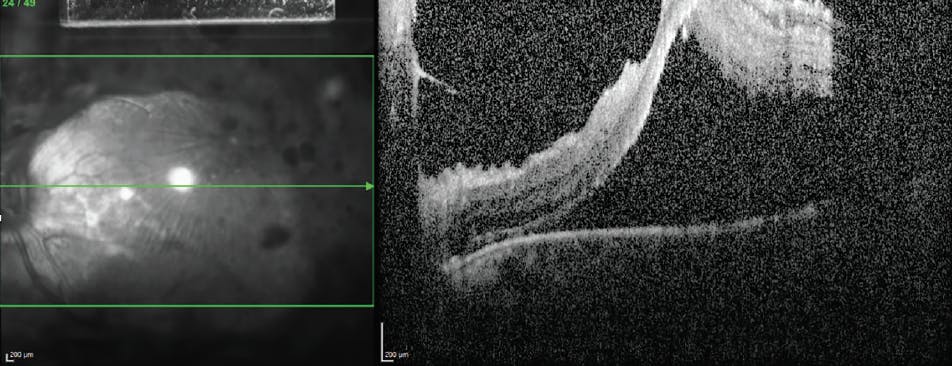
Figure. This 27-year-old woman with type 1 diabetes presented with recent onset vision loss in her left eye. She had noticed floaters for a couple of months but did not present to the clinic until her vision had decreased. On examination, VA was 20/400 with extensive tractional membranes inducing a fovea-off macular detachment. Ultimately, she required pars plana vitrectomy with extensive membrane segmentation and delamination to reattach her retina with 20/400 vision under silicone oil. The right eye received full PRP along with anti-VEGF therapy for treatment of PDR.
HOW ANTI-VEGF AGENTS WORK
Therapy with anti-VEGF agents usually leads to the regression of clinically apparent DR. Hemorrhages and microaneurysms improve, and exudates slowly resolve. Less is known about the effects of anti-VEGF agents on retinal capillary nonperfusion, the primary driver of angiogenesis.
The PERMEATE study used ultra-widefield fluorescein angiography to evaluate panretinal leakage and ischemic indices in patients receiving intravitreal anti-VEGF injections for DME and retinal vein occlusion.11 The study found that, although leakage improved with regular injections, the underlying ischemic index did not improve, and in fact worsened after 12 months of regular injections. Thus, ischemia, manifesting as peripheral nonperfusion, continues unabated in the setting of anti-VEGF monotherapy.
This is accompanied by functional loss of peripheral vision. Although visual field loss was greater in the PRP group than the anti-VEGF group after 1 and 2 years in Protocol S, the 5-year data demonstrated progressive field loss in the anti-VEGF arm. At 5 years, the mean standard deviation was -330 dB in the ranibizumab (Lucentis, Genentech) group versus -527 dB in the PRP group.6
SLOWING OR STOPPING ANTI-VEGF INJECTIONS
In a post-hoc analysis of the RISE and RIDE studies, Goldberg et al found that eyes treated with anti-VEGF agents that experienced regression of DR score to mild-to-moderate NPDR were prone to faster worsening when anti-VEGF therapy was reduced, in comparison with untreated eyes with mild-to-moderate NPDR.12
Additionally, the authors found that the rate of worsening DR in previously treated eyes occurred at a supraphysiologic level. This raises the question: Is anti-VEGF therapy truly improving DR, or is it instead masking the true DR grading? This analysis has fueled debate over whether anti-VEGF agents are, in fact, disease-modifying in this context.
HOPE FOR THE FUTURE
Every Friday at our center, we operate on patients who are bilaterally blind from traction retinal detachments. The surgeries are exhilarating, but we leave with an overwhelming sadness that we spend our Fridays like this. With the implementation of telescreening programs throughout the city, we hope to capture patients earlier and reduce the number of patients experiencing vision loss due to DR.
During educational meetings, experts in the field discuss anti-VEGF therapy versus PRP, presumably with the goal that the retina community will eventually migrate exclusively to anti-VEGF therapy. However, we hope to stop the binarization of the DR treatment paradigm. Anti-VEGF agents hold incredible merit for the management of DR and DME, and PRP continues to build upon a 50-year history of vision-saving outcomes.
The management of DR is complex and patient-specific. We must understand the entirety of the literature to support our decision-making, and we must also understand the needs of each unique patient and assess the likelihood of adherence to continuous therapy. To eradicate legal blindness due to DR in the United States—a lofty yet attainable goal—we will need a combination of therapies. Today, both laser and injection serve crucial roles, and both should be taught throughout residency and fellowship training programs.
1. Lim JI. Intravitreal aflibercept injection for nonproliferative diabetic retinopathy: year 2 results from the PANORAMA study. Invest Ophthalmol Vis Sci. 2020;61(7):1381-1381.
2. Regeneron Pharmaceuticals. Eylea (aflibercept) injection reduced risk of developing vision-threatening events by 75% after two years in patients with diabetic retinopathy [press release]. February 8, 2020.
3. Maturi RK, Glassman AR, Josic K, et al. Effect of intravitreous anti-vascular endothelial growth factor vs sham treatment for prevention of vision-threatening complications of diabetic retinopathy: the Protocol W randomized clinical trial. JAMA Ophthalmol. 2021;139(7):701-712.
4. Early Treatment Diabetic Retinopathy Study Research Group. Early photocoagulation for diabetic retinopathy. ETDRS report number 9. Ophthalmology. 1991;98(5 Suppl):766-785.
5. The Diabetic Retinopathy Study Research Group. Preliminary report on effects of photocoagulation therapy. Am J Ophthalmol. 1976;81(4):383-396.
6. Gross JG, Glassman AR, Liu D, et al. Five-year outcomes of panretinal photocoagulation vs intravitreous ranibizumab for proliferative diabetic retinopathy: a randomized clinical trial. JAMA Ophthalmol. 2018;136(10):1138-1148.
7. Azad AD, Chen EM, Hinkle J, et al. Anti-vascular endothelial growth factor and panretinal photocoagulation use after Protocol S for proliferative diabetic retinopathy. Ophthalmol Retina. 2021;5(2):151-159.
8. Obeid A, Su D, Patel SN, et al. Outcomes of eyes lost to follow-up with proliferative diabetic retinopathy that received panretinal photocoagulation versus intravitreal anti-vascular endothelial growth factor. Ophthalmology. 2019;126(3):407-413.
9. Ohlhausen M, Payne C, Greenlee T, et al. Impact and characterization of delayed pan-retinal photocoagulation in proliferative diabetic retinopathy. Am J Ophthalmol. 2021;223:267-274.
10. Figueira J, Fletcher E, Massin P, et al. Ranibizumab plus panretinal photocoagulation versus panretinal photocoagulation alone for high-risk proliferative diabetic retinopathy (PROTEUS Study). Ophthalmology. 2018;125(5):691-700.
11. Figueiredo N, Srivastava SK, Singh RP, et al. Longitudinal panretinal leakage and ischemic indices in retinal vascular disease after aflibercept therapy: The PERMEATE Study. Ophthalmol Retina. 2020;4(2):154-163.
12. Goldberg LRH, Abolian A; Stoilov I. What happens to diabetic retinopathy severity scores with less aggressive treatment? A post hoc analysis of the RISE/RIDE open-label extension study examining instability of DRSS with intermittent VEGF suppression. Paper presented at: Retina Society 2020 Virtual.


_1784132761.jpg?auto=compress,format&w=75)





