


What led you to a career as a retina specialist?
At first, I wanted to be a geneticist and studied genetics in microscopic nematodes in college. However, I felt too far removed from helping people, so I decided to keep my options open by entering an MD/PhD program. Although I was happy to find that I enjoyed medicine, I was initially opposed to becoming an ophthalmologist and a retina specialist because my father (Stephen R. Russell, MD) is a retina specialist, and I wanted to blaze my own trail. But when I rotated in ophthalmology and caught my first glimpse of the retina with an indirect ophthalmoscope, there was no going back.
How has your PhD in genetics influenced your career?
Both getting a PhD and working in the clinic and OR are all about asking why and systematically testing ideas until you can answer the question. For example, for 80 years, retina specialists had documented little white spots in retinal detachments, but there was no published explanation of why they formed. So, I collected my observations and proposed that the spots are degenerating photoreceptor outer segments that reflect the path of spreading subretinal fluid.1
A major reason I took a faculty position at the University of Iowa was to join the work on inherited retinal diseases (IRDs). Edwin M. Stone, MD, PhD, Budd A. Tucker, MD, and the team at the Institute for Vision Research are pioneering new gene therapy and stem cell strategies that will hopefully enable us to restore vision to patients with all forms of IRD. Individually, these genetic diseases are rare, but we have tens of thousands of patients waiting for treatments to come to fruition. Also, the stem cell approach holds potential for common diseases like geographic atrophy or outer retinal atrophy after rhegmatogenous retinal detachment. With my genetics background and vitreoretinal surgical skills, it’s the perfect place to launch my career.
What led to your interest in advanced vitreoretinal imaging?
My curiosity was sparked by a single patient. One Sunday while on call as a resident at Bascom Palmer Eye Institute, I treated a man with active proliferative diabetic retinopathy (PDR) in his only seeing eye with dense panretinal photocoagulation (PRP). His VA was 20/25 that day. He returned a few days later with a VA of 20/200, with no obvious cause (eg, subretinal fluid or macular edema). A couple weeks later, his VA returned to normal.
I started wondering whether transient retinal and/or choriocapillaris ischemia after the laser had caused his vision loss, so my co-residents and I used OCT angiography (OCTA) to prospectively image a group of PDR patients after PRP with the help of Philip J. Rosenfeld, MD, PhD. He and I have since published 12 OCTA papers together, many demonstrating the advantages of OCTA in managing diabetic retinopathy.
What has been one of the most memorable moments of your career?
One was the first time I suspected diffuse unilateral subacute neuroretinitis in a patient with unexplained uveitis. Despite a bad view, I was able to find a small nematode wriggling in the retina. I lasered the worm, and the patient’s vision returned to normal. This was a full-circle moment: from the lab studying tiny worms to the clinic lasering tiny worms.
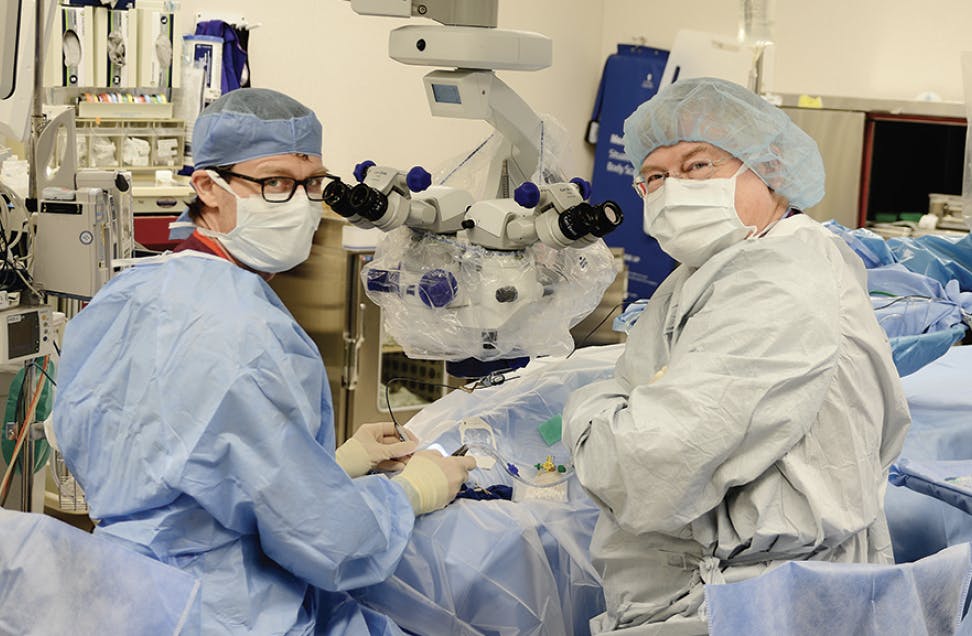
Another was operating with my dad, who is one of my colleagues here at the University of Iowa (Figure). We both love retina surgery, particularly difficult cases and new challenges. Not many people get the chance to collaborate at such a high level with one of their parents. I am very lucky.
What is your favorite hobby outside of work?
I run and bike whenever I can, and I read a lot. Otherwise, I spend my time with my wife chasing around our two young boys. They keep me busy with soccer, swimming, basketball, LEGOs, and more.
1. Russell JF. Whitish outer retinal spots in retinal detachment: longitudinal follow-up, multimodal imaging, and clinical utility. Ophthalmol Retina. 2022;6(6):469-477.


_1784132761.jpg?auto=compress,format&w=75)





