


A giant retinal tear (GRT) is defined as a continuous, circumferential peripheral retinal break of 3 or more clock hours (≥ 90°).1 Risk factors include trauma, age, hereditary vitreoretinopathies, pseudophakia, and high myopia. The mainstay of GRT management is surgery and includes combined scleral buckle/vitrectomy or vitrectomy with gas, PFO liquid, or silicone oil tamponade.1-3
One of the challenges of surgical management of GRTs is the risk of intra- and postoperative complications, including the creation of additional retinal breaks, retinal slippage, and proliferative vitreoretinopathy. The successful treatment of GRTs with primary laser photocoagulation has been previously reported in a small case series, with one GRT extending up to 5 clock hours.4 Here, we report a case of successful treatment of a GRT extending 6 clock hours using laser photocoagulation as primary management.
THE CASE
A 59-year-old phakic male presented with blurry “black pinpoint” vision in his right eye without accompanying photopsias. His ocular history included retinal tears in each eye 7 years prior that were treated with laser barricade. The patient’s medical history was noncontributory. At presentation, his BCVA was 20/50+1 OD with normal IOP. The anterior segment examination revealed mild nuclear sclerotic changes. The fundoscopic examination disclosed a posterior vitreous detachment with a 6 clock hour posterior GRT, extending inferiorly from the 4:00 to 10:00 clock hours without macular subretinal fluid (Figure 1).
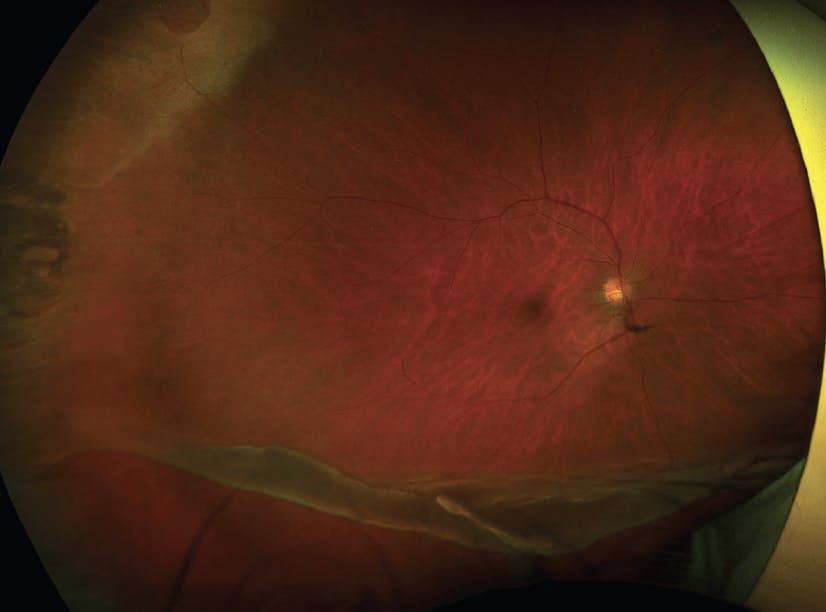
Figure 1. This patient presented with a posterior vitreous detachment and a posterior GRT that extended inferiorly from the 4:00 to 10:00 clock hours.
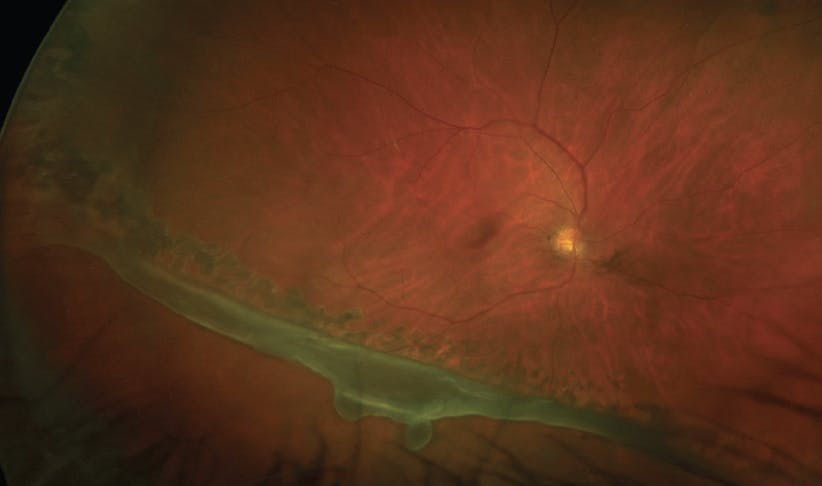
In this unique case of a posterior GRT, the patient’s superior visual field cut would not be measurably improved with conventional vitrectomy and gas or oil tamponade, making indirect laser photocoagulation a reasonable option. After an extensive discussion of the risks and benefits of observation, surgical treatment, and laser retinopexy, the GRT was barricaded solely using primary indirect laser photocoagulation in the clinic. The patient’s BCVA at the 3-month follow-up improved to 20/30+1 OD and remained stable. At 4 months, the retina posterior to the laser barricade remained attached without the development of proliferative vitreoretinopathy, as confirmed on widefield imaging (Figure 2).
DISCUSSION
The conventional approach for GRTs includes the use of primary vitrectomy with PFO, gas, or oil tamponade, or vitrectomy with scleral buckle.5 However, for a posterior GRT with minimal anterior subretinal fluid, primary laser retinopexy alone can be successfully applied.
This case represents one of the largest reported GRTs successfully treated with primary laser retinopexy in the clinic setting, demonstrating that this modality is a viable treatment approach for select macula-sparing GRTs.
1. Phua V, Ting DSW, Wong D. Diagnosis and management of giant retinal tear. EyeNet. 2018;22(9):35-36.
2. Taleb EA, Nagpal MP, Mehrotra NS, Bhatt K, Goswami S, Noman A. Giant retinal tear retinal detachment etiologies, surgical outcome, and incidence of recurrent retinal detachment after silicone oil removal. Oman J Ophthalmol. 2020;13(3):117-122.
3. Ang GS, Townend J, Lois N. Epidemiology of giant retinal tears in the United Kingdom: the British Giant Retinal Tear Epidemiology Eye Study (BGEES). Invest Ophthalmol Vis Sci. 2010;51(9):4781-4787.
4. Ao J, Horo S, Farmer L, Chan WO, Gilhotra J. Primary laser photocoagulation for the treatment of giant retinal tears. Retin Cases Brief Rep. 2018;12(4):371-374.
5. Berrocal MH, Chenworth ML, Acaba LA. Management of giant retinal tear detachments. J Ophthalmic Vis Res. 2017;12(1):93-97.


_1784132761.jpg?auto=compress,format&w=75)





