


There are several reasons surgeons choose to implant a scleral-fixated IOL, including the dislocation of an existing IOL due to pseudoexfoliation syndrome or traumatic aphakia with an altered anterior segment anatomy, and uveitis glaucoma hyphema. The introduction of the Carlevale IOL provided a useful solution for scleral-fixated IOLs and is currently on-label in Europe (though not yet approved by the US FDA).
In this article, we offer a quick overview of the important steps to perform this technique with Carlevale IOLs by two different manufacturers (MD Tech and Soleko) and a discussion of some key product differences to be aware of (see Lens Considerations).
LENS CONSIDERATIONS
There are two key differences to be aware of between the Carlevale IOLs discussed in this article:
1. The lens composition of each IOL type is different. While the Soleko Carlevale IOL is hydrophilic, MD Tech’s is hydrophobic. If you anticipate problems in the posterior segment requiring a gas tamponade or in cases of preexisting endothelial corneal pathology that may require an endothelial corneal transplantation, it is wise to opt for a hydrophobic solution.1 Because the Soleko design is more hydrophilic, explantation of this lens tends to be easier to perform than MD Tech explantation, in our experience.
2. The anchor rigidity differs significantly. Because the MD Tech anchors are stiffer, they cannot be externalized via a trocar-based 27-gauge approach like the Soleko anchors. However, the Soleko anchors can be ripped off more easily and have a slightly smaller span, potentially being more affected by shearing forces.
1. Grzybowski A, Zemaitiene R, Markeviciute A, Tuuminen R. Should we abandon hydrophilic intraocular lenses? Am J Ophthalmol. 2022;237:139-145.
CONCEPT EXPLAINED
The idea behind the Carlevale IOL technique is to externalize the anchors of this single-piece IOL through the sclera using either a flap or pocket approach and to cover the IOL haptics with the sclera. These two scleral-fixation techniques (ie, flap vs pocket) have been shown to have comparable results.1
A small conjunctival incision is used to reach the sclera, creating extra coverage of the anchors. The IOL can be implanted via a regular tunnel incision. The procedure can be performed with no infusion, anterior chamber infusion, or infusion via the pars plana.
We recommend taking the posterior approach, as many cases require a complete vitrectomy.
STEP-BY-STEP TECHNIQUE
Step 1
Carefully measure for the exact placement of the haptics; a mark on the cornea can be helpful during the first few cases, as you must rotate the eye significantly during the procedure. Avoid the 3:00 and 9:00 clock positions because of the long posterior ciliary arteries at these locations.2,3 Instead, opt for the 2:00 and 8:00 clock positions on the right eye and the 10:00 and 4:00 clock positions on the left eye to avoid recurrent vitreous or anterior chamber bleeding.
After opening the conjunctiva, make a 3 mm frown incision 2.5 mm to 3 mm from the limbus, and then create a flap or pocket approximately half the scleral thickness in depth, reaching to the blue line or the limbus.
Hint: It is helpful to first move the eye to the optimal position for each lateral approach and then adjust/fix the infusion line as an extra “hand” to keep the bulbus in place. To reach the perfect pocket depth, your crescent blade should barely be visible through the sclera.
Step 2 (MD Tech)
Once the first flap/pocket is created, move the eye to the contralateral position and use the infusion line to stabilize the eye. Then create the second pocket. Lift the flap and create a transconjunctival sclerotomy with a thin-walled 23-gauge needle 1.8 mm to 2.0 mm from the limbus.
Hint: Try to use your right hand for the right side and your left hand for the left side. This will help you navigate the close space in which you have to operate. The sclerotomy should be well covered by the scleral flap/pocket.
Step 2 (Soleko)
A relatively long incision should be made to create the scleral flap because the upper part of the incision will retract as healing progresses. Therefore, start the incision 4 mm from the limbus. The scleral distance should be at least 1.5 mm so that the anchor of the Carlevale IOL remains securely covered. Implant the 27-gauge trocars into the posterior chamber or the sulcus at the end of the scleral incision at 1.5 mm to 2 mm posterior to the limbus. This will ensure a correct retropupillary position.
Hint: The scleral incision must be long enough to safely cover the haptics. Anticipate wound retraction of the superior scleral portion.
Step 3
Maintain the anterior chamber with a cohesive viscoelastic. Place the paracentesis at the 2:00 to 3:00 clock position (depending on the nose) and 10:00 clock position for the right eye, or the 4:00 to 5:00 clock position and the 10:00 clock position for the left eye. If you have a posterior rather than an anterior chamber infusion, make sure to switch the infusion off after the viscoelastic is in place and you start inserting the IOL. Insert the Carlevale IOL via a 2.4 mm clear corneal tunnel.
Hint: Failure to stop the infusion can cause loss of the viscoelastic, with the possibility of endothelial damage or even prolapse of iris tissue through the tunnel.
Step 4 (MD Tech)
Manually place the IOL into the single-use injector. Ensure that no part of the IOL is stuck within the injector. Grasp the leading haptic using the custom intraocular 23-gauge forceps and carefully externalize the first anchor (Figure 1). It is important not to apply too much force on the anchor. Pull the forceps out slowly, and stop pulling as you start to see the beginning of the trenches. Push on the sclera from the outside to passively externalize the anchors. This prevents ripping of the anchors or pulling out more of the haptics than necessary.
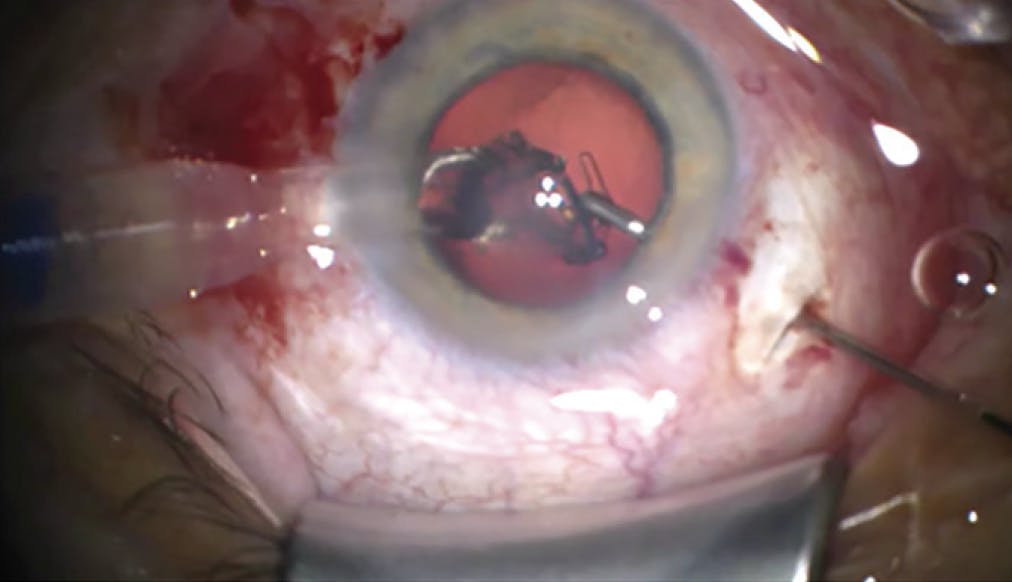
Figure 1. The foldable Carlevale IOL (MED Tech) is implanted through a clear corneal tunnel of 2.4 mm. In the 23-gauge approach, the leading haptic is grasped using the custom intraocular 23-gauge forceps, and the first anchor is carefully externalized. Pushing on the sclera from the outside to passively externalize the anchors is a key maneuver.
Hint: Before injecting the lens, make sure that no part of the IOL is caught in the injector.
Step 4 (Soleko)
When grasping the leading haptic, use end-gripping 27-gauge forceps, as no custom bent forceps come with this Carlevale IOL (Figure 2). It is even more crucial to avoid applying too much force on the anchors because the Soleko IOL is more delicate than the MD Tech IOL. Although pushing on the sclera to passively externalize the anchors is a key technique with this lens as well; there is still a high chance that surgeons may rip off the anchors early in the learning curve.
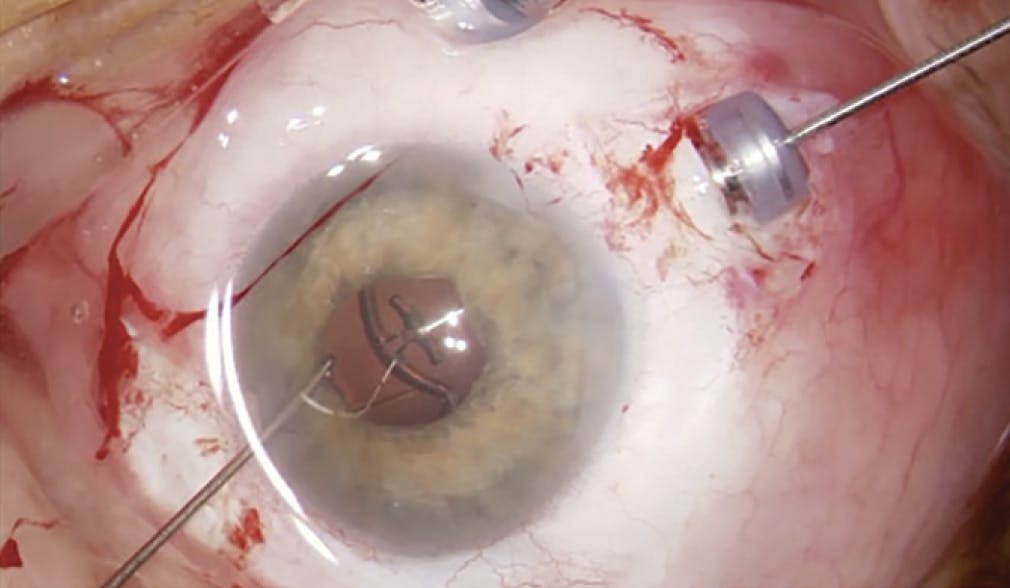
Figure 2. The Soleko Carlevale IOL is also implanted through a 2.4 mm clear corneal tunnel. For this lens, the leading haptic is grasped with end-gripping 27-gauge forceps, as no bent forceps exists. Similar to the MD Tech lens approach, pushing on the sclera from the outside to passively externalize the anchors is an important technique, although damage to the haptics is more likely with this lens.
Hint: The Soleko Carlevale can be folded and explanted easily if you damage the haptics.
Step 5
Carefully cover the anchors of the Carlevale IOL with the sclera. If you are not confident that the haptics will stay covered, use a self-resorbing suture.
Hint: When in doubt, suture your flap or pocket.
Step 6
Suture the conjunctiva with 9.0 Vicryl, and make sure the eye stays pressurized. Only then should you remove the infusion port. In complicated cases, put in a contact lens or even suture the port.
Hint: Be careful to avoid hypotony.
FINAL POINTS
The technique to place an IOL without capsular support is not difficult to learn, and once you are comfortable managing the complications of anchor breaks, the surgery typically takes only 15 to 20 minutes.
In our experience, the greatest challenges with this technique are making sure that no part of the IOL is stuck within the injector, handling the anchors while measuring for placement of the insertion sites, and externalizing the haptics in a controlled fashion. The most common mistake is forgetting to switch off the infusion, resulting in iris prolapse; other common mistakes include damaging the anchors and losing the IOL in the vitreous body. We recommend that every surgeon become familiar with explanting an IOL before attempting this technique.
1. Fiore T, Messina M, Muzi A, et al. Comparison of two different scleral fixation techniques of posterior chamber Carlevale lens. Medicine (Baltimore). 2021;100(32):e26728.
2. Pfister RR. The intraocular changes of anterior segment necrosis. Eye (Lond). 1991;5(Pt 2):214-221.
3. Enghelberg M, Chalam KV. Ultra wide field angiography documented peripheral retinal eovascularization as cause of vitreous hemorrhage after scleral buckle surgery. J Surg Case Rep. 2020;2020(6):rjaa142.


_1773249222.png?auto=compress,format&w=75)





