


AT A GLANCE
- Various surgical approaches have been used for the treatment of myopic traction maculopathy, the most common being vitrectomy with internal limiting membrane peeling.
- In a study of 13 patients treated with scleral imbrication, the postoperative axial length decreased by a mean of -0.18 ± 0.37 mm.
- The anatomical success rate was good with 71% achieving successful macular reattachment.
Myopic foveal retinoschisis was first described in 1958 as a posterior retinal detachment without a macular hole.1 With the advent of OCT, more detailed characteristics have been described.2 Typical OCT images of this disease show splitting of the inner and outer retina within a posterior staphyloma.
The prevalence of myopic foveoschisis varies from 9% to 34% in myopic eyes.2 Although myopic foveoschisis remains relatively stable over years for most patients, some can progress to visual loss from progressive traction and schisis, known as myopic traction maculopathy, which can further progress to macular detachment with or without development of a macular hole.
Various surgical approaches have been used for the treatment of the different stages of myopic traction maculopathy. Vitrectomy with internal limiting membrane (ILM) peeling has been the most common choice for managing these patients; however, ILM peeling can be responsible for the creation of a macular hole in 19% to 27% of these patients.3,4 As a result, fovea-sparing ILM peeling may be able to relieve the traction without the risk of inducing a macular hole.3
In the presence of a posterior staphyloma in tractional cases, reapposing the detached macula to the outpouched scleral wall is another complicating factor for which external macular scleral buckling has been used. However, externally applied macular scleral buckles are not commonly available, require a unique set of surgical risks, and come with their own possible postoperative complications.
In these cases, scleral imbrication is an alternative surgical technique that may change the curvature of the macular staphyloma. This approach, first described by Swan in 1959,5 involves the placement of sutures through the temporal sclera, a technique similar to that which is used with traditional scleral buckling. The placement of these scleral sutures flattens the staphyloma posteriorly and can be an adjunctive step to help relieve traction and allow retinal attachment in challenging myopic traction maculopathy cases.
THE STUDY
We conducted a retrospective, nonrandomized case series of 13 patients who were treated with scleral imbrication combined with vitrectomy and fovea-sparing ILM peeling for myopic traction maculopathy. The primary outcome was the anatomical success rate. The secondary outcomes included BCVA, axial length change, postoperative refraction, and the shape of the posterior segment as determined by OCT.
The surgical method consisted of scleral imbrication combined with 23-gauge vitrectomy. Imbrication was performed using four 5-0 nylon mattress sutures at 6 mm wide (Figure). Two of the mattress sutures were placed in the superior temporal quadrant, and two were placed in the inferior temporal quadrant. The sutures were placed as posteriorly as possible, and the passage through the sclera was approximately 3 mm to 5 mm.
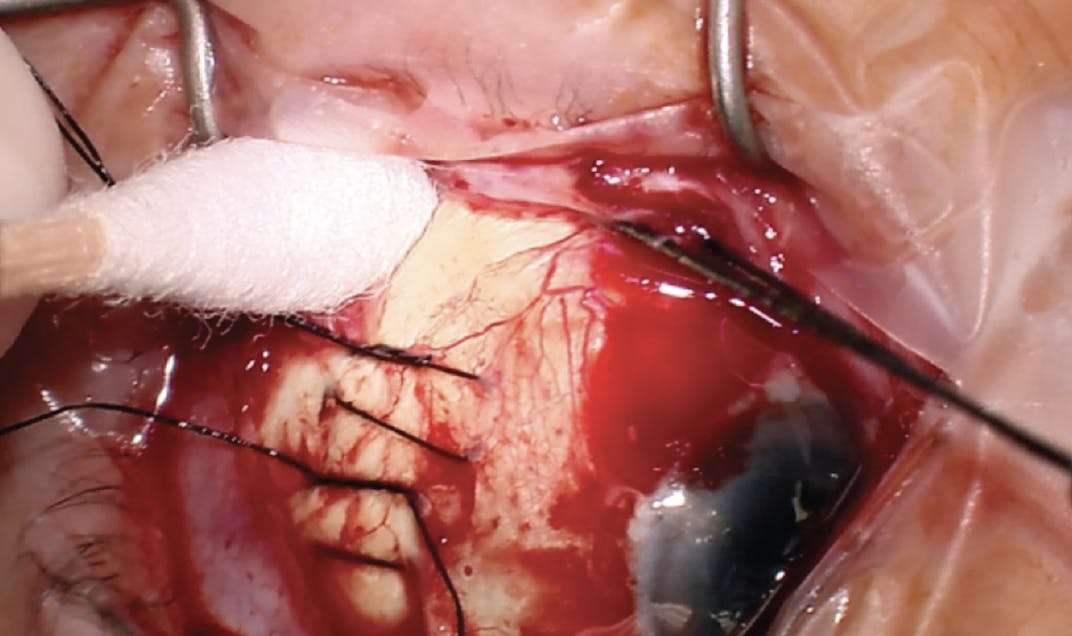
Figure. Two 5-0 partial scleral thickness nylon sutures are placed in the inferotemporal quadrant. The sutures are placed as posteriorly as possible with a bite size of 6 mm in width. The same is repeated in the superotemporal quadrant.
After the core vitrectomy, the ILM was peeled using ILM forceps, sparing the fovea. The sutures were then tightened once the fluid infusion was switched to air to allow for greater tightening of the mattress sutures. Once the sutures were tied, an indent was noticeable.
The mean preoperative BCVA was 0.97 ± 0.4 logMAR, and the mean postoperative BCVA was 1.16 ± 0.5 logMAR. The mean preoperative axial length was 30.13 ± 1.99 mm, which showed a significant postoperative decrease to 29.38 ± 2.62 mm with a mean decrease in axial length of -0.18 ± 0.37 mm. The postoperative refraction shifted by +0.25 ± 0.79 D. The percentage of successful macular attachment with scleral imbrication/vitrectomy and fovea-sparing ILM peeling was 71.4% with one patient lost to follow-up.
DISCUSSION
Postoperatively, there was a significant decrease in axial length and a significant shift in refraction, but given the small sample size, there was a nonstatistically significant improvement in visual acuity. The anatomical success rate was good with 71% achieving successful macular reattachment. Our longest follow-up period was 4 years for one patient, who did not have a recurrence of myopic traction maculopathy.
This study was limited by its retrospective, noncomparative nature and the number of patients. Other limitations include the short period of follow-up and the nonrandomized design. Further studies with larger sample sizes and longer observation periods are needed to confirm these results and show whether axial length shortening and the subsequent refractive changes diminish over time. Such studies could also reveal whether the imbrication resulted in a slower progression of myopic staphyloma.
Overall, we found the use of scleral imbrication in combination with vitrectomy and fovea-sparing ILM peeling to be a useful treatment modality for myopic traction maculopathy.
1. Phillips CI. Retinal detachment at the posterior pole. Br J Ophthalmol. 1958;42(12):749-753.
2. Baba T, Ohno-Matsui K, Futagami S, et al. Prevalence and characteristics of foveal retinal detachment without macular hole in high myopia. Am J Ophthalmol. 2003;135(3):338-342.
3. Hirakata A, Hida T. Vitrectomy for myopic posterior retinoschisis or foveal detachment. Jpn J Ophthalmol. 2006;50(1):53-61.
4. Sayanagi K, Ikuno Y, Tano Y. Reoperation for persistent myopic foveoschisis after primary vitrectomy. Am J Ophthalmol. 2006;141(2):414-417.
5. Swan KC. Scleral imbrication for retinal detachment. AMA Arch Ophthalmol. 1959;61(1):110-114.


_1784132761.jpg?auto=compress,format&w=75)





