


Risk stratification and management of cutaneous melanoma have been rigorously developed for nearly 50 years now.1 The Fitzpatrick skin type (FST) sorts complexion along a spectrum from I to VI, with FST I representing the lightest skin tone, which consistently burns when exposed to the sun, and FST VI representing the darkest skin tone, which rarely burns with sun exposure.2 FST was originally developed in a study of skin resilience to ultraviolet light and has since become a useful, at-a-glance means of broadly stratifying cutaneous melanoma risk, with greatest risk in FST I and least in FST VI.2
DERMATOLOGY RECAP
In the dermatology literature, FST plays a vital role in the detection and management of cutaneous melanoma and related outcomes. Kulichová et al confirmed the widely recognized fact that patients with FST I and II are at a significantly increased risk for developing cutaneous melanoma in a cohort of 442 patients (odds ratio [OR] = 4.25 and 6.98, P < .001).3
Mercieca et al further found that skin phototype affected the risk for invasive versus in situ cutaneous melanoma, with individuals with FST I and II having a higher likelihood of developing invasive cutaneous melanoma than FST III and IV (P = .00027).4
It is evident that a patient’s FST is highly relevant for counseling from a dermatology perspective, and using this tool leads to more thorough examination of at-risk patients. Based on these dermatologic observations, our team explored the literature in ophthalmology to better categorize the relationship between FST and uveal melanoma outcomes (Figure).
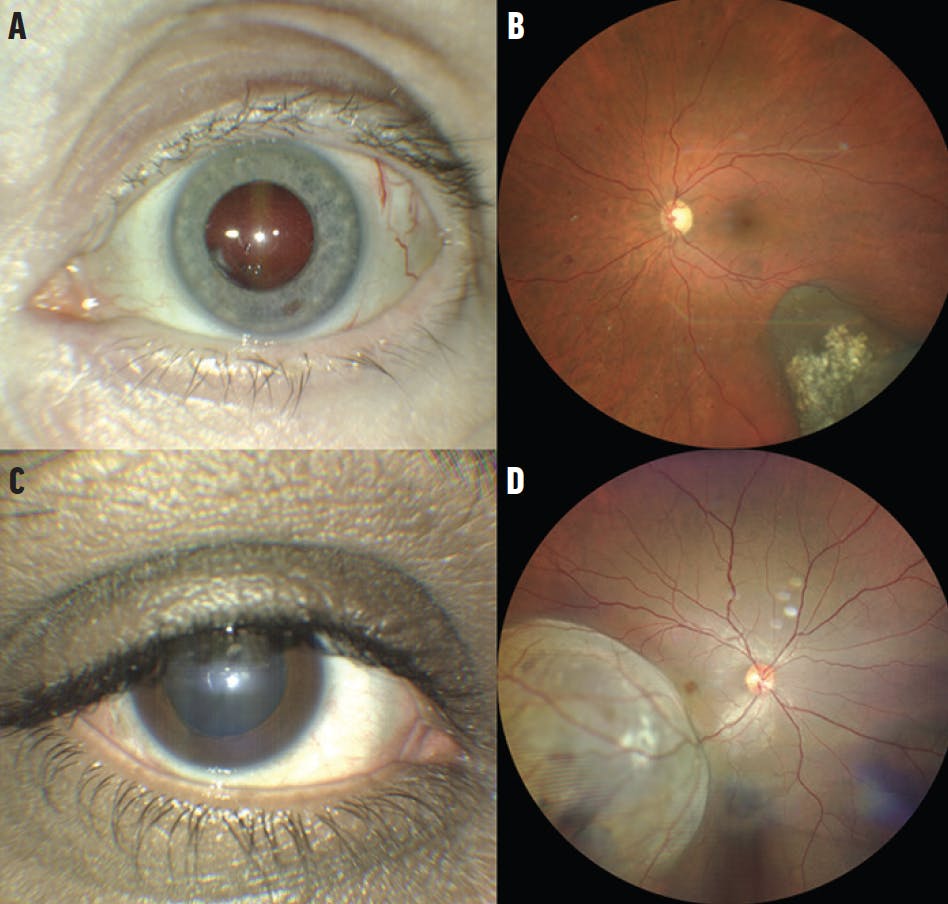
Figure. A patient with FST I (A) has a choroidal melanoma located inferotemporally on fundus photography (B). Another patient with FST V (C) has a choroidal melanoma located inferotemporally on fundus photography (D).
FST AND OCULAR MELANOMA
In the ophthalmology literature, there is little data on this topic, and what does exist has mostly been published within the last 2 years.5-7 The first report on FST and uveal melanoma was published by Sen et al, evaluating 854 eyes with uveal melanoma for FST-related outcomes. They noted that 90% of tumors had a choroidal location across a spectrum of patient skin tones: FST I (n = 97, 11%), FST II (n = 665, 78%), and FST III-V (n = 92, 11%). They further studied the correlation of FST with The Cancer Genome Atlas (TCGA) classification. This classification is based on cytogenetic mutations with predictive value for metastasis, including TCGA Group A (disomy 3, no 8q gain), TCGA Group B (disomy 3, partial 8q gain), TCGA Group C (monosomy 3, 8q gain), and TCGA Group D (monosomy 3, multiple 8q gains). They noted that patients with FST I were more likely to have the highest-risk cytogenetic mutations (TCGA group D, OR = 2.34, P = .002), while patients with FST III-V were more likely to have lower-risk cytogenetic mutations (TCGA group B, OR = 2.26, P = .002).5 They also noted that there was no difference in melanoma-related metastasis or death within each TCGA group.
The second report on FST and uveal melanoma was by Negretti et al, who further studied the same 854 eyes regarding FST and risk for uveal melanoma-related metastasis and death. They found that patients with FST I (vs FST II vs FST III-V) demonstrated the greatest 10-year incidence of melanoma-related metastasis (25% vs 15% vs 14%, P = .02) and death (9% vs 3% vs 4%, P = .04).6 They concluded that FST I patients were at substantially increased risk for melanoma-related metastasis and should be advised to have genetic testing of the tumor.
A third report by Shields et al was on FST related to conjunctival melanoma (n = 540).8 They looked at patients with FST I (n = 126, 23%), FST II (n = 337, 62%), and FST III-VI (n = 77, 15%). Regarding outcomes, they found that patients with FST I (vs FST II vs FST III-VI) had lower tumor thickness (2.1 mm vs 2.8 mm vs 3.6 mm, P = .01) but no difference in 5-year visual acuity loss, tumor recurrence, enucleation, exenteration, metastasis, or death.
Together, these reports define a spectrum of FST as it relates to ocular melanoma. Study findings suggest that patients with uveal melanoma and FST I or II tend to demonstrate more cytogenetic mutations and, thus, have a greater risk for metastasis and death. However, with regard to conjunctival melanoma, those with FST I are more likely to have thinner tumors, and there is no difference in metastasis or death per skin tone.
THE SHORT ANSWER IS YES
Skin tone appears to matter when it comes to the prognosis of ocular melanoma. As with cutaneous melanoma, patients with FST I and II are more vulnerable to developing choroidal and conjunctival melanoma and experience greater risk for metastasis with choroidal melanoma. Thus, a patient’s FST is relevant information for the retina specialist, who often is consulted on the nature of a choroidal mass.
Support provided in part by the Eye Tumor Research Foundation, Philadelphia, PA (CLS). The funders had no role in the design and conduct of the study, in the collection, analysis and interpretation of the data, or in the preparation, review, and approval of the manuscript. Carol L. Shields, MD, has had full access to all the data in the study and takes responsibility for the integrity of the data.
1. Ward WH, Lambreton F, Goel N, et al. Clinical presentation and staging of melanoma. In: Ward WH, Farma JM, eds. Cutaneous Melanoma: Etiology and Therapy. Brisbane, AU: Codon Publications; 2017:79-89.
2. Fitzpatrick TB. The validity and practicality of sun-reactive skin types I through VI. Arch Dermatol. 1988;124(6):869-871.
3. Mercieca L, Aquilina S, Calleja N, Boffa MJ. Cutaneous melanoma more likely to be invasive in fairer skin phototypes: a retrospective observational study. Skinmed. 2021;19(4):280-283.
4. Kulichová D, Dáňová J, Kunte C, et al. Risk factors for malignant melanoma and preventive methods. Cutis. 2014;94(5):241-248.
5. Sen M, Card KR, Caudill GB, et al. Relationship between Fitzpatrick skin type and the cancer genome atlas classification with melanoma-related metastasis and death in 854 patients at a single ocular oncology center. Ophthalmic Genet. 2022;43(6):742-755.
6. Negretti GS, Bayasi F, Goldstein S, et al. Association of Fitzpatrick skin type with metastatic risk from uveal melanoma in 854 consecutive patients at a single center. Manuscript submitted for publication.
7. Agrawal KU, Chiang L, Ni R, et al. Correlation of Fitzpatrick skin type and iris color with tumor size in 823 patients with uveal melanoma. Manuscript submitted for publication.
8. Shields CL, Yaghy A, Dalvin LA, et al. Conjunctival melanoma: features and outcomes based on the Fitzpatrick skin type in 540 patients at a single ocular oncology center. Ophthalmic Plast Reconstr Surg. 2020;36(5):490-496.


_1784132761.jpg?auto=compress,format&w=75)




