


AT A GLANCE
- Most clinicians still use the 1995 classification system for full-thickness macular holes (FTMHs), which does not integrate newer treatment approaches.
- The CLOSE Study Group gathered cases of FTMHs beyond 400 µm and proposed a new classification system based on surgical results, including those of newer techniques.
- The new CLOSE classification may help clinicians better care for patients with large FTMHs that until recently were deemed inoperable.
Despite the impressive evolution in retinal imaging and instrumentation, most ophthalmologists still use the Gass reappraisal of macular hole classification from 1995.1 It was based on biomicroscopic features for pathophysiological purposes alone, not surgical prognosis. The first classification for full-thickness macular holes (FTMHs) based on spectral-domain OCT (SD-OCT) was introduced in 2013 by the International Vitreomacular Traction Study Group.2 Although the main purpose was to define the pathological progression of anomalous posterior vitreous detachment at the vitreomacular interface, the group also classified eyes with FTMHs into three groups: small (< 250 µm), medium (≥ 250-400 µm), and large (> 400 µm). These are based on what they called minimum hole width or aperture size, which is measured at the narrowest point of the hole in the mid retina (now termed minimum linear diameter [MLD]). More recently, surgical series using internal limiting membrane (ILM) peeling have demonstrated that FTMHs < 400 µm have success rates near 100%, but holes > 400 µm only reach 80% closure rates overall.3
THE NEED FOR BETTER CLASSIFICATION
The first attempt to introduce a surgical FTMH classification was made by the Manchester Large Macular Hole Study.4 The series, which included only eyes undergoing pars plana vitrectomy and wide ILM peeling, confirmed a worse outcome for FTMHs beyond MLD of 650 µm.
Parameters other than MLD, such as base linear diameter (BLD), hole edge height and configuration (lifted edges with a subretinal fluid cuff vs flat), macular hole index (height x BLD), cystoid changes, presence of vitreomacular traction, and presence of epiretinal membrane/epimacular proliferation, have been described as SD-OCT biomarkers that have additional effects on either anatomical and/or functional surgical outcomes.5,6 Lately, many alternative surgical techniques—such as autologous ILM flaps, perifoveal hydrodissection, human amniotic membrane (hAM) graft, and autologous retinal transplantation (ART)—have been introduced with encouraging results for large FTMHs with worse SD-OCT characteristics or recurrent and recalcitrant holes.7-10
THE CLOSE CLASSIFICATION
A group of experienced retina surgeons convened (virtually during the COVID-19 pandemic) to create the CLOSE Study Group.11 The main goal was to gather cases of FTMHs beyond 400 µm and propose a new classification based on surgical results that included newer techniques. The new CLOSE classification is based on preoperative MLD (determined using dense radial SD-OCT scans) and postoperative visual acuity recovery and hole closure (type 1) outcomes of more than 1,000 cases (Tables 1-3, Figure 1).
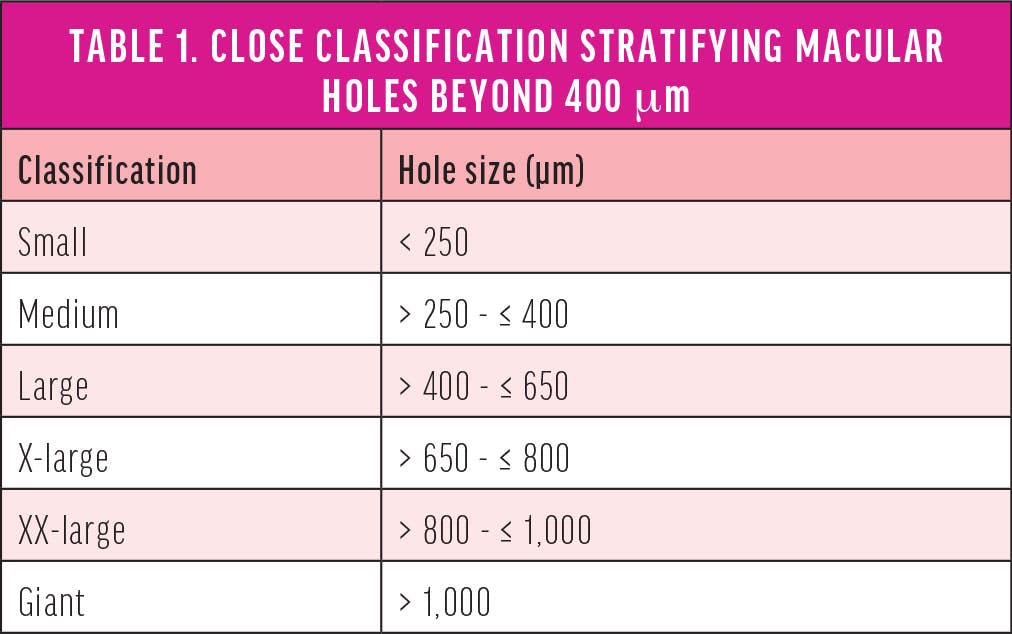
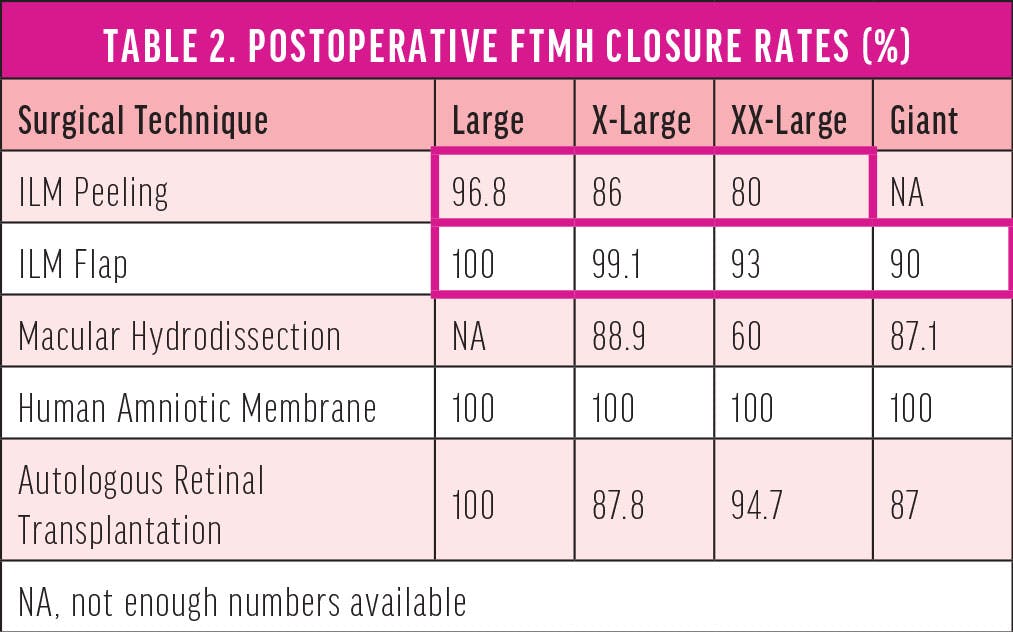
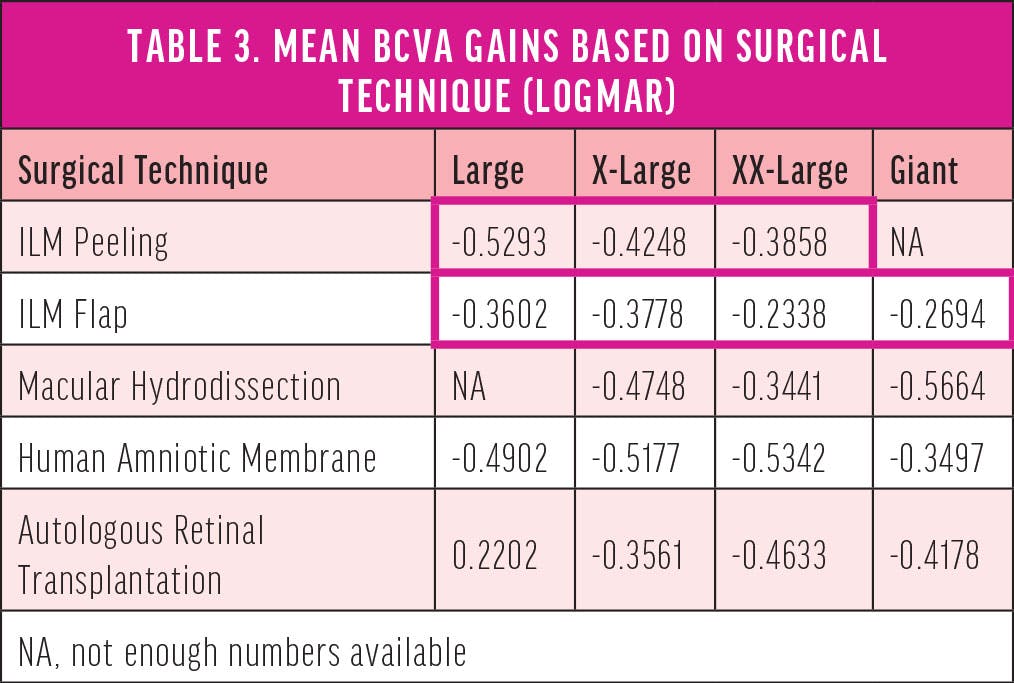
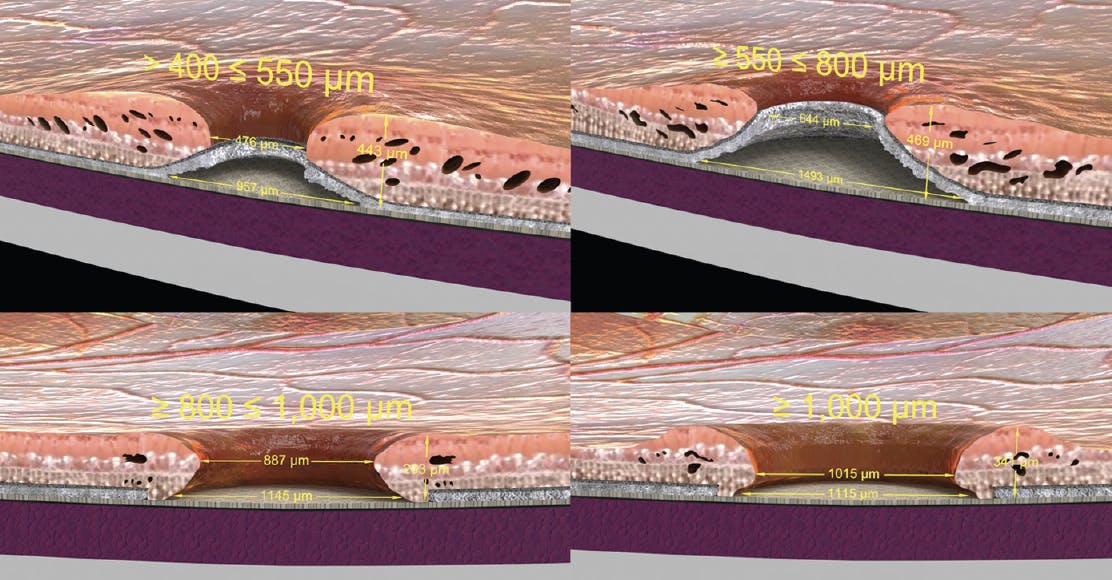
Figure 1. These 3D illustrations of each hole size group show MLD, BLD, and macular hole edge height measurements. As the hole gets larger, the edges become flatter with less cystic cavities (shorter height), and MLD and BLD dimensions become similar.
The classification also considers the importance of measuring BLD and hole edge height (Figures 2 and 3). Larger FTMHs and holes that fail to close with the first intervention are more likely to have flatter edges and are less likely to respond to ILM peeling/flap techniques. These flat-edged holes (type 2) were considered successful anatomical results in the past but are now deemed failed holes, and further surgical intervention can provide additional visual gains.
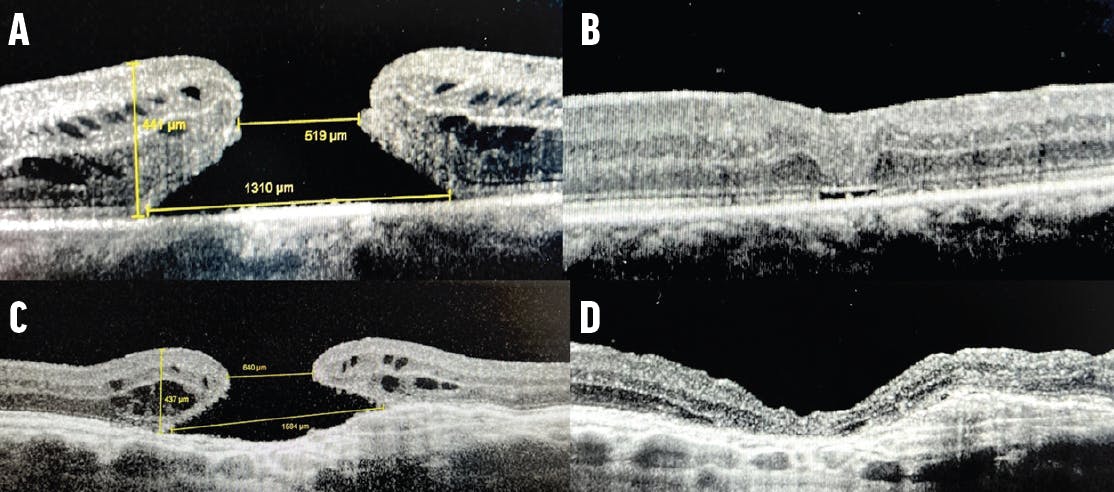
Figure 2. This preoperative large macular hole (MLD: 519 µm) has elevated edges and multiple cystoid spaces (A); 6 months after wide ILM peeling, OCT shows continued improvement of the outer foveal structure after hole closure and 6 lines of visual acuity gain (B). This preoperative X-large FTMH (MLD: 640 µm) also has elevated edges and cystoid spaces (C); the patient was being treated with an anti-VEGF agent for a juxtafoveal neovascular membrane. An inverted ILM flap technique achieved good closure with 4 lines of visual acuity gain (D).
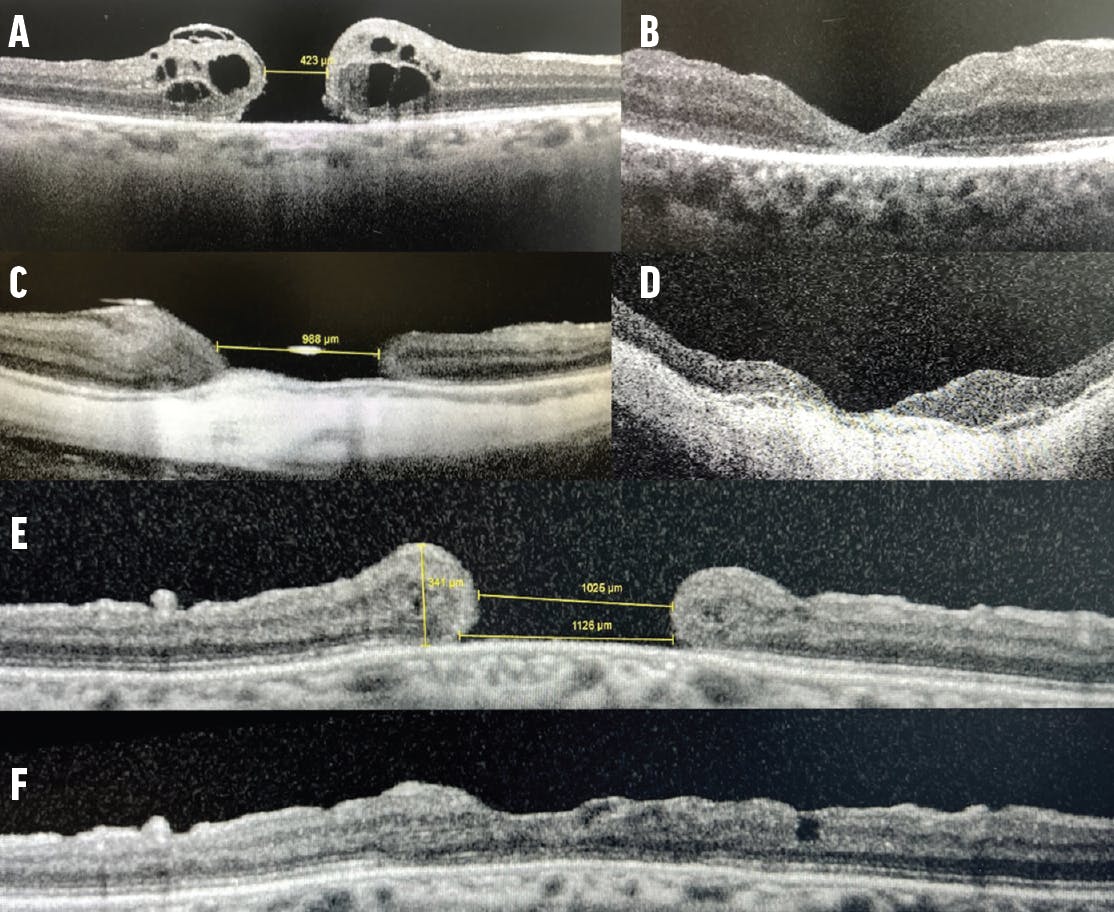
Figure 3. This large FTMH (MLD: 423 µm) did not close after a previous ILM flap procedure but still had elevated edges with cystoid spaces (A). Hole closure was achieved with perifoveal hydrodissection, and VA improved from 20/400 to 20/60 1 year postoperative (B). This XX-large hole (MLD: 933 µm) was under silicone oil tamponade after multiple surgeries (C). Hole closure was achieved with a hAM graft, and VA improved from hand motion to 20/300 (D). This giant hole (MLD: 1,025 µm) with flat dehydrated edges had undergone two previous surgeries (E). After ART, the hole closed with significant VA improvement from counting fingers to 20/80 (F).
The new classification shows high closure rates and significant visual acuity gains for large macular holes undergoing ILM peeling. However, the success rates with ILM peeling dropped with the X-large group and were worse for holes beyond 800 µm. ILM flaps performed well even for primary holes that were XX-large and bigger.
Thus, alternative techniques, such as perifoveal hydrodissection, hAM grafts, and ART, should be reserved for eyes that failed the first surgery with ILM peeling or flap techniques or when a patient presents with a FTMH that is larger than 800 µm with flat dehydrated edges.
An important aspect to keep in mind is that surgical goals are slowly changing, and macular hole closure is no longer the only target; instead, the aim is to also reestablish outer foveal integrity (external limiting membrane and ellipsoid zone continuity on SD-OCT). An updated hole closure classification recently published by Rossi et al can also help understand the differences in healing patterns after various surgical techniques.12
Macular holes with or without retinal detachment in eyes with high myopia and features of myopic tractional maculopathy are a subset that may benefit from alternative techniques not included in the CLOSE classification, and we refer to the classification proposed by Parolini et al for those.13
IMPLEMENTATION
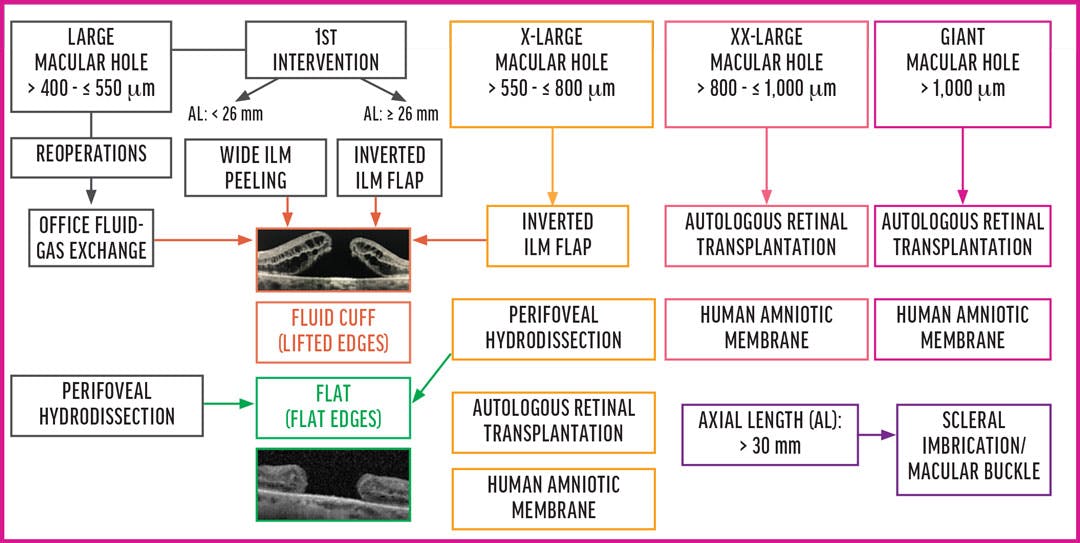
Using this latest information, I created a personal surgical algorithm to address various situations associated with primary or failed macular holes beyond 400 µm (Figure 4). As more retina surgeons and researchers become familiar with the new CLOSE classification, we can start speaking the same language and better care for patients with large FTMHs, which until recently were deemed inoperable, by choosing the best surgical approach for each clinical scenario.
1. Gass JDM. Reappraisal of biomicroscopic classification of stages of development of a macular hole. Am J Ophthalmol. 1995;119(6):752-759.
2. Duker JS, Kaiser PK, Binder S, et al. The International Vitreomacular Traction Study Group classification of vitreomacular adhesion, traction, and macular hole. Ophthalmology. 2013;120(12):2611-2619.
3. Liu L, Enkh-Amgalan I, Wang NK, et al. Results of macular hole surgery. Evaluation based on the International Vitreomacular Traction Study Classification. Retina. 2018;38(5):900-906.
4. Ch’ng SW, Patton N, Ahmed M, et al. The Manchester large macular hole study: is it time to reclassify large macular holes? Am J Ophthalmol. 2018;195:36-42.
5. Kusuhara S, Escaño MFT, Fujii S, et al. Prediction of postoperative visual outcome based on hole configuration by optical coherence tomography in eyes with idiopathic macular holes. Am J Ophthalmol. 2004;138(5):709-716.
6. Ruiz-Moreno JM, Staicu C, Piñero DP, Montero J, Lugo F, Amat P. Optical coherence tomography predictive factors for macular hole surgery outcome. Br J Ophthalmol. 2008;92(5):640-644.
7. Michalewska Z, Michalewski J, Adelman RA, Nawrocki J. Inverted internal limiting membrane flap technique for large macular holes. Ophthalmology. 2010;117:2018-2025.
8. Meyer CH, Szurman P, Haritoglou C, et al. Application of subretinal fluid to close refractory full thickness macular holes: treatment strategies and primary outcome: APOSTEL study. Graefe Arch Clin Exp Ophthalmol. 2020;258:2151-2161.
9. Rizzo S, Caporossi T, Tartaro R, et al. A human amniotic membrane plug to promote retinal breaks repair and recurrent macular hole closure. Retina. 2019;39(Suppl 1):S95-S103.
10. Moysidis SN, Koulisis N, Adrean SD, et al. Autologous retinal transplantation for primary and refractory macular holes and macular hole retinal detachments: the Global Consortium. Ophthalmology. 2021;128(5):672-685.
11. Rezende FA, Ferreira BG, Rampakakis E, et al. Surgical classification for large macular hole: based on different surgical techniques results: The CLOSE study group. Int J Retina Vitreous. 2023;30;9(1):4.
12. Rossi T, Bacherini D, Caporossi T, et al. Macular hole closure patterns: an updated classification. Graefes Arch Clin Exp Ophthalmol. 2020;258(12):2629-2638.
13. Parolini B, Arevalo JF, Hassan T, et al. International validation of myopic traction maculopathy staging system. Ophthalmic Surg Lasers Imaging Retina. 2023;54(3):153-157.


_1784132761.jpg?auto=compress,format&w=75)





