


AT A GLANCE
- Studies show that patients with vision degrading myodesopsia (VDM) would be willing to exchange 1 year of each remaining decade of life just to be rid of their floaters.
- Vitrectomy is a safe and effective treatment for VDM and can normalize contrast sensitivity within 1 week of surgery.
- Researchers are investigating the use of nanoparticles to enhance laser ablation of vitreous opacities.
Vitreous floaters are a common symptom, estimated in one survey to affect two out of every three individuals, with one in three reporting visual impairment.1 When vitreous floaters measurably degrade vision, the diagnosis of vision degrading myodesopsia (VDM) can be established based on objective, quantitative criteria.2 The psychological features of depression and perceived stress associated with VDM have been extensively documented.3-5 Studies have further determined that patients with VDM would be willing to exchange 1 year of each remaining decade of life just to be rid of their floaters.6 This article explains the pathophysiology of VDM and the emerging treatment approaches.
THE AGING PROCESS
Vitreous is a clear gel in youth but undergoes significant structural changes with aging and myopia.7 The gel state and transparency of normal vitreous result from an intricate interaction between collagen and hyaluronan, which are initially homogeneously distributed throughout the vitreous body (Figure 1).8 Vitreous opacification results from fibrous liquefaction, a progressive process that begins in youth and advances more rapidly in myopic eyes, leading to myopic vitreopathy (Figure 2, Video 1).7,9,10 Fibrous liquefaction features dissociation of hydrophilic hyaluronan molecules from collagen, resulting in the formation of liquid vitreous and crosslinking/aggregation of vitreous collagen into structures that interfere with light passing through the center of the eye, casting perceptible shadows. When fibrous liquefaction of the vitreous body occurs in tandem with dehiscence of vitreoretinal adhesion, the result is a posterior vitreous detachment (PVD), the most common cause of vitreous floaters and VDM.2,11,12
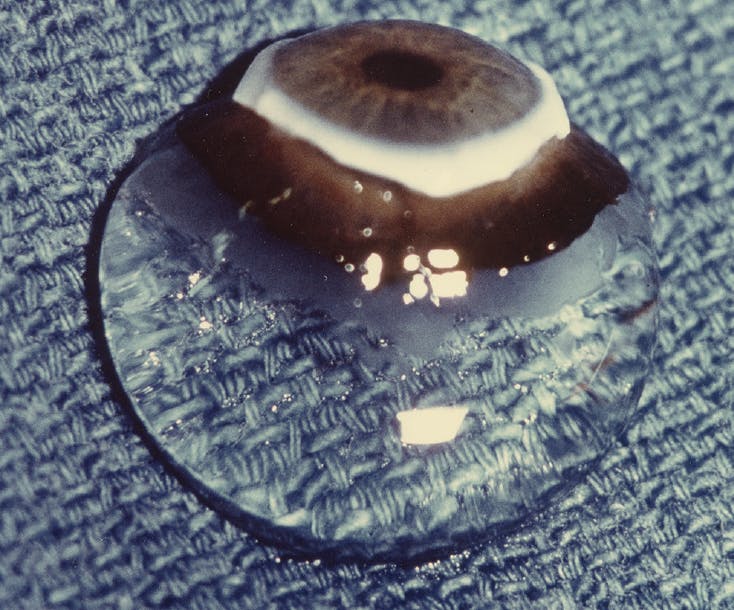
Figure 1. Postmortem dissection of the sclera, choroid, and retina off the vitreous body, which remained attached to the anterior segment of a 9-month-old child. Although the fresh, unfixed specimen is composed of 98% water and situated on a surgical towel in room air, its solid gel consistency is maintained by the collagen/hyaluronan matrix. Reprinted with permission from Sebag J. Vitreous—in Health & Disease. Springer; 2014. Specimen courtesy of the New England Eye Bank.
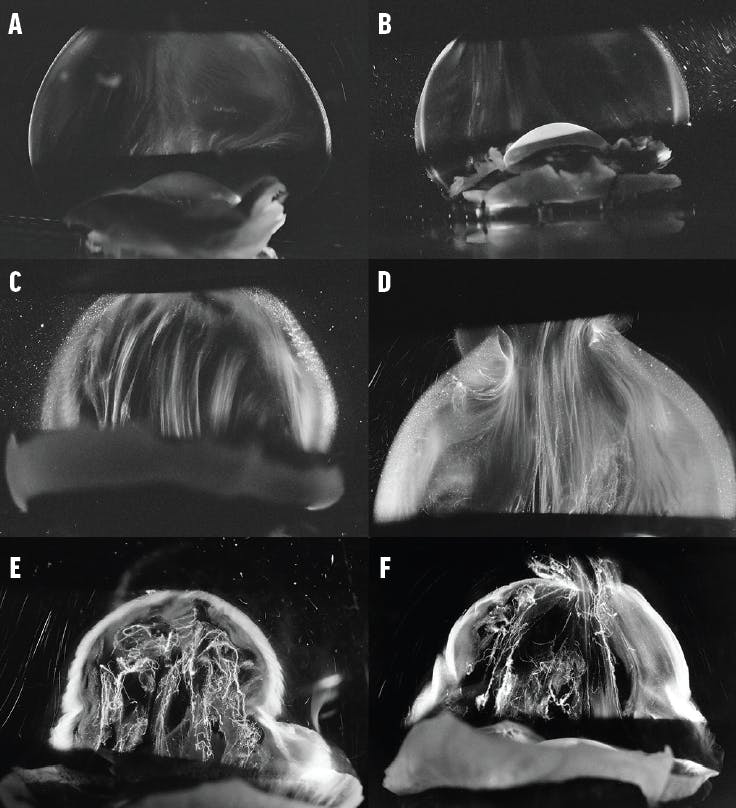
Figure 2. Postmortem darkfield slit microscopy of whole human vitreous with the sclera, choroid, and retina dissected off the vitreous body. The vitreous bodies of an 11-year-old (A) and a 14-year-old (B) feature a homogeneous structure with no significant light scattering, except at the periphery where the vitreous cortex is comprised of a dense matrix of collagen fibrils (see Figure 3). The vitreous structures of a 56-year-old (C) and a 59-year-old (D) feature macroscopic fibrils in the central vitreous body with an anteroposterior orientation. In the eyes of an 88-year-old (E, F), central vitreous fibers are thickened and tortuous. Adjacent to the large fibers are areas of liquid vitreous, at times forming pockets called lacunae. Reprinted with permission from Sebag J. Vitreous—in Health & Disease. Springer; 2014.

Video 1. Myopic Vitreopathy. Video courtesy of Carl Glittenberg, MD, and Susanne Binder, MD
Even in the absence of the pathologic effects of anomalous PVD, the separation of the posterior vitreous cortex from the inner limiting membrane (ILM) can significantly disturb vision, due to light scattering. This is caused by the high density of collagen fibrils in the outer vitreous and/or folding of the outer vitreous, which is forced into a smaller surface area after separation from the ILM (Figure 3, Video 2). Opacities in the central vitreous and the outer shell of the vitreous body result in floaters and, in advanced cases, VDM.
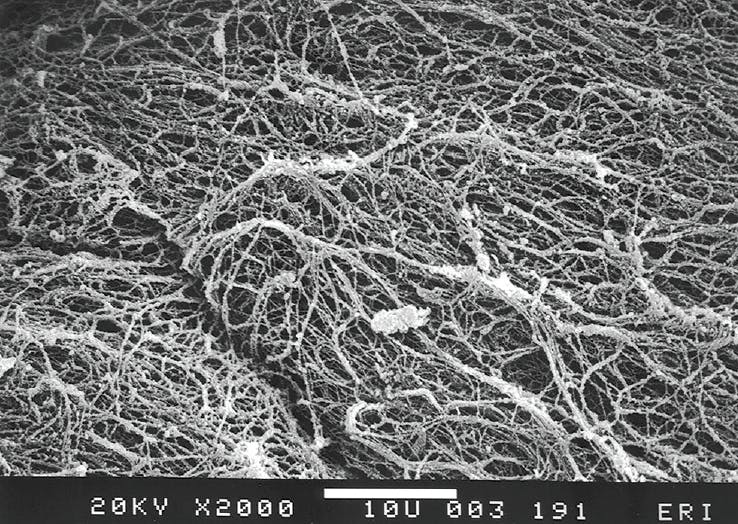
Figure 3. Scanning electron microscopy of the posterior aspect of the posterior vitreous cortex demonstrates dense packing of collagen fibrils (white bar = 10 μm). Reprinted with permission from Sebag J. Vitreous—in Health & Disease. Springer; 2014.
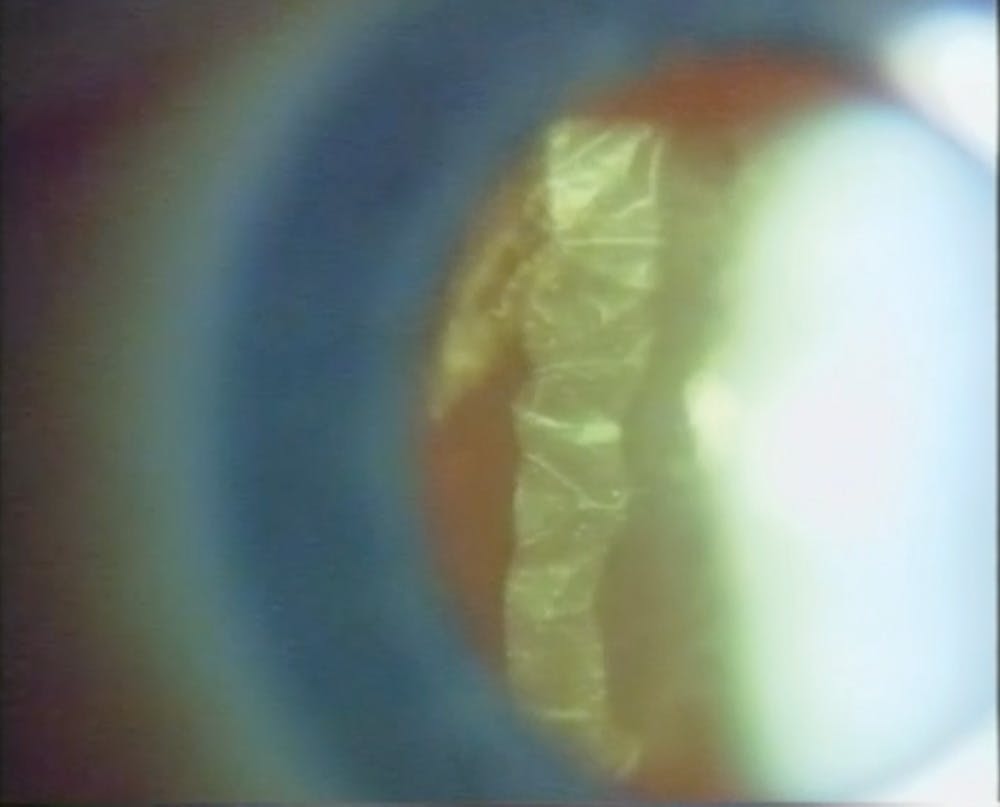
Video 2. Posterior Vitreous Folds After PVD. Video courtesy of Martin Snead, MD
VISUAL SIGNIFICANCE
Recent investigations have determined that floaters can have a measurable effect on vision. While visual acuity is unaffected, studies have detected profound degradation in contrast sensitivity; one study found contrast sensitivity declined by 91% compared with age-matched controls.12 Investigations have correlated this degradation in contrast sensitivity with PVD, vitreous density by ultrasonography, and quality of life as measured by the National Eye Institute Visual Function Questionnaire.10,13,14 With the advent of quantitative ultrasonography to objectively assess vitreous structure and by measuring contrast sensitivity to evaluate visual function, clinicians are now able to quantitatively determine VDM severity to help guide management.
TREATMENT ADVANCES
Although Nd:YAG laser vitreolysis has been widely employed to treat vitreous opacities, no definitive studies prove its efficacy.12,15-19 Thus, the United Kingdom National Institute for Health and Care Excellence (NICE) concluded that evidence on the safety and efficacy of Nd:YAG laser vitreolysis in the treatment of vitreous floaters is inadequate in quality and quantity. NICE officially recommended that Nd:YAG laser vitreolysis should only be used in the context of research and be done by retina specialists.20
In contrast, vitrectomy is a safe and effective treatment for VDM.12,21-23 In one study of 139 consecutive cases, contrast sensitivity normalized within 1 week of surgery and remained normal for years thereafter.23 Moreover, vitrectomy for VDM was found to be more cost-effective than cataract surgery, amblyopia therapy, and retinal detachment (RD) repair.24
To mitigate complications such as cataract and RD, limited vitrectomy was developed to preserve 3 mm to 4 mm of retrolental gel vitreous and avoid surgical PVD induction. In a series of 195 cases, the incidence of retinal tears and RD was markedly reduced to 1.5% compared with traditional vitrectomy with surgical PVD induction, which has a reported incidence of 30% for retinal tears and 6.8% to 10.9% for RD.23,25-27 Furthermore, the historically high incidence of cataract surgery following vitrectomy for floaters was reduced to 18% (mean follow-up of 20 months) in one study and 16.9% (mean follow-up of 32 months) in a larger study of limited vitrectomy for VDM.23,28 In these studies, cataract surgery was required in patients with a mean age of 64 ± 7 years. Importantly, when cataract surgery was performed, there were no complications related to the previous limited vitrectomy, perhaps due to the preservation of intact anterior gel vitreous.
PHARMACEUTICAL INTERVENTION
Despite the demonstrated safety and efficacy of limited vitrectomy for VDM for vitreous floaters, advanced therapeutics may be able to address this issue in the future. Pharmacologic vitreolysis has been approved for treating vitreomacular traction but has not been tested in VDM.29-31
One interesting approach is the use of nanoparticles to enhance laser ablation of vitreous opacities. Designed with gold cores coated with hyaluronic acid, these nanoparticles have an affinity for vitreous collagen. Once bound to collagenous opacities and the detached posterior cortex, they absorb laser energy at levels 1,000 times lower than that which is currently employed for Nd:YAG laser vitreolysis and produce nanobubbles that ablate vitreous opacities. In vitro experimentation followed by in vivo investigations in rabbits have demonstrated efficacy and safety.32,33
CLINICAL IMPLICATIONS
Our past inability to properly evaluate the structural changes within the vitreous body and their effect on visual function has hampered our willingness to consider vitreous floaters as a disease. While most patients consider floaters a nuisance, some patients may have VDM. We must treat such patients with the same respect and consideration we afford to patients with other vitreoretinal diseases. In addition, we must commit ourselves to the development of novel diagnostic tools and therapeutics to address VDM and improve the quality of life for millions of patients worldwide.
Acknowledgments: Research discussed in this article was supported by the VMR Research Foundation. Alfredo A. Sadun, MD, PhD, FARVO, graciously reviewed this article.
1. Webb BF, Webb JR, Schroeder MC, North CS. Prevalence of vitreous floaters in a community sample of smartphone users. Int J Ophthalmol. 2013;6(3):402-405.
2. Sebag J. Vitreous and vision degrading myodesopsia. Progr Ret Eye Res. 2020;79:100847.
3. Spielberger CD, Gorsuch RL, Lushene R, et al. Manual for the State-Trait Anxiety Inventory. Consulting Psychologists Press; 1983.
4. Cipolletta S, Beccarello A, Galan A. A psychological perspective of eye floaters. Qual Health Res. 2012;22(11):1547-1558.
5. Kim YK, Moon SY, Yim KM, et al. Psychological distress in patients with symptomatic vitreous floaters. J Ophthalmol. 2017;191576.
6. Wagle AM, Lim WY, Yap TP, et al. Utility values associated with vitreous floaters. Am J Ophthalmol. 2011;152(1):60-65.
7. Sebag J. The Vitreous - Structure, Function, and Pathobiology. Springer-Verlag; 1989.
8. Chew L, Sebag J. Vitreous. In: Adler’s Physiology of the Eye. 12th Ed [in press]. Elsevier; 2023.
9. Nguyen N, Sebag J. Myopic vitreopathy – significance in anomalous PVD and vitreoretinal disorders. In: Myopia & Related Diseases. Midena, ed. Ophthalmol Comm Soc; 2005:137-145.
10. Nguyen JH, Nguyen-Cuu J, Mamou J, Routledge B, Yee KMP, Sebag J. Vitreous structure and visual function in myopic vitreopathy causing vision-degrading myodesopsia. Am J Ophthalmol. 2021;224:246-253.
11. Sebag J, Yee KMP, Huang L, Wa C, Sadun AA. Vitrectomy for floaters – prospective efficacy analyses and retrospective safety profile. Retina. 2014;34(6):1062-1068.
12. Sebag J. Methodological and efficacy issues in a randomized clinical trial investigating vitreous floater treatment. JAMA Ophthalmol. 2018;136(4):448.
13. Garcia G, Khoshnevis M, Yee KM, Nguyen-Cuu J, Nguyen JH, Sebag J. Degradation of contrast sensitivity following posterior vitreous detachment. Am J Ophthalmol. 2016;172:7-12.
14. Mamou J, Wa CA, Yee KM, et al. Ultrasound-based quantification of vitreous floaters correlates with contrast sensitivity and quality of life. Invest Ophthalmol Vis Sci. 2015;56:1611-1617.
15. Nguyen JH, Nguyen-Cuu J, Yu F, et al. Assessment of vitreous structure and visual function after neodymium:yttrium-aluminum-garnet laser vitreolysis. Ophthalmology. 2019;126(11):1517-1526.
16. Ivanova T, Jalil A, Antoniou Y, et al. Vitrectomy for primary symptomatic vitreous opacities: an evidence-based review. Eye. 2016;30:645-655.
17. Milston R, Madigan M, Sebag J. Vitreous floaters - etiology, diagnostics, and management. Surv Ophthalmol. 2016;61(2):211-227.
18. Kokavec J, Wu Z, Sherwin JC, et al. Nd:YAG laser vitreolysis versus pars plana vitrectomy for vitreous floaters. Cochrane Database Syst Rev. 2017;6(6):CD011676.
19. Lim JI. YAG laser vitreolysis—is it as clear as it seems? JAMA Ophthalmol. 2017;135(9):924-925.
20. NICE. YAG laser vitreolysis for symptomatic vitreous floaters. October 26, 2022. Accessed March 20, 2023. bit.ly/3OYraWI
21. Delaney YM, Oyinloye A, Benjamin L. Nd:YAG vitreolysis and pars plana vitrectomy: surgical treatment for vitreous floaters. Eye. 2002;16(1):21-26.
22. Mason III JO, Neimkin MG, Mason IV JO, et al. Safety, efficacy, and quality of life following sutureless vitrectomy for symptomatic vitreous floaters. Retina. 2014;34(6):1055-1061.
23. Sebag J, Yee KMP, Nguyen JH, Nguyen-Cuu J. Long-term safety and efficacy of vitrectomy for vision degrading myodesopsia from vitreous floaters. Ophthalmol Retina. 2018;2(9):881-887.
24. Rostami B, Nguyen-Cuu J, Brown G, Brown M, Sadun A, Sebag J. Cost-effectiveness of limited vitrectomy for vision degrading myodesopsia. Am J Ophthalmol. 2019;204:1-6.
25. Tan HS, Mura M, Lesnik Oberstein SY, Bijl HM. Safety of vitrectomy for floaters. Am J Ophthalmol. 2011;151(6):995-998.
26. Schulz-Key S, Carlsson JO, Crafoord S. Long-term follow-up of pars plana vitrectomy for vitreous floaters: complications, outcomes, and patient satisfaction. Acta Ophthalmol. 2011;89(2):159-165.
27. de Nie KF, Crama N, Tilanus MA, et al. Pars plana vitrectomy for disturbing primary vitreous floaters: clinical outcome and patient satisfaction. Graefe’s Arch Clin Exp Ophthalmol. 2013;251(5):1373-1382.
28. Yee KM, Tan HS, Lesnick-Oberstein SY, et al. Incidence of cataract surgery after vitrectomy for vitreous opacities. Ophthalmol Retina. 2017;1:154-157.
29. Sebag J. Pharmacologic vitreolysis (Guest Editorial). Retina. 1998;18:1-3.
30. Sebag J. Pharmacologic vitreolysis – premise and promise of the first decade. Retina. 2009;29(7):871-874.
31. Sebag J. Pharmacologic vitreolysis. In: Sebag J, ed. Vitreous—in Health & Disease. Springer; 2014:799-816.
32. Sauvage F, Fraire JC, Remaut K, et al. Photoablation of human vitreous opacities by light-induced vapor nanobubbles. ACS Nano. 2019;13(7):8401-8416.
33. Sauvage F, Nguyen VP, Li Y, et al. Laser-induced nanobubbles safely ablate vitreous opacities in vivo. Nat Nanotechnol. 2022;17(5):552-559.


_1784132761.jpg?auto=compress,format&w=75)





