


Cobalamin C deficiency is the most common heritable error of vitamin B12 metabolism, often leading to severe infantile-onset retinal degeneration.1 In this autosomal recessive disorder, MMACHC protein dysregulation and subsequent metabolic imbalances contribute to a broad disease phenotype, including rapidly progressive maculopathy that may expand peripherally and optic nerve atrophy.2
Given the value of early identification and prompt treatment, newborn screening is commonly recommended. Despite nutritional treatment’s effect on systemic disease, ocular disease is notoriously resistant to treatment, and patients almost universally progress to blindness at a young age.3
THE CASE
A 3-year-old boy was brought to the Emory Eye Center for a second opinion after not tolerating glasses, despite several attempts at adjusting his prescription. His teachers had commented that his vision did not seem to be affected by wearing glasses. He had previously been diagnosed with myopia and bilateral retinal colobomas, which his parents understood would limit his vision.
On presentation, his visual acuity was central, unsteady, and maintained in each eye. There was no relative afferent pupillary defect, and IOP was 17/16 mm Hg OU. He was orthophoric with intact extraocular muscles and was noted to have nystagmus in each eye. Anterior examination was within normal limits for each eye.
The fundus examination revealed mild bilateral optic nerve pallor, severe central macular atrophy of the outer retina/retinal pigment epithelium with visible choroidal vasculature, and diffuse peripheral pigmentary abnormalities, which are consistent with sequelae of cobalamin C deficiency (Figure). On electroretinogram, the photopic and white scotopic responses were non-recordable, consistent with widespread rod and cone photoreceptor dysfunction.
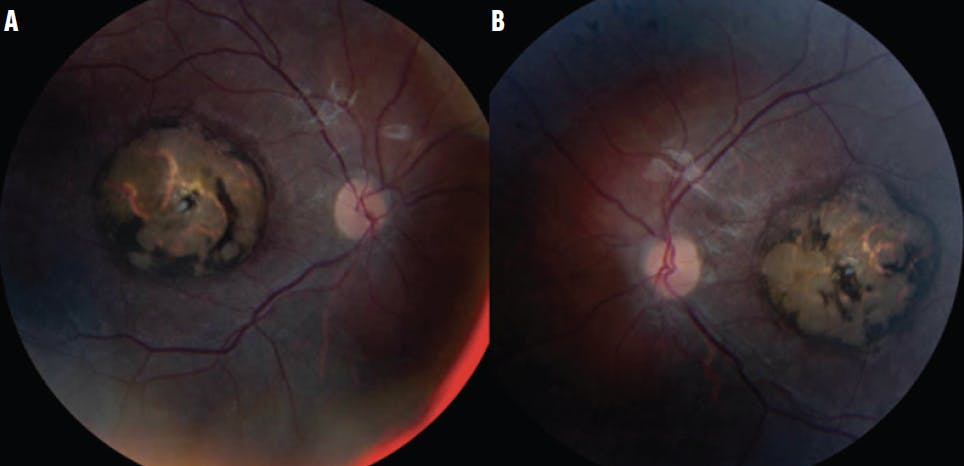
Figure. Fundus photos of the right (A) and left (B) eyes demonstrate findings consistent with a diagnosis of cobalamin C deficiency: mild optic nerve pallor, severe central macular atrophy of the outer retina/retinal pigment epithelium with visible choroidal vasculature, and diffuse peripheral pigmentary abnormalities.
A genetic evaluation that was undertaken earlier returned as notable for cobalamin C deficiency (an autosomal recessive mutation in the MMACHC gene on chromosome 1). This finding resulted in prompt initiation of supplementation and regular follow-up in the genetics clinic to ensure appropriate nutritional titration and to monitor developmental progress.
LOW VISION SUPPORT
Since his diagnosis, the patient continues to follow up routinely for eye examinations. At 11 years of age, he has reported worsening VA of 20/500 OD and 20/640 OS. Fundus examination has shown worsening retinal atrophy.
Globally, he has met developmental milestones without major illnesses or metabolic decompensation. He has done well in school and has explored many hobbies with the aid of low vision resources.
1. Lerner-Ellis JP, Tirone JC, Pawelek PD, et al. Identification of the gene responsible for methylmalonic aciduria and homocystinuria, cblC type. Nat Genet. 2006;38(1):93-100.
2. Ku CA, Ng JK, Karr DJ, et al. Spectrum of ocular manifestations in cobalamin C and cobalamin A types of methylmalonic acidemia. Ophthalmic Genet. 2016;37(4):404-414.
3. Ahrens-Nicklas RC, Whitaker AM, Kaplan P, et al. Efficacy of early treatment in patients with cobalamin C disease identified by newborn screening: a 16-year experience. Genet Med. 2017;19(8):926-935.


_1773249222.png?auto=compress,format&w=75)





