



AT A GLANCE
- During surgical exploration of an open-globe injury, the intraocular contents prolapsed through the deep scleral rupture.
- Postoperative proliferative vitreoretinopathy resulted in total retinal detachment, necessitating another trip to the OR.
- Another case of ocular trauma led to a macula-involving rhegmatogenous retinal detachment and a superior scleral rupture, which required a scleral buckle, vitrectomy, and a second surgery.
Retina surgeons are often tasked with seemingly impossible surgical scenarios, whether it’s an ocular trauma case, severe diabetic eye disease, or secondary IOL implantation, to name only a few. Surgeons must be nimble because even if the surgical plan seems straightforward, the case can quickly become a challenge if the unexpected happens.
Retina Today asked experts to share their “oh no” moments in the OR and how they handled the complications with grace.
CASE NO. 1: INTRAOCULAR CONTENTS EXTRUSION
By Takumi Ando, MD
A man in his fifties presented after his right eye had been hit by a piece of wood at work. Slit lamp examination revealed hemorrhagic chemosis and a massive hyphema in the affected eye, and a CT scan showed an irregular globe contour. B-scan ultrasonography documented vitreous hemorrhage and membranes. The patient was diagnosed with an occult globe rupture, and my surgical team immediately performed surgical exploration and planned a one-stage surgery, if possible (Video 1).
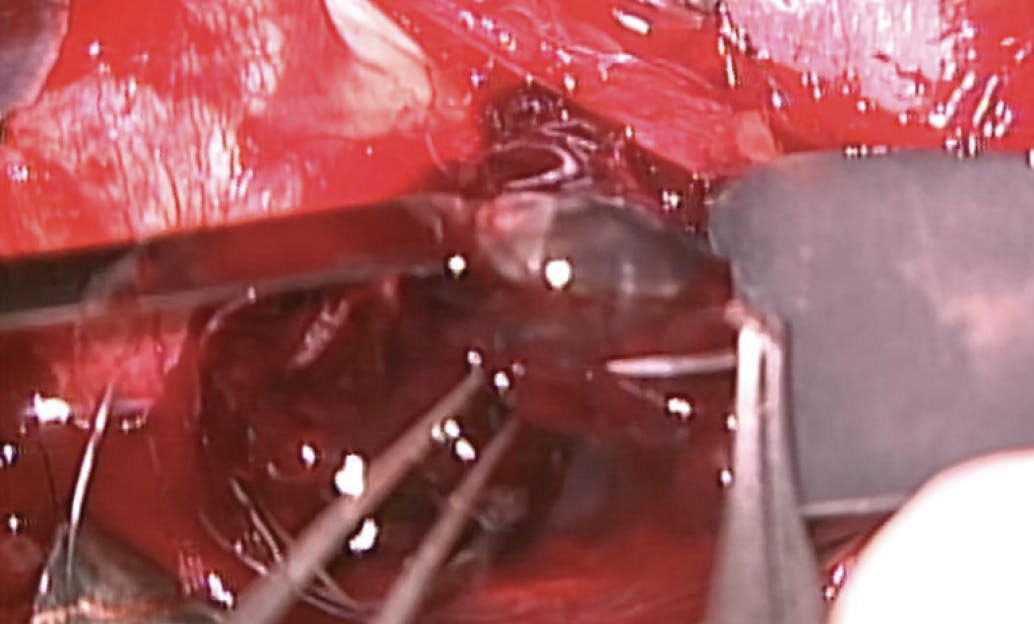
Video 1. Intraocular Contents Extrusion From a Deep Scleral Rupture.
During surgical exploration, a deep scleral rupture approximately 10 mm from the corneal limbus was found at the superotemporal quadrant (Figure 1A). Despite an attempt to suture the wound by reducing the aqueous humor as much as possible and avoiding any pressure on the globe, the intraocular contents prolapsed when the first stitch was placed (Figure 1B). Because repositioning the contents was ineffective, the vitreous body was removed, avoiding the retina. The mass was very large, and the wound remained difficult to suture; therefore, the entire contents were removed, causing extensive retinal incarceration and a retinal defect.
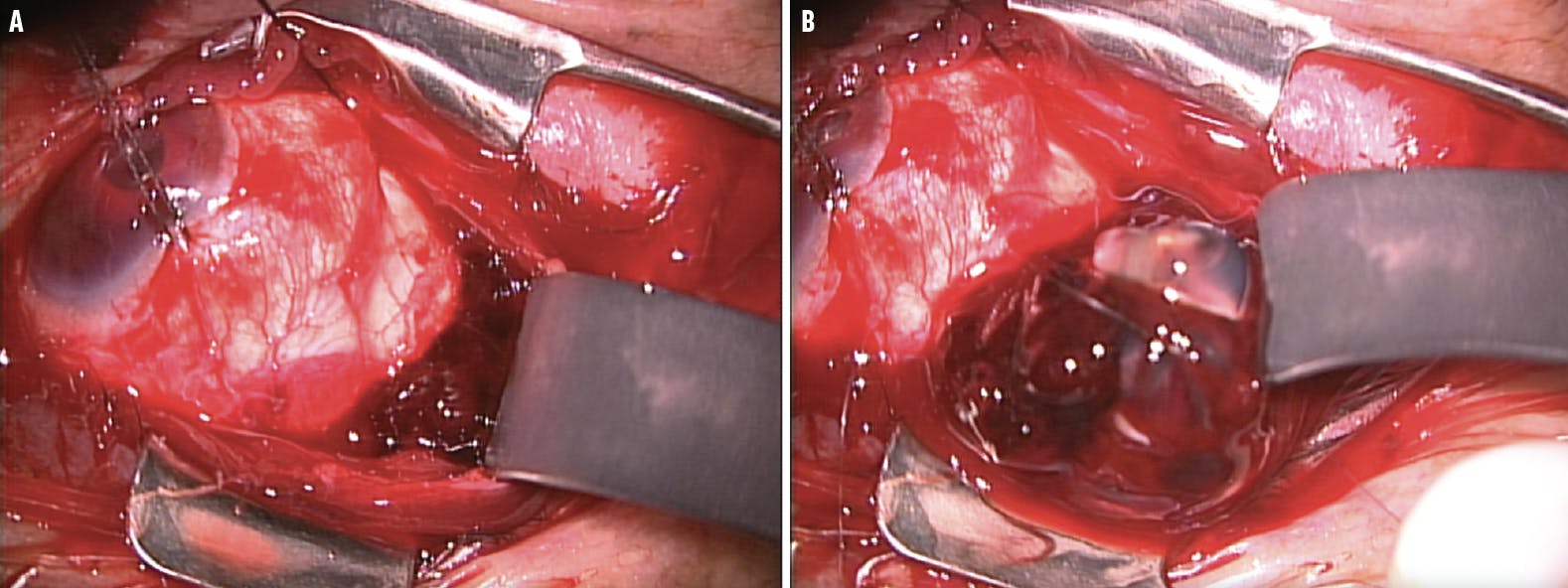
Figure 1. Surgical exploration revealed a deep scleral rupture approximately 10 mm from the corneal limbus (A), through which the intraocular contents prolapsed during surgery (B).
The scleral rupture was circumferentially long, extending under the superior rectus muscle. The superior rectus muscle was incised, and additional sutures were placed. The circumferential length of the scleral wound was approximately 25 mm. Finally, the ruptured wound was discovered to be a very deep and long scleral rupture.
After suturing, the planned lensectomy and vitrectomy was performed. Fluid-air exchange to drain the vitreous hemorrhage revealed that the entire retina was incarcerated into the superior wound. During the retinectomy, perfluorocarbon liquid was injected, but the retinal incarceration remained. We released it again, performed panretinal photocoagulation in all quadrants, and placed silicon oil.
After 4 weeks, the superior retina had been pulled into the superior ruptured wound, resulting in total retinal detachment (RD) caused by proliferative vitreoretinopathy (PVR), necessitating another trip to the OR.
At postoperative week 6, the patient’s VA was 20/500 OD. The retina was attached, but the macula had rotated upward. The nasal choroid was torn by proliferative tissues and the sclera was exposed. At 18 months follow-up, VA was counting fingers, IOP was 5 mm Hg, and neither the RD nor the PVR had recurred. Because of hypotony, the silicone oil tamponade remained in the eye.
CASE NO. 2: A HIDDEN SCLERAL RUPTURE
By Haley S. D’Souza, MD, MS, and Matthew R. Starr, MD
A 59-year-old man presented to the emergency department due to decreased vision in his left eye 2 days after sustaining a fall in which he struck his eye on a door handle. VA was 20/30 OD and hand motion OS. The left pupil was minimally reactive but without an afferent pupillary defect, and IOPs were 16 mm Hg OD and 10 mm Hg OS. Examination of the left eye was remarkable for chemosis with subconjunctival hemorrhage, anterior chamber cell, and a dense vitreous hemorrhage with no view to the posterior pole. B-scan demonstrated a nasal area suspicious for choroidal hemorrhage. The patient was started on prednisolone acetate (Pred Forte, Allergan/Abbvie) six times per day and atropine twice per day. The patient followed up in the retina clinic 2 days later, where B-scan demonstrated an area of vitreoretinal traction concerning for a tear or RD; the decision was made to proceed with early pars plana vitrectomy (Video 2).
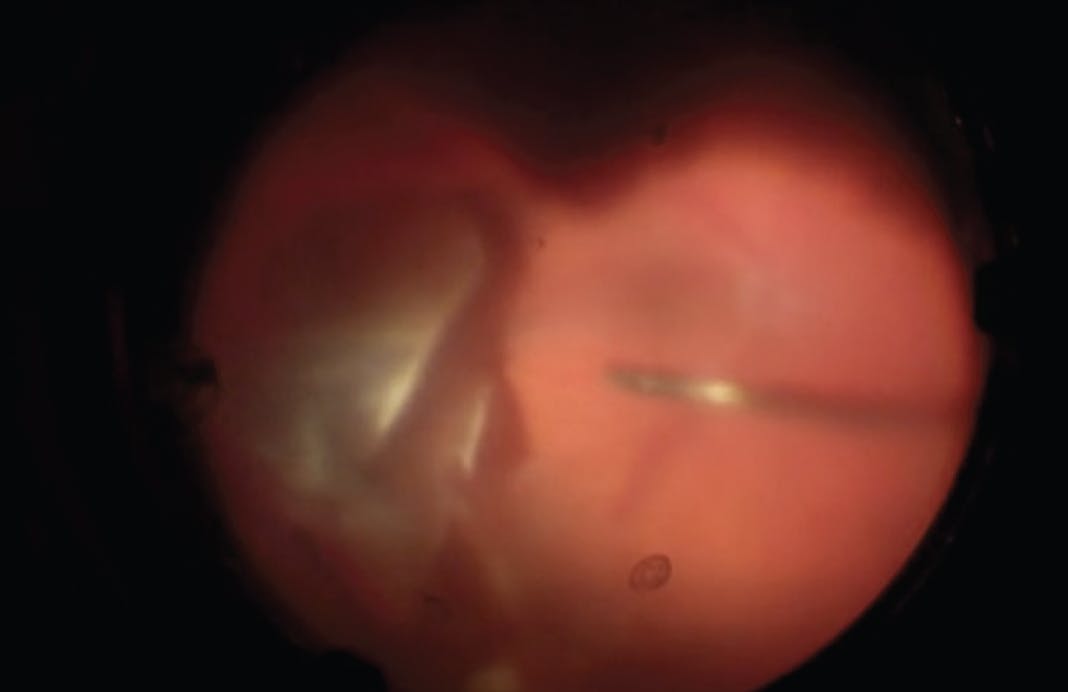
Video 2. Repairing a Hidden Scleral Rupture.
The case began with a standard three-port setup. A pre-tested infusion line was inserted and turned on after verification of positioning with the light pipe. Initial visualization revealed an extremely dense vitreous hemorrhage obscuring the view to the posterior pole. A posterior vitreous detachment was carefully induced, and then a core vitrectomy was performed. At this point, we noted a nasal macula-involving rhegmatogenous RD. After prolonged scleral depression to identify the retinal break, we were surprised to find the fluid was guttering from a superior scleral rupture site, not a retinal tear. The decision was then made to proceed with scleral buckling and an open-globe repair.
After a 360° conjunctival peritomy and dissection, the scleral rupture was noted to extend from the 9 to 3 clock hours. We imbricated and disinserted the superior rectus muscle and closed the rupture with interrupted 8-0 nylon sutures. We then tied down the superior rectus muscle in its original position. We individually isolated and cleaned the rectus muscles and found no additional rupture. We placed a 41 band around the eye with a Watzke sleeve in the superonasal quadrant.
We then performed careful vitreous base shaving. The retina was incarcerated into the scleral rupture site superiorly from approximately the 10 to 2 clock hours. We used the cutter to remove the incarcerated retina superiorly and relax the retina. We instilled perfluorocarbon liquid to reattach the retina and performed endolaser to the superior retinectomy. We then performed a fluid-air exchange and filled the eye with silicone oil.
The patient tolerated the procedure well, and the retina remained attached. Four months postoperatively, he underwent cataract extraction and removal of the silicone oil. At that time, we found that inferior PVR was resting on and just posterior to the scleral buckle, but the retina remained attached. During the oil removal, the internal limiting membrane was peeled and used as a scaffold to peel the posterior PVR.
Ten months following oil removal, the patient’s BCVA was 20/50 OS and the retina remained attached.


_1784132761.jpg?auto=compress,format&w=75)





