


One of the highlights of the 11th annual Vit-Buckle Society (VBS) meeting was the international surgical retina session, presented and moderated by experts from around the world. The session included two parts that covered tips and tricks for various surgical techniques and the outcomes of challenging cases (Figure).
ROUND ONE OF CASES
Part one was moderated by Efrem Mandelcorn, MD, FRCSC, from Canada, and Virgilio Morales-Canton, MD, from Mexico. Danilo Iannetta, MD, PhD, from Italy, presented a case of high myopia-associated macular hole and retinal detachment (RD), and he shared a video of amniotic membrane transplantation. To avoid any damage to the retinal pigment epithelium (RPE), he used a preretinal amniotic membrane transplantation. Dr. Iannetta discussed the importance of placing the amniotic membrane with the stromal layer side down for better adherence.
Şengül Özdek, MD, from Turkey, presented two successful pediatric tractional RD surgical repair cases. First, a 10-month-old boy with bilateral leukocoria achieved retinal reattachment after pupillary reconstruction with pupillary membrane removal and synechiolysis and limbal vitrectomy. Second, a 7-month-old boy with persistent fetal vasculature complicated by vitreous hemorrhage and tractional RD required a limbal lensectomy and vitrectomy with membrane peeling. The surgery resulted in retinal reattachment, and the patient was able to fix and follow light. Both cases highlighted the amazing potential of children to respond remarkably well to advanced surgeries.
Nassim Abreu-Arbaje, MD, from the Dominican Republic, presented a case of vitreous hemorrhage in a 43-year-old woman. Upon removal of the hemorrhage with vitrectomy, Dr. Abreu-Arbaje found a vasoproliferative tumor in the periphery. Among the many options, he chose to apply the triple freeze-thaw technique. His video highlighted the role of cryotherapy in effectively freezing the tumor to its apex.
Helen Mi Fang, MBBS, MMed (Ophth), FRCOphth, FAMS, from Singapore, presented a four-point IOL fixation with a transconjunctival snare technique. Dr. Fang mentioned that postoperative transient hypotony rarely occurs, and she recommended massage of the sclerotomies or, if necessary, a cautious sclerostomy suture if the wound leakage is brisk; she also noted that clinicians should avoid cutting the polytetrafluoroethylene (Gore-Tex, W.L. Gore) stitch.
Raul Velez-Montoya, MD, from Mexico, presented a technique for ultrasound-guided vitrectomy in patients with infectious keratitis endophthalmitis in which the fundus cannot be visualized. For this approach, the ultrasound probe was placed sequentially over the eye to monitor the vitreous cavity while performing the vitrectomy. He highlighted the value of this technique in cases where keratoprosthesis or endoscopic vitrectomy is not available.
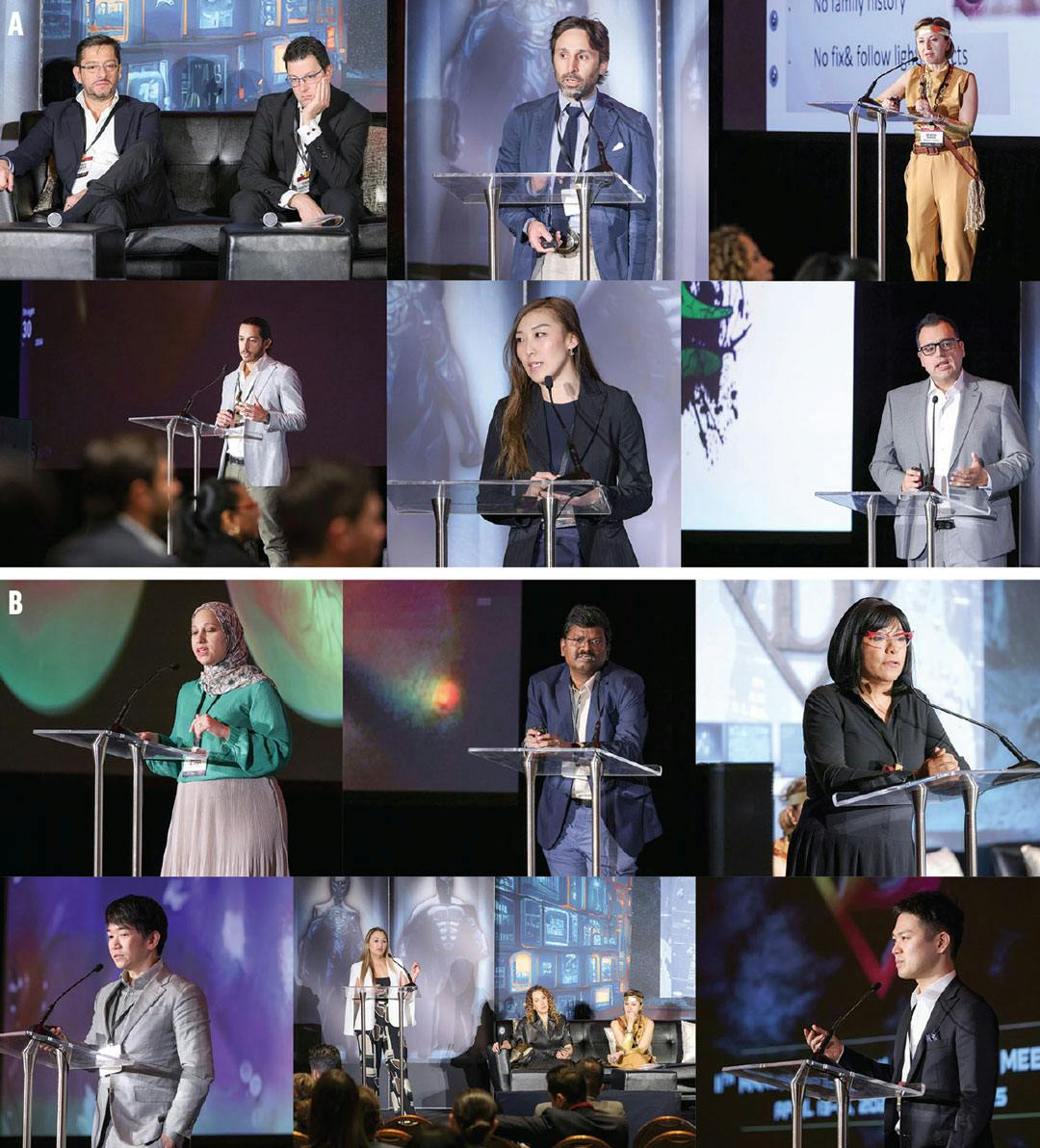
Figure. Part one of the international session was moderated by Efrem Mandelcorn, MD, FRCSC, and Virgilio Morales-Canton, MD, and presenters included Danilo Iannetta, MD, PhD; Şengül Özdek, MD; Nassim Abreu-Arbaje, MD; Helen Mi Fang, MBBS, MMed (Ophth), FRCOphth, FAMS; and Raul Velez-Montoya, MD (A). Part two included cases presented by Mariam A. Al-Feky, MD, FRCSC; Naresh Babu Kannan, MS, FNB, MBA, FASRS; Maria Ana Martinez Castellanos, MD; Chee Wai Wong, MD, PhD; Dhariana Acon, MD; and Kotaro Tsuboi, MD (B). Images courtesy of Kevin Caldwell Photography.
MORE INTERNATIONAL PERSPECTIVES
Part two was moderated by Dr. Özdek and Gabriela Lopezcarasa Hernandez, MD, from Mexico. Mariam A. Al-Feky, MD, FRCSC, from Egypt, presented challenging pediatric retinal cases. She first discussed her approach to cases of premature infants with bilateral central RDs and extensive persistent fetal vasculature and neovascularization. She opted for bilateral intravitreal anti-VEGF injections followed by vitrectomy. At 5 months postoperatively, the children were able to fix and follow. Dr. Al-Feky also presented a case of a 2.5-year-old girl with a history of ruptured globe repair and IOL implantation who presented with extensive cyclitic membrane. After explanting the IOL and cutting the membrane, she treated the RD with minimal laser power to avoid injury. Despite the guarded prognosis, Dr. Al-Feky reported another good outcome.
Naresh Babu Kannan, MS, FNB, MBA, FASRS, from India, presented his approach to the removal of a thick submacular hemorrhage with extensive fibrotic tissue and RPE patching in a patient with wet AMD. Dr. Kannan injected balanced salt solution under the retina and performed a fluid-air exchange followed by a retinectomy with diathermy in the periphery. The retina was then retracted nasally to access and remove the blood clot and fibrotic plaque. He placed an RPE graft over the macula and, very cleverly, barriered the blood clot and fibrotic tissue at the graft site.
Maria Ana Martinez Castellanos, MD, from Mexico, gave an excellent talk on approaches to pediatric laser therapy. She has an anesthesiologist sedate patients who are younger than 6 years of age and then performs an ultra-widefield fluorescein angiography. Then, areas of avascular retina are lasered, guided by angiography, at the slit lamp. In children older than age 6, she uses methoxyflurane, which does not alter patients’ consciousness while providing good analgesia for up to 20 minutes. Methoxyflurane, although widely used in sports in many countries, is banned in the United States due to its association with acute renal failure with repeated use in cancer patients. However, Dr. Castellanos noted that, with limited use and careful consideration of contraindications, side effects may be minimal.
Chee Wai Wong, MD, PhD, from Singapore, presented on high myopes with macular hole RDs that extended beyond the arcades. He first placed a PFO bubble over the disc and macular hole to prevent the subretinal migration of the dye and provide counter-traction while performing the internal limiting membrane (ILM) peel and flap. He highlighted the importance of repeated staining to ensure all the ILM is peeled up to the edges of the staphyloma. He demonstrated the value of using intraoperative OCT for visualizing and confirming the placement of the ILM flaps over the hole.

CHECK OUT OUR VIDEO COVERAGE OF VBS 2023
Dhariana Acon, MD, from Costa Rica, presented challenging cases of tractional RD in patients with diabetes. She had excellent outcomes despite vitreous hemorrhages and difficulty viewing the retina. She opted to use a chandelier with bimanual surgery to aspirate the bleeding and dissect the thick membranes.
Kotaro Tsuboi, MD, from Japan, gave an informative talk on the anterior chamber fluid-gas exchange technique. The technique combines intraocular gas injection and an anterior chamber tap from a paracentesis wound, where all aqueous is removed through the anterior chamber. Dr. Tsuboi demonstrated that injection of the necessary amount of a nonexpanding gas is done inferiorly 3.5 mm posterior to the corneoscleral limbus. A paracentesis is then performed to remove aqueous in the vitreous cavity through the anterior chamber. Dr. Tsuboi noted that the advantages of this technique include complete filling of the vitreous cavity with gas, which may be helpful for patients with difficultly maintaining strict postures.1
1. Tsuboi K, Kamei M. Anterior chamber fluid-gas exchange. Retina. 2022;42(9):1814-1815.


_1784132761.jpg?auto=compress,format&w=75)





