


AT A GLANCE
- Research shows that Black, American Indian or Alaska Native, and Asian patients are underrepresented in retina clinical trials conducted between 2012 and 2022.
- The author mapped out the retina trial site locations that repeatedly recruited patients from ethnically/racially diverse backgrounds, although poor data reporting limited the study.
- Leaders in the field should learn more about the lived experiences of students underrepresented in medicine to encourage inclusion and improve community health outcomes.
- Studies such as this one may not solve the problem, but they are necessary to change how the field views clinical trial recruitment.
This article provides a unique glimpse into not only clinical trial data reporting and analysis, but also the worldview of the researchers themselves—emphasized in italics—and how their lived experiences influence the questions they ask.
– Rebecca Hepp, Editor-in-Chief
Participating in clinical research is a privilege, especially for trainees who are underrepresented in medicine (URiM). Although Black, Hispanic, and Native American groups represent 30.7% of the US population, they are not equally represented in medicine. In ophthalmology in particular, they comprise 6% of practicing ophthalmologists, 5.7% of ophthalmology faculty, and 7.7% of ophthalmology residents.1
As a first-generation, nontraditional student from the Inland Empire community, I was particularly interested to find that only 6% of US physicians are Latino, despite 19% of the US population identifying as Latino—a population that is expected to triple by 2050.2,3
My own nonlinear journey to medical school showed me what health disparities were long before academia explained the concept. I was a research coordinator prior to medical school—a job driven more by my status as a single mother (of twin boys!) than my love for research. But the experience led me to wonder why our clinical trial patients didn’t quite represent our Inland Empire community, and I started asking questions. What were the barriers to recruiting Latino patients? Why didn’t our Latino population meet the hemoglobin A1c inclusion criteria set for the trials? Why did clinicians seem to stereotype my community for being noncompliant with treatments? Was it because patients couldn’t relate to their doctors, and vice versa?
And that’s where my research journey truly began: with a personal connection with the patients themselves.
With my mentor, Vivienne S. Hau, MD, PhD, I set out to discover whether racial and ethnic minorities are equitably represented in retina clinical trials.4
UNDERREPRESENTATION IN RETINA CLINICAL TRIALS
We examined a total of 80 US-based retina trials conducted between 2012 and 2022 and compared the enrollment data with 2019 US Census data on race and ethnicity.5 We reported our race and ethnicity data based on the categories used on clinicaltrials.gov and by the Office of Management and Budget (OMB) Standards: American Indian or Alaska Native (AI/AN), Asian, Black or African American, Native Hawaiian or Other Pacific Islander (NH/PI), White, more than one race, or unknown.6 We also collected ethnicity data using the standard classification of Hispanic or Latino, non-Hispanic or non-Latino, or unknown.
Of the 80 trials included, only 49 (61.25%) reported race per OMB standards. The following race categories were underrepresented in retina clinical trials compared with the US Census data: Black (8.73% vs 12.66%), AI/AN (0.59% vs 0.82%), Asian (4.29% vs 5.27%), and more than one race (0.28% vs 3.07%). NH/PI (0.25% vs 0.18%) and White (79.96% vs 73.21%) were overrepresented in clinical trials.
Ethnicity
When we looked at ethnicity, 30 (37.50%) of the studies reported this per OMB standards. Three studies used custom reporting of race and ethnicity data, with 231 (2.99%) patients listed as Hispanic/Latino. Within the 30 studies reporting ethnicity per OMB standards, 486 (6.29%) participants were Hispanic/Latino, 3,778 (48.87%) were non-Hispanic/non-Latino, 21 (0.27%) were of unknown ethnicity, and 3,251 (41.59%) had no ethnicity reported. Hispanic patients are largely underrepresented in clinical trials compared with US Census data (13.11% vs 15.36%) compared with non-Hispanic patients (86.50% vs 84.68%).
A Focus on Diabetes
The trials were also stratified by disease state: diabetic retinopathy (DR, 37.50%), retinal vein occlusion (12.5%), and AMD (40%). We focused on DR studies and found a total of 30 studies that included 2,964 patients: 25 studies involved diabetic macular edema, one involved nonproliferative DR, and four involved proliferative DR. Ethnicity was poorly reported, as only nine (30%) studies reported ethnicity per OMB standards. In those nine studies, 448 patients were reported as Hispanic/Latino, 715 were non-Hispanic/non-Latino, three were of unknown ethnicity, and 1,798 patients had no reported ethnicity. In comparison, race was reported in 20 studies (66.67%), with the largest groups being White (n = 1,851, 69.14%) and Black (n = 433, 16.17%) patients. Black and NH/PI patients had a larger presence in diabetes-related trials versus non-diabetes-related trials (16.17% vs 2.92% and 0.45% vs 0.09%, respectively).
Other researchers published similar findings soon after we presented this data at the 2022 American Society of Retina Specialists (ASRS) annual meeting.7
A HELPING HAND
I am grateful for the funded programs that have helped me get where I am today:
Mapping Disparities
As a continuation study, we identified trends in the recruitment of racial and ethnic minorities by geographic location in retina clinical trials over the last 10 years, and we presented our findings at the 2023 ASRS annual meeting.8 Of 30 DR trials, 90 clinic sites recruited at least one racial/ethnic minority. Using a LivingAtlas Map available on arcGIS, we mapped out the retina trial site locations that repeatedly recruited our populations of interest (Figure 1).9
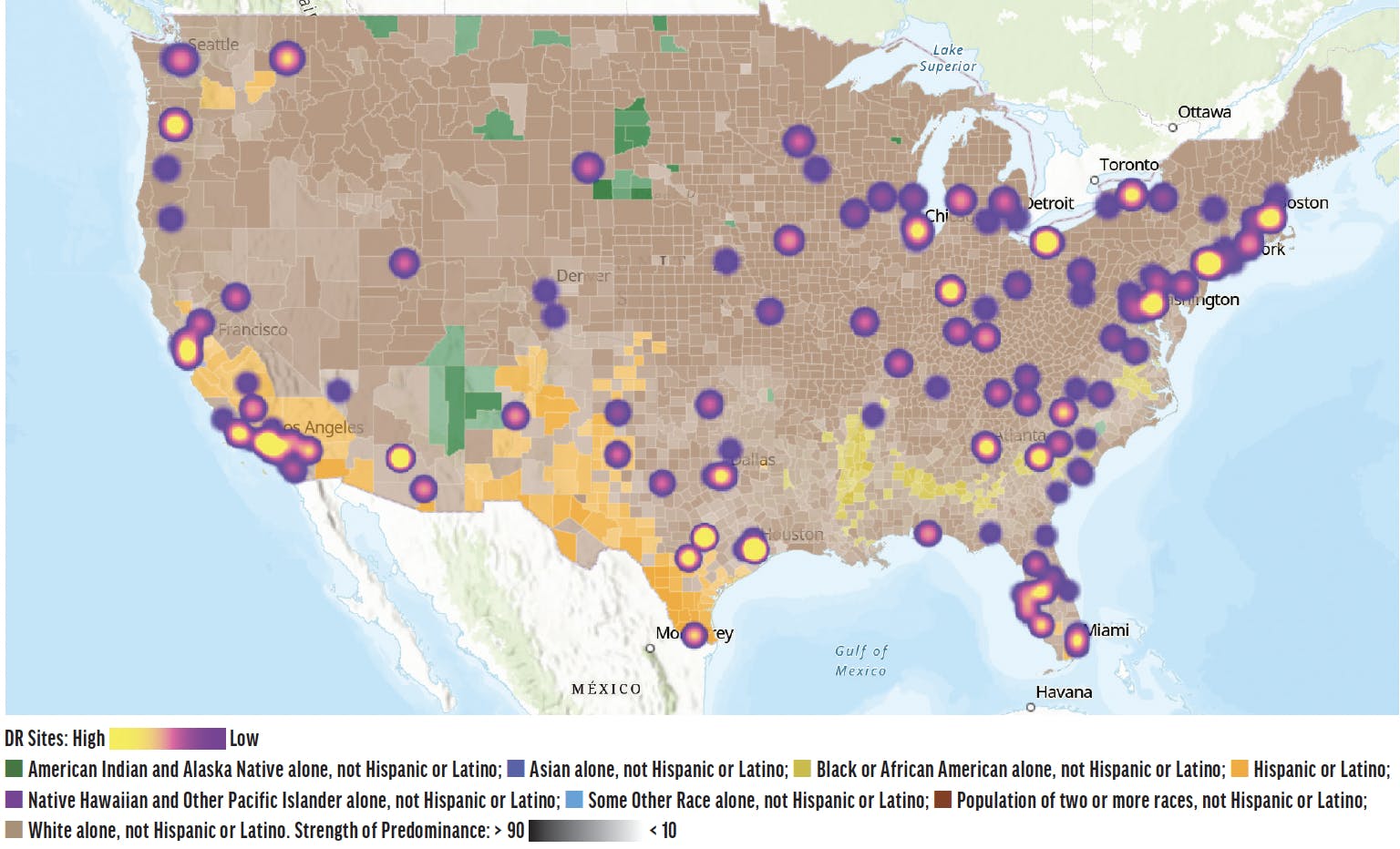
Figure 1. This map depicts continental US Census data overlayed with diabetes-related clinical trial locations. The trial sites are indicated with purple dots that brighten and increase in size with increased magnitude of recruiting racially/ethnically diverse participants. Although emphasis in recruiting in metropolitan areas is shown, the numbers recruited are not representative of the underlying Census data on race and ethnicity information by county.9
Although the map suggests some balance between Census data and trial recruitment, the raw numbers of participation reveal a significant lack of demographics reporting data, which limited our study (Figure 2).
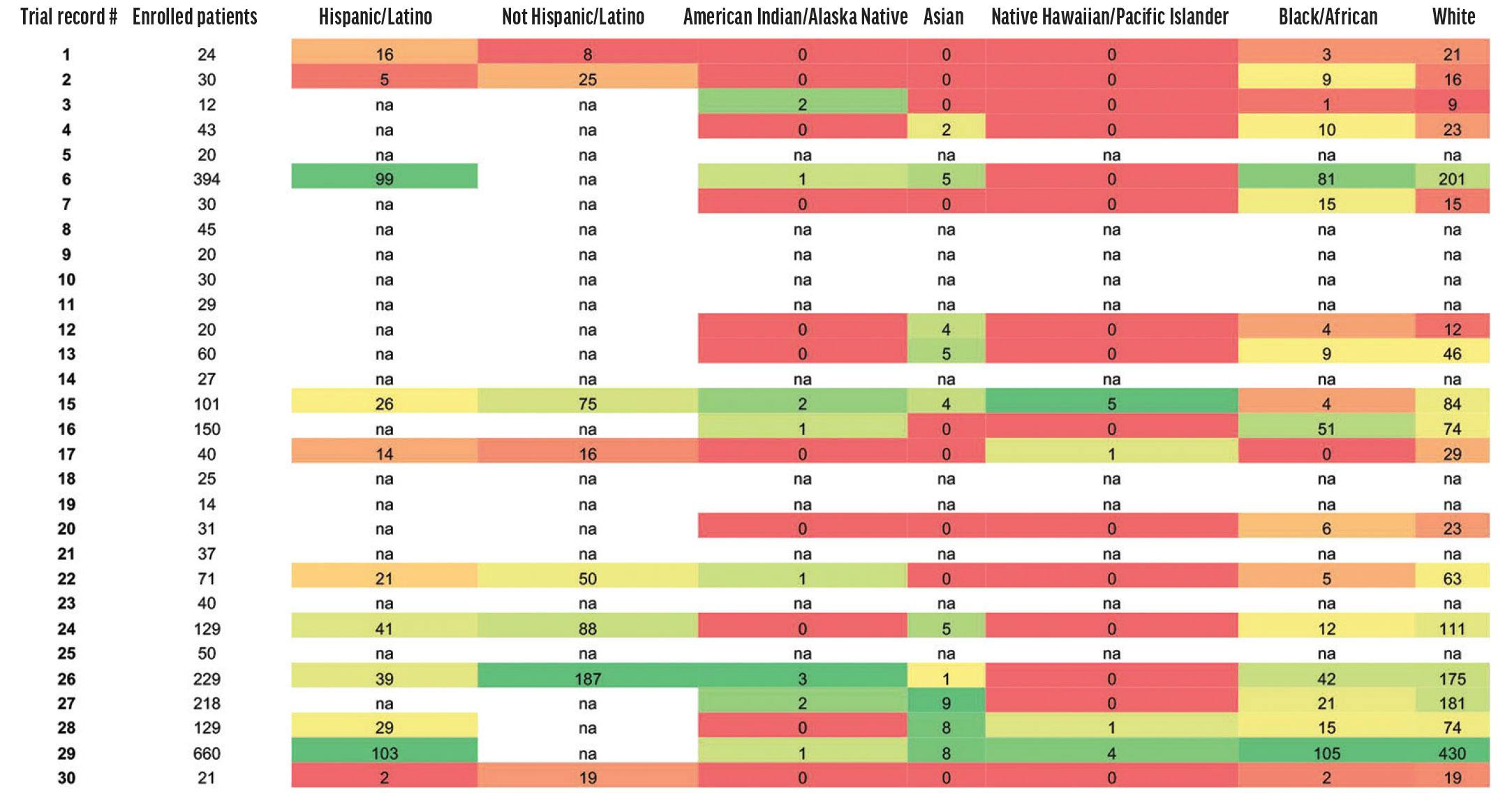
Figure 2. This is the breakdown of the 30 DR trials included in our study. Each were color-coded as red, yellow, or green based on the demographics data that were reported. Red represents low/lacking demographics data, yellow indicates some data was recorded, and green indicates a robust reporting of demographics information. Rather than show over- or underrepresentation within each trial, this chart indicates just how much a lack of demographics data reporting limits studies like ours.
TRANSLATING DATA TO PRACTICE
In conducting this research, I learned that diversity, equity, and inclusion (DEI) topics must be explored with caution. At times, I struggled to discuss entire groups of people in monoliths, and I didn’t like the word minority in our title. As a member of the Inland Empire, I didn’t see the Latino population as a minority. The term minoritized may be a better representation.
Another problem that I struggled with was that we were just describing a problem, not solving it. Nonetheless, studies like ours are necessary because they change how the field views clinical trial recruitment and help us move toward better representation. We can use this as a starting point to venture into studies that create change instead of merely discussing problems.
I hope this piece provides insight into not only the complexities of DEI-related research within ophthalmology, but also who is doing the research. I encourage leaders in the field to learn about the educational paths of URiM students. For many, simply making it to college is an incredible accomplishment, let alone getting accepted into medical school and pursuing a specialty. We must encourage diverse practitioners to join this space based on active engagement in the communities they are serving; this will build URiM representation in medicine and improve the health outcomes of our communities—doctors and patients will finally relate to each other’s lived experiences.
1. Xierali IM, Nivet MA, Wilson MR. Current and future status of diversity in ophthalmologist workforce. JAMA Ophthalmol. 2016;134(9):1016-1023.
2. Poll-Hunter N. 6% is not enough. Association of American Medical Colleges. October 17, 2023. Accessed October 26, 2023. www.aamc.org/news/6-not-enough
3. Passel JS, Cohn D. U.S. Population Projections: 2005-2050. Pew Research Center. February 11, 2008. Accessed October 26, 2023. www.pewresearch.org/hispanic/2008/02/11/us-population-projections-2005-2050
4. Hau VS. Assessment of the inclusion of racial/ethnic minorities in retina clinical trials. Presented at ASRS 2022; New York, NY; July 16, 2022.
5. National population by characteristics: 2010-2019. United States Census Bureau. Update February 2022. Accessed October 26, 2023. www.census.gov/data/tables/time-series/demo/popest/2010s-national-detail.html
6. Office of Management and Budget (OMB) Standards. National Institutes of Health. Accessed October 26, 2023. https://orwh.od.nih.gov/toolkit/other-relevant-federal-policies/OMB-standards
7. Kaakour A, Hua H, Rachitskaya A. Representation of race and ethnicity in randomized clinical trials of diabetic macular edema and retinal vein occlusion compared to 2010 US Census data. JAMA Ophthalmol. 2022;140(11):1096-1102.
8. Hau VS. Geographic trends in the recruitment of participants of racial and ethnic minorities for diabetic retinopathy-related clinical trials. Presented at ASRS 2023; Seattle, WA; July 30, 2023.
9. USA 2020 Census race and ethnicity characteristics - metro geographies. ArcGIS. Accessed October 26, 2023. www.arcgis.com/apps/mapviewer/index.html?layers=038d9be721ae486a9cc82937fdad913e


_1773249222.png?auto=compress,format&w=75)





