


AT A GLANCE
- Women comprise about half of the medical student population yet make up 22% to 54% of surgical residents and fellows across subspecialties.
- Residency program directors and selection committee members should implement a holistic application review and selection process to improve the match for underrepresented-in-medicine applicants into our field.
- Mentorship programs create mentor-mentee partnerships and support opportunities for junior residents to present at national conferences.
Ophthalmic advancement, patient-centered care, and outreach are contingent on sustained efforts that recruit and retain a diverse workforce within our dynamic specialty.
WHERE WE STAND
The Association of American Medical Colleges (AAMC) defines underrepresented in medicine (URiM) as “those racial and ethnic populations that are underrepresented in the medical profession relative to their numbers in the general population.”1 While this definition allows for routine accommodations based on changing ethnic populations within our country, the groups to whom this definition most commonly applies to are Blacks, Hispanics, Native Americans (American Indian/Alaska Native/Native Hawaiian), and mainland Puerto Ricans.1,2
Decades of ophthalmic research has demonstrated vast examples of disease-specific disparities in treatment and outcomes based on race/ethnicity, socioeconomic status, and other factors.3 Importantly, physician-patient concordance in demographic factors (eg, race/ethnicity, culture, and gender) increases patient satisfaction, medical adherence, and health outcomes.4-6 However, women comprise approximately half of the medical student population yet make up 22% to 54% of surgical residents and fellows across subspecialties.7 Similarly, URiMs comprise 7.7% of resident trainees, 6% of practicing ophthalmologists, and 5.7% of ophthalmology faculty, despite making up 30.7% of the US population.8
By lacking in diversity, ophthalmology misses out on the wealth of knowledge and experiences embodied within women and URiM trainees that can help tackle complex research and clinical challenges, coined the diversity bonus by social scientist Scott E. Page, PhD.9
AN UNEQUAL EDUCATION SYSTEM
Nearly 70 years after the landmark 1954 Brown vs. Board of Education Supreme Court ruling, our country’s education system continues to perpetuate unequal learning opportunities. There is a stark opportunity gap between Black and White students (known as the achievement gap).10,11 Black students are more likely to attend schools with less funding per student, have less access to advanced placement courses, have lower rates of acceptance into gifted programs, experience lower expectations from teachers, and receive greater suspensions and discipline.12-14
Although we cannot uproot decades of inequitable education, we can acknowledge its existence. Ophthalmologists in a position of influence must examine each step of the student-to-physician pipeline to develop sustainable programs and policies that will increase awareness of our specialty, offer academic and research support, promote holistic evaluations, and prioritize longitudinal career development and retention.
Undergraduate and Graduate Training
It is imperative that URiM students establish an ophthalmology mentor early in their educational training. Health expos, career exploration days, and youth summits are invaluable because they can impress upon young learners that a career in ophthalmology is real and attainable.
At the collegiate level, we must recognize the valuable role that Historically Black Colleges and Universities (HBCUs) play in the student-to-physician pipeline; they educate 10% of all Black undergraduates, accounting for 17% of bachelor degrees and 24% of STEM field degrees earned by Black students.15 Many minority patients still find the greatest amount of trust and reliability in the medical centers that are associated with or predominantly staffed by members of their own community. Without a doubt, partnership with HBCUs is integral to meeting the demand of diversifying our field with bright and culturally competent physicians.
Linz et al performed a cross-sectional survey of the reasons why medical students (particularly URiMs) chose not to pursue a career in ophthalmology.16 Regardless of URiM status or gender, the top reasons included insufficient interest and lack of exposure. A greater percentage of URiMs, however, responded that ophthalmology had insufficient role models or mentorship opportunities. This same group expressed “concern for finding same-race or same-gender role models/mentors in this field” and “concern about the lack of ethnic/racial diversity in the field.”16
Post-graduate Training and Faculty
Residency program directors and selection committees hold one of the most powerful positions to transform the diverse landscape of our field. We suggest two strategies to aid significantly in matching URiMs into our field.
First, directors and committee members should be aware of their personal biases (one tool is the Harvard Implicit Association Test17) and work to actively deconstruct them.
Second, committees should implement a holistic application review and selection process, which is particularly important given the fact that overreliance on the United States Medical Licensing Examination scores can eliminate many URiM applicants from review.18
A 2022 cross-sectional study found that among all medical disciplines, ophthalmology has the second lowest number of URiM residents.19 The 8-year study (2011-2019) did not observe a positive trend of URiMs entering surgical specialties but did see a positive trend with non-surgical specialties. Still, we are encouraged to see an annual increase in the percentage of Black medical students who successfully matched between 2020 and 2022.20 This milestone would not have been possible without the efforts of pipeline programs such as the AAO’s Minority Ophthalmology Mentoring Program and the Rabb-Venable Excellence in Ophthalmology Research Program, the latter of which held an outstanding match rate of 75% between 2008 and 2020.21
Women and URiMs continue to be underrepresented across surgical fields. Choinski et al examined surgical fellow application demographics in 2018 and found that women constituted 26% to 54% of applicants (lowest in thoracic surgery and highest in pediatrics). URiMs accounted for 9% to 15% of applicants (lowest in colorectal surgery and highest in pediatrics).7
Ali et al completed one of the first studies investigating the sex and racial disparities among ophthalmology subspecialty fellowship applicants. Pediatric ophthalmology had the highest percentage of matched applicants who were women, while vitreoretinal surgery had the highest percentage of men. URiMs, who represented 8.8% of all matched fellows, had a lower match rate (55%) compared with their non-URiM counterparts (72.2%).22 In addition, underrepresented applicants had a lower median of 10 submitted applications for fellowship compared with Asian and White applicants (21 and 17, respectively). One potential reason for this discrepancy is the financial barrier. On multivariable analysis, there were higher odds of matching into fellowship with more completed interviews and a higher Step 2 CK score.22
A lack of diversity among premedical students leads to a lack of diversity in medical school training, residency, fellowship, and faculty. Fairless et al analyzed the 2019 AAMC faculty roster and found that ophthalmology had only eight URiM chairpersons and the third lowest proportion of URiM faculty compared with 17 other clinical departments.23 While the proportion of URiMs entering medical school has increased, this has not translated into the recruitment, retention, and equitable promotion of URiM faculty members and chairpersons across many specialties, including ophthalmology.24 The potentially taxing experience of a URiM faculty member without career development, mentor support, and perception of inclusion and equity should not be ignored.25 As URiM trainees consider the pursuit of further training, one determining factor may be how a particular subspecialty and future department will support their professional growth.
Mentorship Programs
Pipeline programs are crucial in a trainee’s career trajectory (Figure). Mentorship programs can provide surgical simulations, create mentoring partnerships, and support opportunities for junior residents to present at national conferences. For example, the Vit-Buckle Society developed the Fostering Careers for Underrepresented Stars program, an initiative designed to expose URiMs to surgical retina alongside junior and senior faculty mentors. The Retina Society established its Underrepresented in Medicine Mentoring Program, which provides mentor-mentee partnering for the development of research projects and subsequent publication.
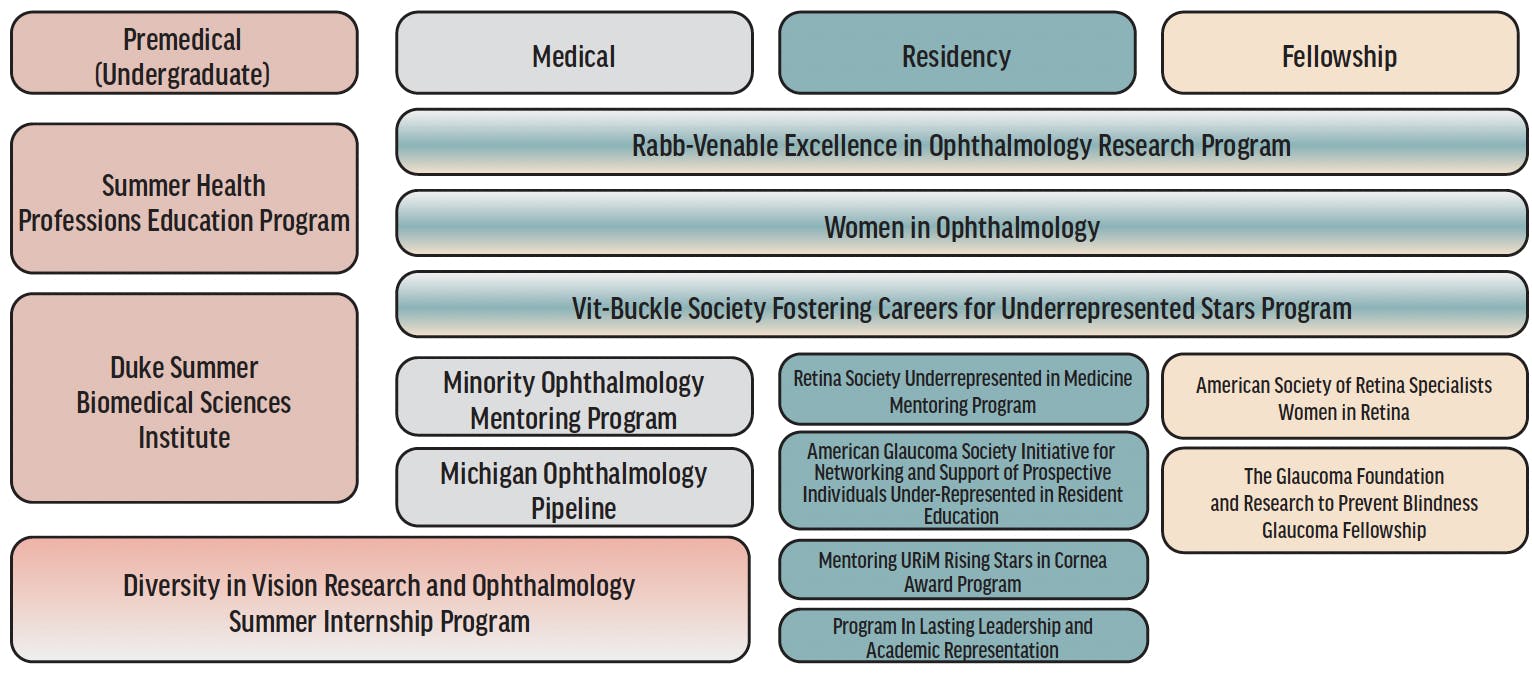
Figure. These pipeline programs for URiMs in ophthalmology and ophthalmology subspecialties continue to help us achieve a diverse ophthalmic workforce. While this list is not exhaustive, we applaud the ongoing work across numerous medical schools, trainee hospitals, and health care societies to further this mission.
Women in Ophthalmology provides an annual mentor-mentee match for residents interested in a subspeciality. With this program, trainees can gain gender-congruent advice on important topics such as work-life balance, leadership, and how to navigate male-dominated organizations.
The Program in Lasting Leadership and Academic Representation, supported by the Byers Eye Institute and the Rabb-Venable Excellence in Ophthalmology Program, is geared toward the recruitment of URiMs into academic ophthalmology. The program provides interactive panels on various topics, such as how to become future program leaders, apply for career development awards, and build partnerships with medical device and pharmaceutical companies.
Industry partners have also developed career development awards to support junior URiM faculty within academic medicine. For example, the Genentech Career Development Award for Underrepresented Minority Emerging Vision Scientists provides monetary support and mentorship outside of the recipient’s home institution.
WHY IT MATTERS
It behooves us to invest our resources and time in all stages of the student-to-physician pipeline; in doing so, we will increase the diversity of our subspecialty fellowship applicants and academic faculty.
1. AAMC. Underrepresented in medicine definition. Accessed January 27, 2024. bit.ly/3HCIz3X
2. Clay WA, Jackson DH, Harris KA. Does the AAMC’s definition of “underrepresented in medicine” promote justice and inclusivity? AMA J Ethics. 2021;23(12):E960-964.
3. Elam AR, Tseng VL, Rodriguez TM,et al. Disparities in vision health and eye care. Ophthalmology. 2022;129(10):e89-e113.
4. Takeshita J, Wang S, Loren AW, et al. Association of racial/ethnic and gender concordance between patients and physicians with patient experience ratings. JAMA Network Open. 2020;3(11):e2024583-e2024583.
5. Saha S, Komaromy M, Koepsell TD, Bindman AB. Patient-physician racial concordance and the perceived quality and use of health care. Arch Intern Med. 1999;159(9):997-1004.
6. Adamson AS, Glass DA, Suarez EA. Patient-provider race and sex concordance and the risk for medication primary nonadherence. J Am Acad Dermatol. 2017;76(6):1193-1195.
7. Choinski K, Lipsitz E, Indes J, et al. Trends in sex and racial/ethnic diversity in applicants to surgery residency and fellowship programs. JAMA Surgery. 2020;155(8):778-781.
8. Xierali IM, Nivet MA, Wilson MR. Current and future status of diversity in ophthalmologist workforce. JAMA Ophthalmol. 2016;134(9):1016-1023.
9. Page SE. The Diversity Bonus. Princeton University Press; 2019.
10. Ladson-Billings G. Pushing past the achievement gap: an essay on the language of deficit. J Negro Ed. 2007;76(3):316-323.
11. Quinn DM, Desruisseaux T-M. Replicating and extending effects of “achievement gap” discourse. Ed Researcher. 2022;51(7):496-499.
12. Spatig-Amerikaner A. Unequal Education: Federal Loophole Enables Lower Spending on Students of Color. Center for American Progress. 2012.
13. Gershenson S, Holt SB, Papageorge NW. Who believes in me? The effect of student–teacher demographic match on teacher expectations. Economics Ed Rev. 2016;52:209-224.
14. Rights UDoEOfC. 2013–2014 civil rights data collection: A first look. US Department of Education Office for Civil Rights. 2016.
15. United Negro College Fund I. HBCUs make America strong. Accessed January 27, 2024. bit.ly/3w2bdZO
16. Linz MO, Jun AS, Clever SL, Lawson SM, Sanyal A, Scott AW. Evaluation of medical students’ perception of an ophthalmology career. Ophthalmology. 2018;125(3):461-462.
17. Greenwald T BM, Nosek B. Accessed Harvard Implicit Association Test—Education. Project Implicit. Accessed January 27, 2024. implicit.harvard.edu/implicit/education.html
18. Knight OR. How over-reliance on USMLE scores inhibits diversification of ophthalmology. Association of University Professors of Ophthalmology. 2021. Accessed January 27, 2024. www.loom.com/share/3e9dc729e4fe4335b79c121821141fb6
19. Aguwa UT, Aguwa CJ, Onor GI, et al. Racial and ethnic diversity within U.S. residencies: trends from 2011 to 2019. J Surg Ed. 2022;79(3):587-594.
20. Ophthalmology AoUPo. Gender and ethnicity data: ophthalmology residency. January 2022. Accessed January 27, 2024. aupo.org/sites/default/files/2022-03/Feb%202022-Oph%20Residency%20Match-Demographic%20Stats%20final.pdf
21. Knight OJ, Padovani-Claudio DA, Croteau-Chonka CC, Olivier MMG, Miller-Ellis EG. Rabb-Venable Excellence in Ophthalmology Research Program: contributions to ophthalmology workforce diversity. J Acad Ophthalmol. 2021;13(2):e298-e303.
22. Ali M, Menard M, Zafar S, Williams BK Jr, Knight ORJ, Woreta FA. Sex and racial and ethnic diversity among ophthalmology subspecialty fellowship applicants. JAMA Ophthalmology. 2023;141(10):948-954.
23. Fairless EA, Nwanyanwu KH, Forster SH, Teng CC. Ophthalmology departments remain among the least diverse clinical departments at United States medical schools. Ophthalmology. 2021;128(8):1129-1134.
24. Abelson JS, Wong NZ, Symer M, Eckenrode G, Watkins A, Yeo HL. Racial and ethnic disparities in promotion and retention of academic surgeons. Am J Surg. 2018;216(4):678-682.
25. Pololi LH, Evans AT, Gibbs BK, Krupat E, Brennan RT, Civian JT. The experience of minority faculty who are underrepresented in medicine, at 26 representative U.S. medical schools. Acad Med. 2013;88(9):1308-1314.


_1784132761.jpg?auto=compress,format&w=75)





