


As imaging has advanced in the field of retina, so has our ability to distinguish various clinical entities such as wet AMD, polypoidal choroidal vasculopathy (PCV), and central serous chorioretinopathy (CSCR). Advances in spectral-domain OCT, OCT angiography (OCTA), fluorescein angiography (FA), ICG angiography (ICGA), and fundus autofluorescence (FAF) have made diagnosing these clinical entities easier and tracking treatment responses more manageable.
Here, we discuss how multimodal imaging can help differentiate classic wet AMD from PCV and CSCR.
BASELINE IMAGING OF THE AMD SUSPECT
In addition to fundus photography, many other imaging tools are useful at the initial visit. Findings such as intraretinal fluid (IRF), subretinal fluid (SRF), pigment epithelial detachment (PED), and subretinal hyperreflective material (SHRM) on OCT can be used to monitor disease activity and determine when to initiate intravitreal injections and when to follow up with patients.1
OCT findings can also serve as biomarkers for visual outcomes. For example, the FLUID study demonstrated that patients administered ranibizumab (Lucentis, Genentech/Roche) on a treat-and-extend basis for an intensive fluid regimen (intolerance of both IRF and SRF) versus those on a relaxed fluid regimen (tolerance of SRF except for > 200 µm at the foveal center) had similar visual outcomes.2
Moreover, unique OCT findings can help identify patients with specific types of neovascularization. For example, one of the earliest signs of type 3 macular neovascularization (MNV) is a punctate hyperreflective focus above the external limiting membrane (ELM), anterior to a PED.3 Additionally, the presence of a double-layer sign can be suggestive of PCV.4
FA is helpful for detecting and grading MNV and is particularly useful when distinguishing MNV secondary to AMD from entities such as CSCR or choroiditis.5
Classic CNV on FA is characterized by a well-demarcated area of hyperfluorescence appearing early and exhibiting progressive leakage. The border of the lesion can be intense with a central hypofluorescence. The lesion continues to leak into late phases, obscuring the boundaries of the lesion.
Occult CNV is characterized as either a fibrovascular PED or late leakage of an undetermined source. Fibrovascular PED has ill-defined areas of irregular elevation of staining/leaking with stippled hyperfluoresence. Late leakage of undetermined source is a less common form of occult CNV in which poorly defined areas of leakage appear at the level of RPE in the late phase.
Retinal angiomatous proliferation (RAP) can present as a combination of findings such as intraretinal leakage and/or hemorrhage and serous PED.6
The major constraint of FA is that it is time-consuming and has a rare, yet life-threatening side effect of anaphylaxis.
OCTA can directly visualize type 1 MNV without using intravenous dyes. A literature review found that the incidence of conversion to exudation, as documented with OCTA, ranged between 20% and 80% (between 6 months and 2 years).7 One of the studies found that patients with dry AMD identified on OCTA in one eye and wet AMD in the other eye demonstrated approximately an 18-fold increased risk of subsequent exudation.8
Limitations to OCTA include movement artifacts, the need for clear media, and difficulties detecting flow beneath PEDs.9
Indocyanine green has a greater binding affinity to plasma proteins than fluorescein and is associated with minimal leakage through the fenestrated choriocapillaris, allowing better visualization of the choroid than with FA. This may be useful for detecting MNV beneath macular hemorrhage and for distinguishing between AMD and PCV.4
FAF is particularly useful in monitoring geography atrophy, which corresponds to a hypoautofluorescent lesion within the macula. Specific patterns on FAF can correlate with changes in visual acuity that do not result from MNV.10 In addition, FAF is useful in distinguishing atrophic lesions other than AMD, such as acquired vitelliform lesions.
FOLLOW-UP IMAGING
At subsequent visits, multimodal imaging is often not a requirement unless the diagnosis of AMD remains in question. If it is, further imaging can help. Most retina specialists would agree that every visit should involve OCT because of its greater sensitivity for monitoring MNV activity compared with clinical examination. Patients with an increase in retinal thickness greater than 10% compared with prior visits will likely have clinically significant disease activity.3
A lack of response to intravitreal anti-VEGF therapy should raise suspicion for other etiologies such as CSCR, drusenoid PED, and acquired vitelliform lesions. Additional imaging, such as enhanced-depth imaging OCT can help to identify focal choroidal vascular dilation, thickening, subretinal fibrosis, and choroidal neovascularization, all of which can be found in chronic CSCR.11
Depending on the scenario, a patient with dry AMD can be monitored with OCTA. Moreover, OCTA can evaluate sudden changes in visual acuity not explained by OCT alone.
ICGA can help to identify the slow filling of polyps and late leakage in patients suspected of having PCV. It can also identify classic choroidal hyperpermeability in patients with CSCR.
AMD-OVERLAP SYNDROMES
When establishing the diagnosis of wet AMD, clinicians look for drusen and a relatively thin-to-normal choroidal thickness. Hemorrhage or exudation out of proportion with what is expected raises the possibility of PCV. PCV often presents with orange nodules on clinical examination or OCT features such as a peaked PED, sub-RPE ring-like lesions, and an adjacent double-layer sign.12 ICGA remains the standard and can clearly demonstrate the classic polyps.
As for chronic CSCR, clinicians look for the absence of drusen, bilateral RPE changes, and in most cases, the absence of neovascularization on OCTA (Figure 1).
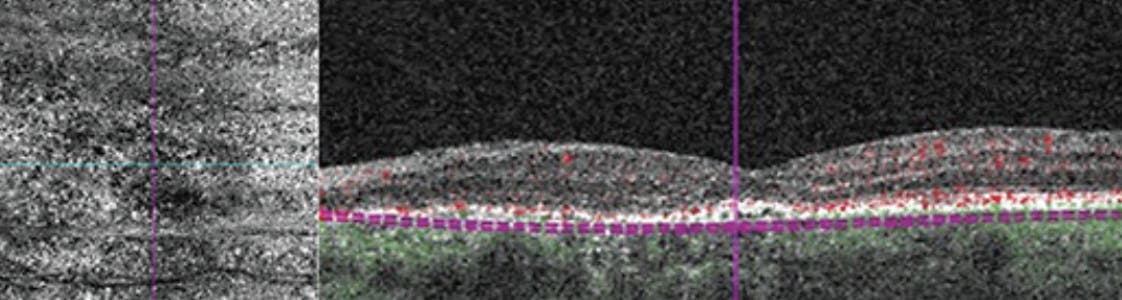
Figure 1. This patient was initially referred for wet AMD. OCTA of the left eye segmented at the level of the choriocapillaris demonstrated no neovascularization ( left). Adjacent flow overlay on the cross-sectional OCT imaging demonstrated no flow in the sub-RPE space (right). The patient was diagnosed with CSCR in each eye based on this imaging.
FAF may also be helpful to demonstrate guttering hypo- and hyperautofluorescent changes (Figure 2).
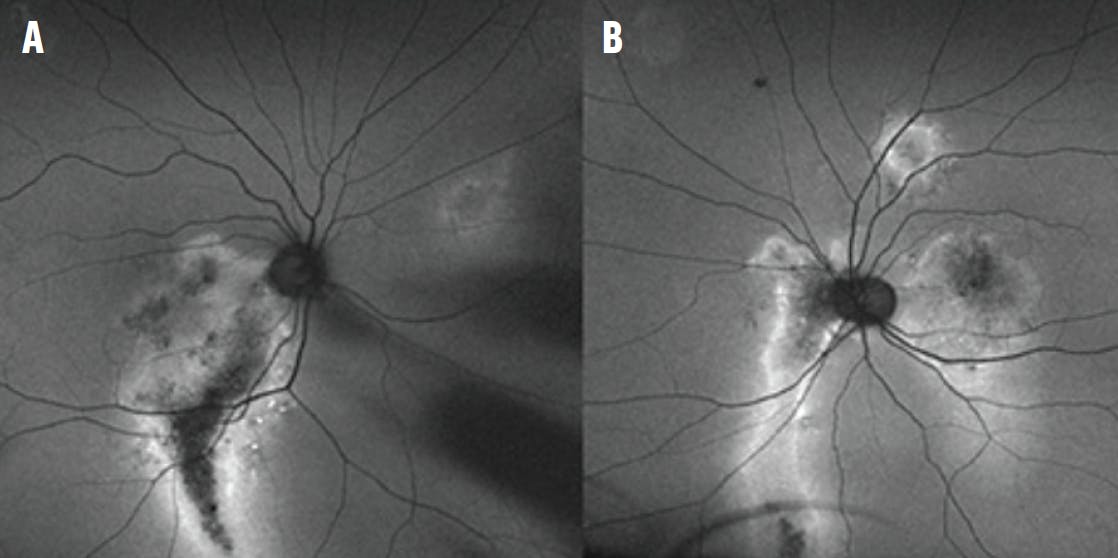
Figure 2. FAF of the right (A) and left eye (B) of the same patient in Figure 1 demonstrated characteristic hypo- and hyperautofluorescent “guttering” characteristic of multifocal chronic CSCR.
Type 1, 2, and 3 lesions on OCT correspond to occult, classic, and RAP lesions, respectively.13 Additionally, OCT provides anatomic details of fluid location and whether there may be hemorrhage or fibrin corresponding with subretinal hyperreflective material.
CASE STUDIES
Though rare, CSCR may coexist with exudative AMD, making it difficult to differentiate wet AMD from CSCR with or without CNV. Here we describe two cases involving CSCR and overlying AMD:
Case No. 1: A 78-year-old White man was referred for intermediate AMD in each eye. The fundus examination demonstrated intermediate drusen in each eye with pigmentary changes in the left eye greater than the right. The foveal cross-sectional OCT of the right eye demonstrated small drusenoid PEDs with subfoveal atrophy (Figure 3A). This was overlying a thickened choroid with enlarged or pachyvessels. The left eye’s OCT demonstrated SRF in excess of what would be expected for wet AMD and a confluent row of PEDs forming a double-layer sign (Figure 3B). FAF showed the classic guttering consistent with chronic CSCR in the right and left eyes (Figure 3C). The early frame FA (Figure 3D, left) in the arteriovenous phase at 37 seconds and a later frame at 4 minutes and 12 seconds (right) showed subtle hyperfluorescence and leakage of a type 1 CNV and an “ink-blot” leakage consistent with CSCR.
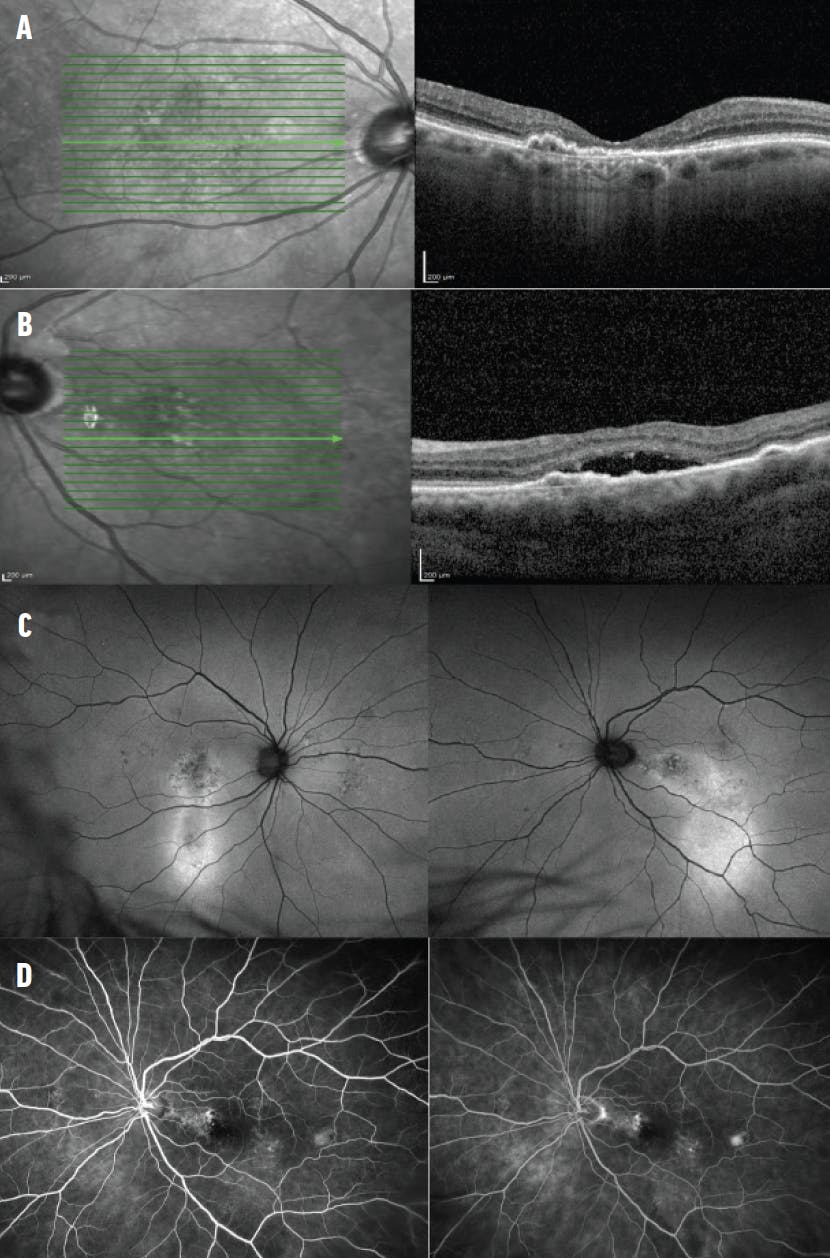
Figure 3. OCT of the right (A) and left (B) eyes, FAF (C), and FA (D) showed clinical signs of chronic CSCR of the right eye and CSCR with indolent secondary type 1 neovascularization of the left eye superimposed on intermediate AMD.
Case No. 2: A 60-year-old White woman was referred for bilateral intermediate AMD. The fundus examination demonstrated intermediate drusen in each eye with pigment changes in the left eye and no hemorrhage. The foveal cross-sectional OCT of the right eye demonstrated small drusenoid PEDs (Figure 4A). The left eye demonstrated SRF in excess of what would be expected for wet AMD and a confluent row of PEDs forming a double-layer sign (Figure 4B). OCTA demonstrated type 1 neovascularization along the nasal margin of the PED (Figure 4C).
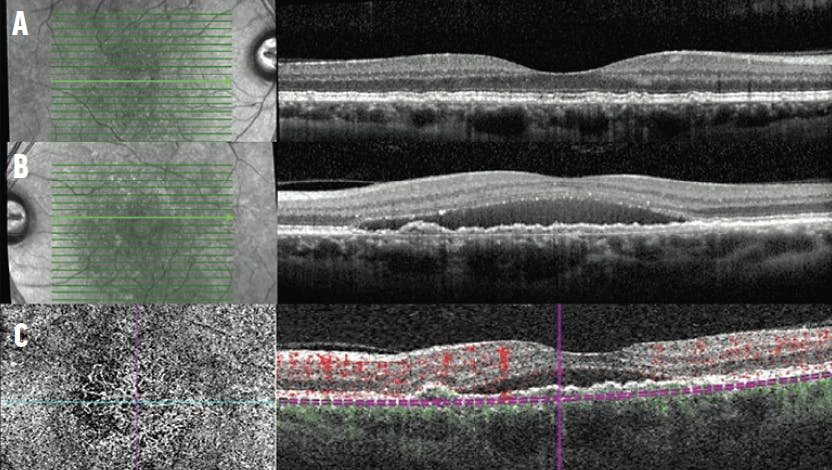
Figure 4. OCT of the right (A) and left (B) eyes showed intermediate AMD of the right eye and CSCR with indolent secondary type 1 neovascularization of the left eye superimposed on intermediate AMD. OCTA with an en-face flow image using a slab with boundaries between the RPE and Bruch membrane demonstrated a type 1 neovascularization along the nasal margin of the PED (C).
Both cases demonstrate the utility of multimodal imaging in confirming AMD/CSCR overlap, which would have been an otherwise difficult diagnosis to make.
1. Rosenfeld PJ. Optical coherence tomography and the development of antiangiogenic therapies in neovascular age-related macular degeneration. Invest Ophthalmol Vis Sci. 2016;57(9):14-26.
2. Guymer RH, Markey CM, McAllister IL, et al. Tolerating subretinal fluid in neovascular age-related macular degeneration treated with ranibizumab using a treat-and-extend regimen: FLUID study 24-month results. Ophthalmology. 2019;126(5):723-734.
3. Nagiel A, Sarraf D, Sadda SR, et al. Type 3 neovascularization: evolution, association with pigment epithelial detachment, and treatment response as revealed by spectral domain optical coherence tomography. Retina. 2015;35(4):638-647.
4. Dansingani KK, Gal-Or O, Sadda SR, Yannuzzi LA, Freund KB. Understanding aneurysmal type 1 neovascularization (polypoidal choroidal vasculopathy): a lesson in the taxonomy of ‘expanded spectra’—a review.
Clin Exp Ophthalmol. 2018;46(2):189-200.
5. Holz FG, Sadda SR, Staurenghi G, et al. Imaging protocols in clinical studies in advanced age-related macular degeneration: recommendations from classification of atrophy consensus meetings. Ophthalmology. 2017;124(4):464-478.
6. Domalpally A, Danis RP. Fluorescein angiography in neovascular AMD. Rev Ophthalmol. August 25, 2008. Accessed February 15, 2021. reviewofophthalmology.com/article/fluorescein-angiography-in-neovascular-amd
7. Laiginhas R, Yang J, Rosenfeld PJ, Falcão M. Nonexudative macular neovascularization – a systematic review of prevalence, natural history, and recent insights from OCT angiography. Ophthalmol Retina. 2020;4(7):651-661.
8. Bailey ST, Thaware O, Wang J, et al. Detection of nonexudative choroidal neovascularization and progression to exudative choroidal neovascularization using OCT angiography. Ophthalmol Retina. 2019;3(8):629-636.
9. Kuehlewein L, Bansal M, Lenis TL, et al. Optical coherence tomography angiography of type 1 neovascularization in age-related macular degeneration. Am J Ophthalmol. 2015;160(4):739-748.
10. Holz FG, Bindewald-Wittich A, Fleckenstein M, et al. Progression of geographic atrophy and impact of fundus autofluorescence patterns in age-related macular degeneration. Am J Ophthalmol. 2007;143(3):463-472.
11. Ferrara D, Mohler KJ, Waheed N, et al. En face enhanced-depth swept-source optical coherence tomography features of chronic central serous chorioretinopathy. Ophthalmology. 2014;121(3):719-726.
12. Cheung CMG, Lai TYY, Teo K, et al. Polypoidal choroidal vasculopathy: consensus nomenclature and non-indocyanine green angiograph diagnostic criteria from the Asia-Pacific Ocular Imaging Society PCV Workgroup. Ophthalmology. 2021;128(3):443-452.
13. Freund KB, Zweifel SA, Engelbert M. Do we need a new classification for choroidal neovascularization in age-related macular degeneration? Retina. 2010;30(9):1333-1349. Published correction appears in: Retina. 2011;31(1):208.


-1_1674489004.jpg?auto=compress,format&w=70)


_1674488812.jpg?auto=compress,format&w=70)
_1784132761.jpg?auto=compress,format&w=75)





