


The novel therapeutics that are pouring out of the pipeline may be taking center stage lately, but we all know that imaging technology has seen just as much growth—and may be just as important. During our 50th annual Aspen Retinal Detachment Society (ARDS) meeting, two experts—K. Bailey Freund, MD, and Judy E. Kim, MD, FARVO, FASRS—shared their insights into the newest imaging modalities and techniques that may change how we care for our patients.
If imaging is in your wheelhouse, don’t miss the 2023 Taylor Smith & Victor Curtin Lecture on advances in retinal imaging, which will be presented by Giovanni Staurenghi, MD.
— Timothy G. Murray, MD, MBA, FASRS
INSIGHTS ON HIGH-RESOLUTION OCT
Dr. Freund began his lecture with a quick review of high-resolution OCT—a prototype that increases the axial resolution (but not lateral resolution) to 3 µm. The increased resolution provides a much better definition of the outer retinal bands than current OCT models; in fact, “if we have a patient who is young and has very clear media, we can now make out six outer retinal bands,” according to Dr. Freund. Researchers can see every single capillary, he added. The device can also provide dense raster scans with a 6-µm inter-scan distance—“with exquisite detail”—and provides OCT angiography, he added.
Dr. Freund then focused on specific clinical indications for which high-resolution OCT has proven useful for him. First up was a patient with new lacquer cracks and small hemorrhages. The details of the scan helped Dr. Freund be confident that the patient did not have any neovascularization.
Dr. Freund noted that he has a particular interest in pseudoxanthoma elasticum and angioid streaks, and he showed how high-resolution OCT could help to explain why some streaks are red and some have hypopigmented areas—the retinal pigment epithelium (RPE) bridges the gap in areas that are red but not in the hypopigmented areas.
Dr. Freund also sees an important role for this high-resolution imaging tool with new therapies on the way for dry AMD. “Once we get into the phase where we have complement inhibition, the deposition of material between the RPE and Bruch membrane, whether it’s basal laminar deposits or other materials, will become a very important indicator to help us determine which patients might be suitable for complement inhibitors,” he explained. High-resolution OCT can do that, he said.
Another pearl he wanted to emphasize using high-resolution OCT is that not every double-layer sign indicates neovascularization. He showed several examples of double-layer signs that were not traditional macular atrophy (such as acquired vitelliform lesions) to drive home the point.
Dr. Freund introduced a batch of clinical cases to help illustrate the many disease states that may benefit from high-resolution OCT imaging, including Best disease, extensive macular atrophy with pseudodrusen, bacillary layer detachment, choroideremia, persistent plaque-like maculopathy, macular telangiectasia type 2, solitary idiopathic choroiditis, and Stargardt, to name only a few.
THE HISTOLOGY OF RETINAL IMAGING
In Dr. Freund’s second ARDS lecture, he shared his takeaway right out of the gate: “histologic analysis of well-documented eyes could validate recent imaging technology and inform current and future treatments for AMD.” To support this notion, he discussed imaging findings in three AMD subtypes, beginning with type 1 macular neovascularization.
Using multimodal imaging and AMD classifications, Dr. Freund and others have found evidence to suggest that type 1 neovascularization “appeared to have the potential to exert a protective effect on the overlying RPE and photoreceptors, providing some resistance to macular atrophy.” Dr. Freund’s team further suggested that treatment strategies could be altered to try to preserve type 1 neovascularization, which might help maintain central vision.
For one patient, long-term follow-up with OCT angiography showed significant atrophy in one eye with dry AMD over a span of 5 years; the fellow eye maintained vision because the atrophy continued to spare the area with type 1 neovascularization. “If we can figure out how to harness this naturally protective process and control these vessels, we will have found the cure for AMD,” he speculated.
Moving on, he noted that basal laminar deposits and basal linear deposits are the two main histologic features that define the early and intermediate stages of AMD—or type 2 neovascularization. He walked attendees through several cases, including OCT imaging of a large drusenoid pigment epithelial detachment (PED) with an overlying vitelliform lesion. He highlighted the basal laminar deposit, a thin hyperreflective line beneath the RPE band and above the basal linear deposit that formed the drusenoid PED. He also emphasized that the basal laminar deposit can resemble a double-layer sign or a shallow, regular RPE elevation that you might think harbors neovascularization—but it doesn’t.
As for type 3, Dr. Freund gave all the credit to Mary Elizabeth Hartnett, MD, FACS, FARVO, who helped the field understand the mechanisms behind type 3 macular neovascularization. “Once you lose the photoreceptors and the RPE, the Müller cells become activated, and they send processes down that start to invade that basal laminar deposit, forming a strong adhesion between what’s left of the outer retina and this resilient basal laminar deposit material,” he explained. A handful of cases later, the audience was well-versed on classic forms of type 3 neovascularization as well as atypical lesions that “can look identical to type 3, but are probably not true neovascular lesions,” Dr. Freund concluded.
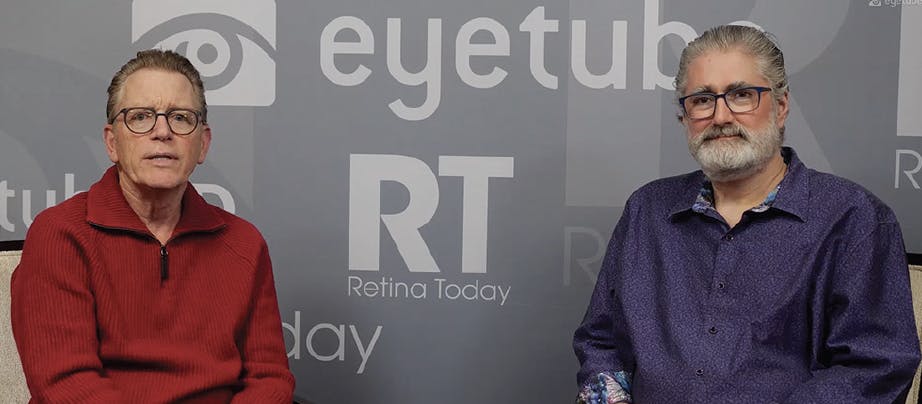
Clinical Insights from High-Resolution OCT
ARTIFICIAL INTELLIGENCE AND RETINAL IMAGING
Dr. Kim began her talk by clarifying for the audience that they have all interacted with artificial intelligence (AI), whether they knew it or not; email, texting, facial recognition, and even ride shares all incorporate some form of AI, she noted.
“The field of medicine is leading AI,” she continued. “Radiology, dermatology, pathology, ophthalmology—they all have imaging in common, and AI loves imaging.”
She flashed a fundus photo on the screen, and no one in the audience could determine the patient’s sex, age, or other demographics. But AI could, according to Dr. Kim. AI determined that the patient was female, a nonsmoker, and in the ballpark of 59 years of age. “Why should ophthalmologists be interested in this technology at all?” Dr. Kim queried. Because diabetes is an epidemic, and half of the patients remain undiagnosed, she explained.
AI can even interpret OCT images, she said. She provided an example of images segmented by layers and graded by human graders and AI, noting that the AI tools can tell if fluid is subretinal, foveal, or parafoveal, and even measure the volume. Home-based AI-powered OCT may also one day allow clinicians to track minute changes before and after injections, she said.
“We can find out how the fluid behaves between visits, which may help us to address undertreatment,” she said. “We may have better visual acuity outcomes and decreased treatment burden because the patients can come in only when they accumulate a certain amount of fluid.”
AI also can help with AMD. One day, this tool may be able to tell if the patient requires an urgent or routine referral, according to Dr. Kim, and it can predict conversion in early AMD, how the AMD will progress, how geographic atrophy will grow over time, and how many injections the patient may need.
But nothing is ever that easy, she cautioned. Ethics play a big part in AI implementation, and while AI doesn’t have emotion, it can still introduce bias into the interpretation. The output is only as good as the data you provide—“garbage in, garbage out,” Dr. Kim quipped. For example, if you put in data only from women or Caucasians, AI cannot provide a reliable interpretation of data from men or a Latinx patient.
“It’s really, really important to have great data,” she warned. Researchers need more data sets that are diverse, that include various races, ages, and genders, she added. Not only that, who is ultimately responsible if the machine misdiagnoses the patient? That is a question researchers will have to answer before AI truly can be embraced in clinical practice, she said.
“Right now, you have more power at your fingertips than entire generations that came before you,” Dr. Kim said to wrap up. “That’s what technology really is—it’s possibility, adaptability, and capability. But in the end, it’s only a tool. It’s not about what technology can do, it’s about what you can do with it.”
To learn more about and register for the 2023 ARDS meeting, set for March 4–8, visit aspenretina.com.


-1_1674489004.jpg?auto=compress,format&w=70)

_1674488812.jpg?auto=compress,format&w=70)


_1784132761.jpg?auto=compress,format&w=75)





