


CASE PRESENTATION
A 52-year-old healthy male was referred to us for a macular hemorrhage in the left eye that was found on a routine optometric eye examination. His VA was 20/20 OU. His medical history was significant for creatine supplementation coupled with fasting without water for religious reasons. He had grown up in Somalia and moved to the United States at a young age. Based on fundus imaging of the left eye, he was initially presumed to have a small branch vein occlusion (Figure 1).
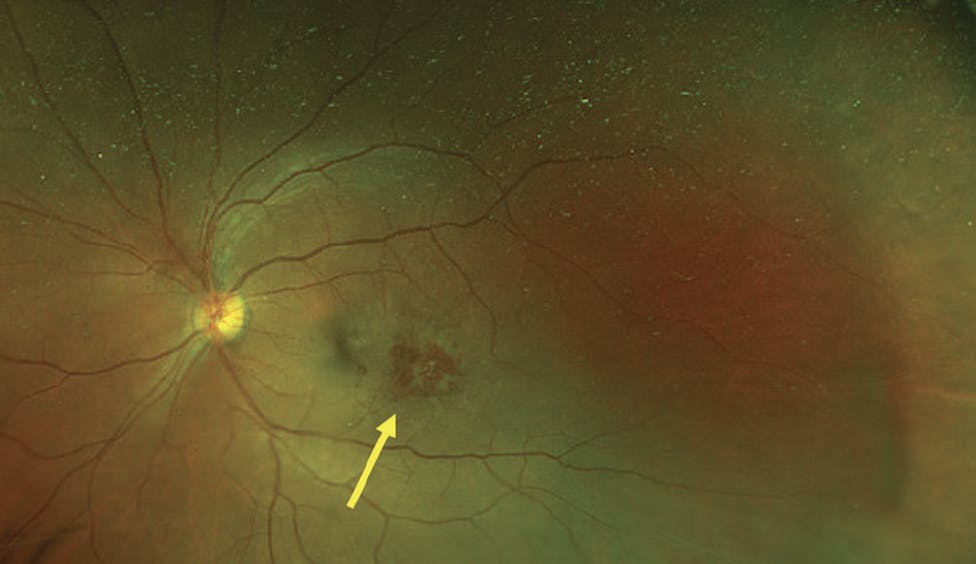
Figure 1. Fundus photography at his initial retina visit raised concern for a small branch vein occlusion (yellow arrow).
At the 1-month follow-up, however, his VA dropped to 20/150 OS and significant temporal retinal atrophy was noted on fundus examination and OCT (Figure 2). Fluorescein angiography showed late perifoveal leakage that did not fit a clear vascular pattern (Figure 3). At this time, given the retinitis and vision loss, there was concern for an alternative etiology.
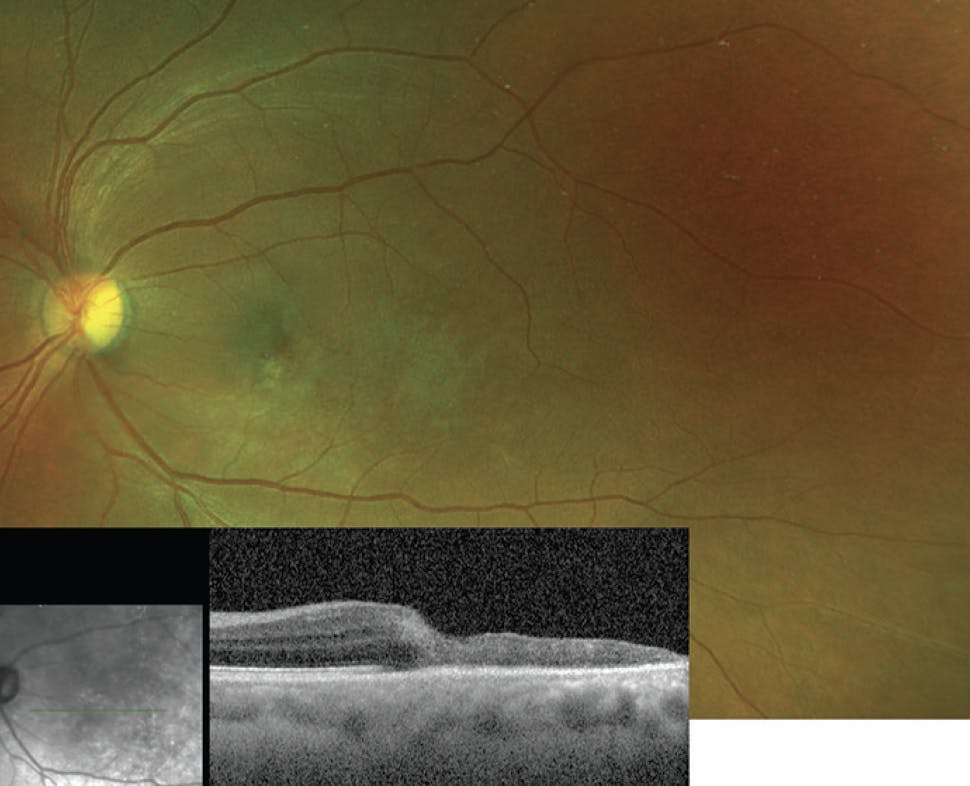
Figure 2. The fundus photograph and OCT at the 1-month follow-up showed significant temporal retinal atrophy.
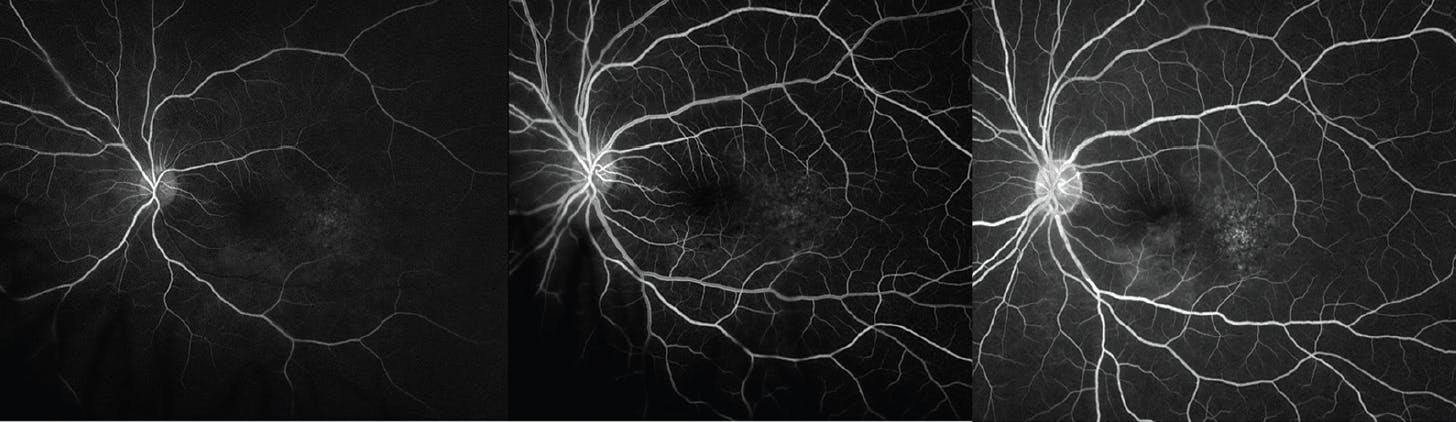
Figure 3. Late perifoveal leakage on fluorescein angiography did not reveal a clear vascular pattern.
A DIAGNOSTIC ODYSSEY
An extensive diagnostic evaluation was undertaken. The first set of tests showed mild anemia and slight vitamin B12 deficiency. Infectious labs for syphilis (rapid plasma reagin and fluorescent treponemal antibody absorption), tuberculosis (QuantiFERON-TB Gold), and human immunodeficiency virus were negative.
The inflammatory workup—sarcoidosis (angiotensin converting enzyme, lysozyme, chest x-ray, and CT scan), lupus (antinuclear antibody [ANA]), and antineutrophilic cytoplasmic antibody associated vasculitis—was also negative. Hypercoagulable tests for protein C and S deficiency were negative, and Factor V Leiden thrombophilia, homocystinuria, antiphospholipid syndrome (anticardiolipin antibodies and anti-beta-2 glycoprotein), and plasma cell dyscrasias (serum protein electrophoresis) were unrevealing.
Second Opinions
Given the atypical presentation in an otherwise healthy male, additional opinions were gathered from medical retina diagnosticians. The first recommended adding Lyme disease testing, and the second endorsed checking for toxoplasmosis. A third expert considered the possibilities of anemic retinopathy, Chikungunya virus, and West Nile virus. Each of these tests returned negative, however, and the patient had normal cardiac and carotid ultrasonography.
At his next follow-up 1 month later, the patient presented with an alarming new area of nasal perifoveal intraretinal hemorrhage and focal retinitis (Figure 4). A uveitis expert was consulted at this time, who recommended testing for Behçet syndrome (HLA-B51) and bartonella (IgG/IgM) and testing again for erythrocyte sedimentation rate, c-reactive protein, and ANA. Each of these tests returned normal. The consultant recommended trialing 60 mg prednisone daily with taper, given the negative infectious workup thus far.
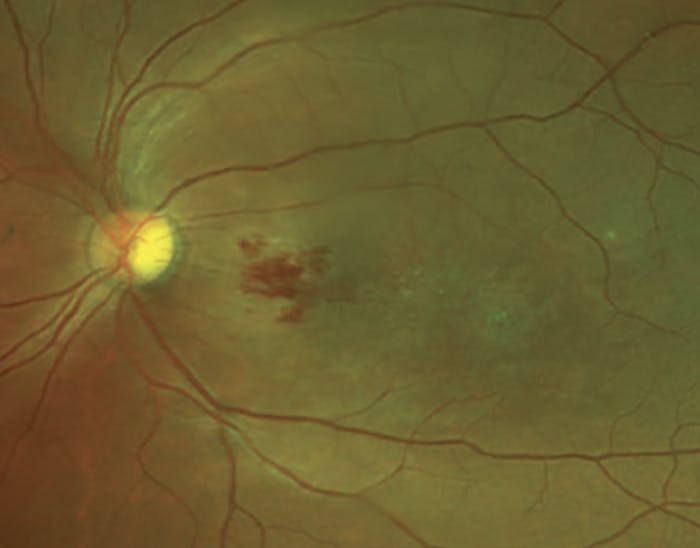
Figure 4. New nasal perifoveal intraretinal hemorrhage and focal retinitis noted on his retina follow-up visit.
The patient presented again after 1 month with another focality of intraretinal hemorrhage with retinitis along the inferior arcade (Figure 5). The prednisone was then discontinued. The next retinal consultant suggested the possibility of malaria, and another considered diffuse unilateral subacute neuroretinitis. However, a peripheral blood smear was negative, and no nematode was found.
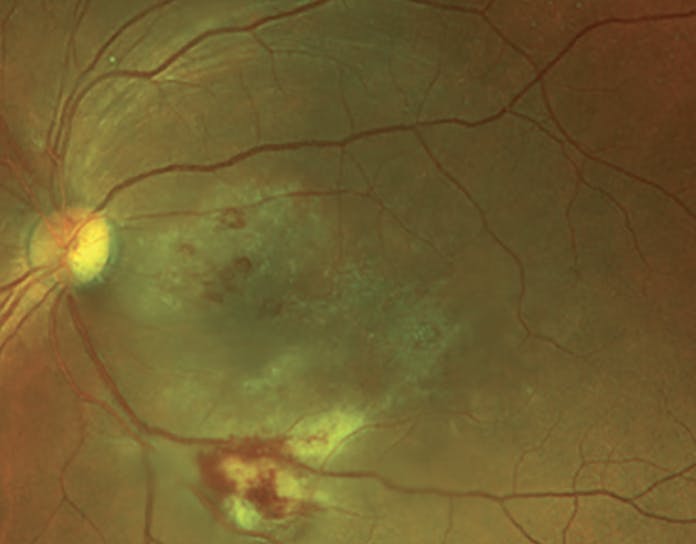
Figure 5. The patient presented for another follow-up visit, this time with a new focality of intraretinal hemorrhage with retinitis along the inferior arcade.
AN ANSWER AT LAST
Finally, it was suggested that, given the unilateral and localized nature, the condition still might be infectious and that an anterior chamber paracentesis should be performed, despite a lack of intraocular inflammation. The aqueous returned positive for cytomegalovirus (CMV) IgG and IgM. Additional serologies were sent, which confirmed CMV viremia.
The patient was given intravitreal ganciclovir, started on oral valganciclovir, and closely monitored by an infectious disease specialist. He required four doses of intravitreal ganciclovir before the retinitis resolved.
At the 1-year follow-up, the patient remains stable with no involvement of the right eye. As an atypical case of immunocompetent CMV viremia, the patient is being monitored closely by retina, infectious disease, and hematology/oncology teams.
LEARNING POINTS
From a medical standpoint, this case illustrates that CMV retinitis can present in relatively immunocompetent patients. Although there were some minor systemic abnormalities, the patient was far from the typical compromised patient (ie, those with CD4 count < 50 or those who are undergoing chemotherapy).
This experience demonstrates that it can take a village of experts to solve a challenging case. As clinicians, we are unlikely to see all the various presentations of conditions in residency and fellowship. Some cases can stump even leading experts, and medical retina can be just as, if not more, trying than surgical retina. For this reason, it is imperative that junior attendings ask for advice when needed. When working on this case, it was uplifting to receive immediate and detailed responses from busy leading authorities, some of whom we had not interacted with before.
The primary avenue of communication was the traditional method of email; however, we also used alternative means, including WhatsApp and telegram messaging services with large retina groups, who offered advice in real time.
TAKEAWAYS
Although this case presented difficulties, it was ultimately a positive outcome in that the correct treatment was initiated prior to systemic infection, which may have affected the contralateral eye or other organs. We are fortunate to have a collaborative field, and we should take advantage of our networks to provide optimal care and accurate diagnoses, especially for atypical cases like this one.


-1_1674489004.jpg?auto=compress,format&w=70)


_1674488812.jpg?auto=compress,format&w=70)


_1773249222.png?auto=compress,format&w=75)





