


AT A GLANCE
- Retinal and choroidal biopsies have been shown to provide diagnostic answers in cases of inconclusive vitreous sample analyses.
- Tissue biopsies may be performed with a vitrector, bimanual dissection, or fine needle aspiration.
- Surgeons should promptly fixate or place biopsied cells in a tissue culture and communicate with a cytopathologist.
Vitreoretinal surgeons can obtain tissue for diagnostic identification in several ways, depending on the suspected etiology. Examination of aqueous and vitreous specimens is the mainstay of diagnosis for inflammatory, neoplastic, and infectious ocular diseases, given the ease of sampling and the low risk of complications. However, more advanced approaches may be necessary for certain cases or in the event the vitreous sampling is inconclusive. Here, we discuss the benefits of various biopsy techniques, including fine needle aspiration biopsy (FNAB) and retinal/choroidal biopsies, and the surgical steps to obtain high-quality specimens.
VITREOUS BIOPSY
Vitreous sampling continues to be a mainstay diagnostic method for inflammatory diseases affecting the posterior segment.1 Vitreous can be obtained via pars plana vitrectomy (PPV) or FNAB, which are usually performed as primary procedures and, theoretically, have a lower risk profile than retinal/choroidal biopsies.1
When obtained with PPV, a vitreous sample is collected with aspiration into a syringe through a broken aspiration line while the cutter is activated.1
FNAB involves the insertion of a needle (attached to a syringe) at the pars plana; this method is not recommended for primarily vitreous aspiration, but could be a reasonable option for subretinal, sub-retinal pigment epithelium (RPE), or choroidal biopsy.1
Vitreous samples are often collected in an undiluted form for cytology and a diluted form for flow cytometry; vitreous can also be used for ancillary diagnostic techniques such as polymerase chain reaction (MYD88 or viral), cytokine rearrangement, metagenomic sequencing, and microbial/fungal microscopy and culture.2,3 Cells removed from the vitreous are prone to rapid degeneration; thus, surgeons should promptly fixate or place the cells in a tissue culture and communicate with a cytopathologist.1
Postoperative complications of vitreous biopsy include false negative results, hemorrhage, retinal detachment, needle tract seeding, and endophthalmitis.1
RETINAL/CHOROIDAL BIOPSIES
Retinal and choroidal biopsies have been shown to provide diagnostic answers in cases of inconclusive vitreous sample analyses.1-8 Additionally, false negative vitreous studies are possible, with definitive diagnoses later confirmed using retinal/choroidal biopsies.2,4,6,9 Specific cases where retinal/choroidal biopsies could be considered include retinal, subretinal, or choroidal lesions unresponsive to therapy with inconclusive initial testing. One of the most common indications for a retinal/choroidal biopsy is atypical uveitis unresponsive to treatment, especially when a rare neoplastic or infectious etiology is suspected.2,4
Biopsy Steps
Many internal and external approaches exist for obtaining retinal and/or choroidal biopsies.2,4 Surgeons can choose to cut/aspirate with a vitrector, perform a bimanual dissection of a lesion using scissors and forceps, or perform an FNAB through the pars plana using a 25- or 30-gauge needle.1-3
PPV with tissue dissection of the retina/choroid begins with a vitreous sample and is followed by these steps:
- Perform a complete vitrectomy followed by endodiathermy of retinal vessels surrounding the biopsy area and delineation of the biopsy site with a diode laser and/or full-thickness diathermy.
- Use curved horizontal scissors, vertical scissors, pneumatic vertical scissors, or a small-gauge vitreous cutter to cut through the retina and choroid.
- After dissecting a large enough target specimen, leave a small segment of the retina attached at the base to ensure the tissue is not lost due to fluidic changes.
- Make or extend a full-thickness sclerotomy.
- Use forceps (grasping at the base of the tissue site) to remove the specimen through the sclerotomy. You can also use a fluted, large-bore needle attached to suction or a syringe to extract the tissue.
- If needed, encircle the biopsy site with additional endolaser and tamponade with long-acting gas or silicone oil.1
When performing direct aspiration biopsy with the cutter, we identify the three thickest parts of the lesion, ideally away from large vessels. We raise the IOP to help prevent hemorrhage, introduce the cutter at a low cut rate, and aspirate the tissue, either directly into a syringe or into the tubing and then refluxed into a syringe. Complications of these approaches include cataract, retinal detachment, vitreous hemorrhage, choroidal hemorrhage, proliferative vitreoretinopathy, and endophthalmitis.1
FNAB of posterior choroidal tumors is often completed using a transvitreal approach, following these steps:
- Attach a 25- or 30-gauge needle, with tubing, to a syringe and introduce it through the pars plana at a meridian with the best accessibility to the tumor.
- Guide the needle into the tumor with either indirect ophthalmoscopy or a microscope, while avoiding major retinal or tumor vessels.
- Gently aspirate and withdraw the needle along the path of insertion.
Indirect ophthalmoscopy should be performed post-aspiration to search for any signs of trauma or hemorrhage. Localized hemorrhage can be addressed with targeted pressure; globe softening can be remedied with injection of balanced salt solution into the vitreous.3,7
VISUALIZATION TIPS
Ocular imaging is invaluable as a supplemental tool to help guide our approach. Whether we perform direct aspiration through a lesion or perform a dissection is determined by preoperative and/or intraoperative OCT, which is a crucial part of our surgical management.1 For example, for cases with a predominant sub-retinal pigment epithelium (RPE) and/or choroidal component, we perform an aspiration biopsy with the vitreous cutter (Figure 1). In cases of full-thickness retinal involvement, we prefer a full-thickness tissue dissection (Figure 2).
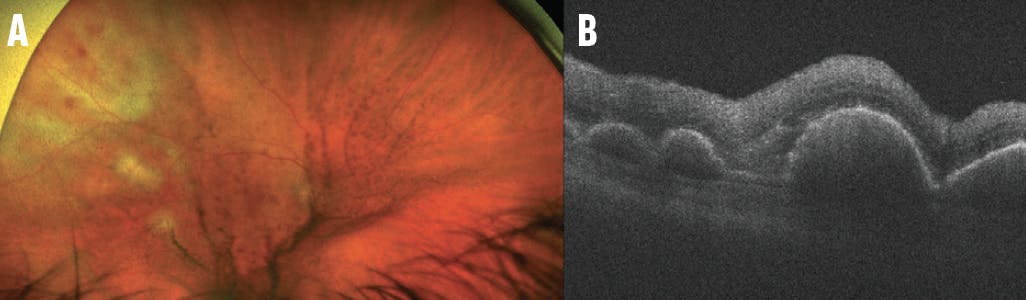
Figure 1. An 82-year-old man presented with floaters and decreased vision in the right eye. Widefield imaging showed dense sheets and clumps of vitritis and temporal and superotemporal deep retinal whitening with intraretinal hemorrhages (A). Peripheral OCT over the lesion demonstrated inner retinal hyperreflectivity with subretinal hyperreflective material and a significant sub-RPE component to the lesion, making vitreoretinal lymphoma a likely diagnosis (B). Initial diagnostic PPV was performed without tissue biopsy due to the significant vitreous cells; it was negative on cytology and flow cytometry. Repeat surgery with tissue biopsy confirmed the diagnosis of vitreoretinal lymphoma. Due to the sub-RPE lesions, direct aspiration into the lesion with the cutter activated was the preferred method.
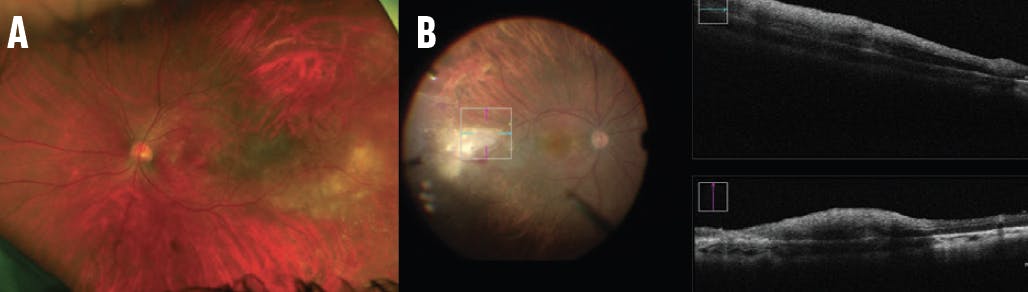
Figure 2. A 49-year-old man presented with decreased vision in the left eye after a negative diagnostic vitrectomy at an outside institution. Widefield imaging demonstrated inferotemporal retinal whitening with associated intraretinal hemorrhages and far temporal hypopigmented deep retinal lesions (A). Macular RPE mottling was also present. Intraoperative OCT confirmed a predominantly full-thickness retinal lesion without any significant subretinal or sub-RPE component (B). A full-thickness retinal biopsy with manual dissection was performed, which was positive for large B-cell lymphoma.
There are many key aspects to note when considering FNAB. Ophthalmic FNAB has a high degree of diagnostic accuracy, although aspirated samples can be jeopardized by insufficient cellularity. Thus, a negative cytologic diagnosis should not exclude possible intraocular malignancy.3 FNAB is also not recommended for the primary goal of obtaining vitreous, as getting a sufficient sample may be difficult. Still, FNAB is a reasonable option for diagnosis of a large subretinal, sub-RPE, or choroidal lesion. Again, priority should be given to prompt fixation or placement of samples into tissue culture.1 Postoperative complications of FNAB can include false negative biopsy, theoretical needle tract seeding, hemorrhage, retinal detachment, and endophthalmitis.3,7,8
External transscleral techniques were some of the earliest methods described but are rarely performed due to the risk of suprachoroidal hemorrhage and other serious complications. These techniques may still be advantageous for lesions located anterior to the equator near the ora.1 The transscleral technique begins with a conjunctival peritomy and isolation of the rectus muscles. A nearly full-thickness scleral flap is created over the biopsy site, and diathermy is applied to the outer margin of the choroidal bed. A blade is then used to excise the specimen, and the flap is sutured back into place.1
A MASQUERADER REVEALED
Intraocular lymphoma is a hallmark example of a masquerade syndrome that requires a definitive diagnosis to initiate proper treatment, yet it may initially respond to steroid therapy, making diagnosis difficult.5 In these situations, vitreous biopsies, MRI brain studies, and lumbar punctures are often ordered but may still be inconclusive. Retinal or choroidal biopsy may provide the definitive diagnosis or exclude infectious or malignant diagnoses, enabling more targeted therapy.2,4
In our single-center retrospective study, 51 patients had diagnostic vitrectomies for suspicion of vitreoretinal lymphoma (VRL).9 Of the 51 diagnostic vitrectomies, 39 were positive (76.5%) for VRL, 29 of which were vitreous positive. The remaining 10 positive biopsies (25%) were vitreous negative but retinal and/or subretinal biopsy (RSRB) positive. We performed a total of 14 RSRBs, and 13/14 (92%) were positive for VRL. Interestingly, 21 patients had retinal, subretinal, and/or sub-RPE lesions on initial visit, and 13 of these individuals (62%) had a negative vitreous biopsy, suggesting that eyes that present with clear lesions might have a lower cytopathological yield in the vitreous specimen.
The average time from symptom onset to diagnosis was 7.45 months among all patients. However, patients who tested positive only on RSRB tended to present later than patients with positive vitreous biopsies. Among RSRB positive but vitreous negative patients, the time to diagnosis was 8.56 months; for those with positive vitreous biopsy, the average time to diagnosis was 5.07 months (P = .002). There were no differences in vitreous haze scores between the groups.9
We hypothesize that by the time a lesion develops, the disease course is more chronic; given the fragility and necrosis of vitreous lymphocyte cells, the vitreous yield may decline with time. We obtained RSRBs through two different techniques: cutting/aspiration with a vitrector (10 cases) and bimanual dissection of a lesion using scissors and forceps (four cases). There were only two postoperative retinal detachments in the series, both from the cutting/aspiration group. These patients were attached after a follow-up PPV with gas tamponade.9
Thus, we highly consider RSRB for suspicious cases at the time of the primary diagnostic vitrectomy to expedite diagnosis and treatment.9
BIOPSY IN OUR OR
Biopsy methods differ depending on surgeon experience and preference. We prefer a PPV approach due to comfort with the procedure and the desire for a definitive diagnosis at the time of the initial surgery. We also prefer a complete, rather than limited, vitrectomy to reduce the rate of false negative results, because inflammatory and lymphoma cells in the cortical vitreous have less chance to be sampled if a single core vitreous biopsy is performed.1 When considering a biopsy site, it is important to note that the margins of lesions are more likely to harbor the pathologic process than the central lesion, which may be dominated by necrotic cells.1 Likewise, effective collaboration with cytopathology cannot be overemphasized to maximize potential biopsy yield.3
1. Mastropasqua R, Di Carlo E, Sorrentino C, Mariotti C, da Cruz L. Intraocular biopsy and immunomolecular pathology for “unmasking” intraocular inflammatory diseases. J Clin Med. 2019;8(10):1733.
2. Lim LL, Suhler EB, Rosenbaum JT, Wilson DJ. The role of choroidal and retinal biopsies in the diagnosis and management of atypical presentations of uveitis. Trans Am Ophthalmol Soc. 2005;103:84-91.
3. Singh AD, Biscotti CV. Fine needle aspiration biopsy of ophthalmic tumors. Saudi J Ophthalmol. 2012;26(2):117-123.
4. Johnston RL, Tufail A, Lightman S, et al. Retinal and choroidal biopsies are helpful in unclear uveitis of suspected infectious or malignant origin. Ophthalmology. 2004;111(3):522-528.
5. Tang LJ, Gu CL, Zhang P. Intraocular lymphoma. Int J Ophthalmol. 2017;10(8):1301-1307.
6. Mastropasqua R, Thaung C, Pavesio C, et al. The role of chorioretinal biopsy in the diagnosis of intraocular lymphoma. Am J Ophthalmol. 2015;160(6):1127-1132.e1.
7. Mashayekhi A, Mazloumi M, Shields CL, Shields JA. Choroidal neovascular membrane after fine-needle aspiration biopsy of vitreoretinal lymphoma. Retin Cases Brief Rep. 2022;16(1):25-28.
8. Ebert JJ, Di Nicola M, Williams BK. Operative complications of posterior uveal melanoma surgery. Internat Ophthalmol Clin. 2022;62(3):15-33.
9. Srivastava SK, Mammo DA, Hamdan A. Vitreoretinal biopsy techniques and the role for retinal biopsy in vitreoretinal lymphoma: a single-institution experience. Presented at ASRS 2022; July 13-16, 2022; New York, New York.
_1674488812.jpg?auto=compress,format&w=70)


-1_1674489004.jpg?auto=compress,format&w=70)


_1784132761.jpg?auto=compress,format&w=75)




