






AT A GLANCE
- Surgeons don’t do enough secondary IOLs to master every technique; pick one and try to get as good as possible with that technique.
- Assess conjunctival mobility preoperatively and place the tunnels in the most mobile conjunctiva; avoid areas of scarring to reduce the risk of erosion.
- To combat hypotony, make the sclerotomies as small as possible and minimize instrument manipulation.
For secondary IOL cases, surgeons must have a host of tools and techniques at the ready. Patient education, lens choice, surgical technique, and minimizing complications are all important considerations. Here, a panel of experts discuss their techniques and tips for patients with a dislocated IOL.
– Rebecca Hepp, Editor-in-Chief
Want to hear the conversation as a Podcast?
Visit New Retina Radio to hear from these experts.
RETINA TODAY (RT): HOW DO YOU APPROACH PATIENTS WHO REQUIRE A SECONDARY IOL PROCEDURE?
Omesh P. Gupta, MD, MBA: The first thing I look at is the lens status and whether the patient is aphakic or pseudophakic. This seems to be a simple determination but, believe it or not, sometimes the history and medical records are not sufficient. I also look to see if there’s some dislocation of the lens, any retained lens material, or vitreous prolapse.
I also consider if they have a history of glaucoma surgery, such as a tube shunt or a trabeculectomy, or if there’s angle pathology or corneal endothelial disease. If they have a history of trauma or have iris defects, that may preclude an anterior chamber lens. For polypropylene or polytetrafluoroethylene (PTFE; Gore-Tex, W.L. Gore) scleral fixation, I assess the status of the conjunctiva for any scarring, a history of scleral buckling, or conjunctival retraction.
RT: WHAT INFLUENCES YOUR DECISION TO RESCUE VERSUS REPLACE AN IOL?
María H. Berrocal, MD: I usually look at the type of lens that was dislocated. I still get PMMA IOLs, and their removal requires a very large incision, so I try to reposition those, which requires suturing them to the iris.
If it is a one-piece acrylic lens, I usually remove it unless the dislocation is with the entire capsule, in which case you can try to fixate the capsule with the IOL. But that is a difficult technique, so I usually replace it with a scleral-fixated three-piece IOL. I do not use anterior chamber IOLs frequently because I’m concerned many patients have low endothelial cell counts and angle or cornea problems.
Ashkan M. Abbey, MD: Many surgeons want to try to rescue every three-piece IOL, but in my experience, many of these IOLs will fail if you do a scleral fixation because they require significant manipulation to remove the residual cortex and capsule.
The best choice for those cases is to remove the lens and start over with a new three-piece IOL. I have found that the highest dislocation rates in scleral-fixated three-piece IOLs occur when you try to be a little too heroic and reposition the ones you should have removed.
Christina Y. Weng, MD, MBA: In addition, it is important to remind patients that this is not a simple run-of-the-mill cataract surgery. We must stress that although we aim to hit a refractive target, that may not always be possible because of the oft-complicated calculations; they should also know that recovery can take longer than what they might anticipate. Setting these expectations goes a long way toward making sure that they’re happy down the line.
RT: DO YOU HAVE A PREFERRED SECONDARY IOL TECHNIQUE?
Dr. Gupta: I most commonly scleral fixate the lens with Gore-Tex sutures (Video 1). I usually will explant the existing IOL. Surgeons don’t like a lot of intraocular gymnastics to clean off a capsular bag and Soemmering ring to expose the haptics. I make sure that the intraoperative time is relatively short because that’s one of the biggest issues that can increase the risk of postoperative corneal edema and cystoid macular edema.
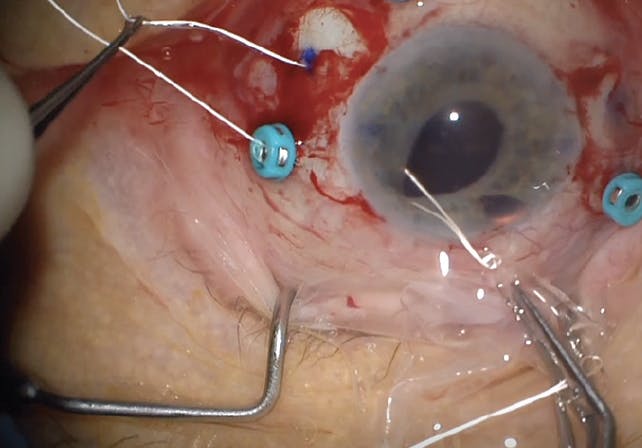
Video 1. Gore-Tex Fixation of a Secondary IOL
Ultimately, it comes down to whatever technique you are comfortable with. For me, I like Gore-Tex fixation with the enVista MX60E (Bausch + Lomb). I always operate superiorly and thankfully rarely have to make adjustments for tube shunts and trabeculectomies. I don’t have to worry about landmarks such as pannus because I scleral fixate at the 3:00 and 9:00 clock positions. The surgical time and refractive outcomes are predictable, and it’s also an easy technique to teach to fellows. They don’t have many issues with IOL tilt or centration, even with the first or second case.
Dr. Berrocal: Not all the lenses we want are available all the time, so my go-to technique is the modified Yamane with 27-gauge cannulas and a CT Lucia three-piece IOL (Carl Zeiss Meditec). Unlike other prolene haptics, the Lucia polyvinylidene fluoride haptics are more rigid and the chances of breaking or bending them—which can lead to decentration and astigmatism—are reduced. Also, I place the cannulas at the correct angle to perform the vitrectomy and then pull one out and reposition it (Video 2). Since it’s all 27-gauge, I don’t have to open a second pack, which is a big concern for surgery centers.
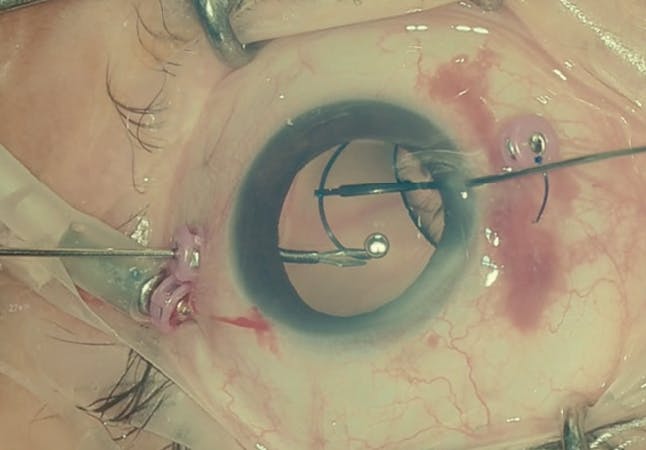
Video 2. IN 3D: Modified Yamane Technique for a Dislocated Three-Piece IOL
Dr. Abbey: I do the same technique, and I like using 27-gauge trocars for my tunnels (Video 3). I usually end up using five trocars total, mainly because I don’t like moving everything around and manipulating myself and my hands too much during the case. I make it straightforward for every case, but I agree that the financial incentive is there to try to use just three trocars. The one thing that I like about the modified trocar-assisted scleral fixation is the efficiency. For me, that is the fastest, and I feel comfortable continuing with that one for most of my cases.
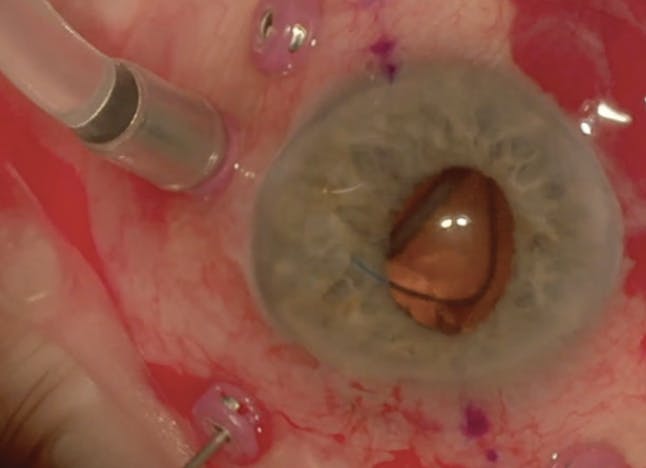
Video 3. Transconjunctival Sutureless intrascleral (SIS) Fixation Using Trocar Cannulas
DR. ABBEY: IS EVERYONE DOING A HANDSHAKE TECHNIQUE? NORMALLY I ALLOW THE LENS TO FALL ON THE BACK AND THEN GRAB ONE HAPTIC OFF THE RETINA TO AVOID DOING A HANDSHAKE.
Dr. Weng: That’s a great technique, but I’ve gone to the handshake or hand-to-hand technique. I love working anteriorly and I find it to be fast, and you avoid having to work in a third dimension by reaching far into the vitreous cavity.
Dr. Gupta: I like the hand-to-hand technique for the trailing haptic side; you can pass it to yourself and then externalize it. When the IOL is sitting on the retinal surface, you can grab it nicely where you want on the leading haptic side, and that is amenable to externalizing it directly. But on the trailing haptic side, it can get a little tricky, especially when there’s a nasal bridge or a deep-set orbit.
Dr. Abbey: I agree that the trailing haptic tends to be a problem with these cases. I always do the side that’s closer to the nasal bridge first. That way, with the trailing haptic, I don’t have to deal with the nose at all, which makes it easier to grab the haptic when it’s under your viewing system. If you still can’t see the haptic, push posteriorly on the optic, which usually shifts it just enough so that you can see it in the corner of your view and grab it.
Dr. Gupta: This technique typically fixates at the 12:00 and 6:00 clock positions, although Yamane himself does it at the 3:00 and 9:00 clock positions. I also do it at the 3:00 and 9:00 clock positions to avoid an existing or future site of a tube shunt or trabeculectomy. I want to keep that superior conjunctiva native and the sclera untouched.
Dr. Berrocal: For me, it’s more like the 10:00 and 4:00 clock positions, or thereabouts. For people with prominent noses or deep-set eyes, I always tilt the head. I don’t like taping the head so that I can tilt the head as needed to have better access during the case.
RT: HOW ARE YOU PROTECTING THE HAPTICS?
Dr. Abbey: That starts with the preoperative planning. It’s important to assess conjunctival mobility beforehand so you know where you want to put your tunnels. Place them in the most mobile conjunctiva and avoid any areas of scarring because that would increase the risk of erosion.
In addition, when I make the flange, I tuck it all the way into the tunnel until just the tip of the flange is visible under the conjunctiva. Having less surface area of the haptic helps to maintain the integrity of the conjunctiva and reduce the risk of erosion.
If and when a haptic does erode, as long as there’s no infection, I often take the patient to the slit lamp, give them anesthetic drops, place a lid speculum, and trim the haptic with Vannas scissors before gently tucking it in. Usually, the conjunctiva will grow over that area.
Dr. Berrocal: Sometimes the haptics are too long, and if you push them in, the lens will not be centered and will be too loose. So, cutting the haptics and doing the flange is necessary. After I externalize the haptics, I play with them to make sure the IOL is perfectly centered before I trim them as needed, then flange and tuck them in.
Dr. Weng: Before I even burn the flanges, I make sure that I’m happy with the centration of the lens itself because sometimes by trimming one side a little bit more than the other, you can get the lens to lay in a more ideal position. The way you burn the flanges is also important. Make sure you have an even, smooth surface at the tip. That decreases the risk of conjunctival erosion.
Dr. Abbey: In addition to that, when you are externalizing the haptics, grab them as parallel as possible to the distal tip to prevent any kinks in the haptic itself, which can sometimes pop up underneath the conjunctiva and increase the risk of erosion.
Dr. Gupta: We do see erosion of Gore-Tex or conjunctival erosion in this procedure as well. To avoid this, when you are re-approximating the conjunctiva back to the limbus, drag the conjunctiva away from the site of the Gore-Tex. I drag it inferotemporally and inferonasally and anchor it to the sclera to help create a smooth, intact surface of conjunctiva over the Gore-Tex.
It’s amazing how difficult it can be to take the haptic out of the tunnel in the setting of Gore-Tex fixation because Gore-Tex is porous and, over time, there’s a lot of cellular ingrowth. Sometimes, it’s impossible to grab the Gore-Tex on the outside of the eye or underneath the conjunctiva. I do most of my explanting from inside the eye. I cut the IOL and bring it out, grab the Gore-Tex from inside the eye, and then try to snip it and pass it through a clear corneal wound. It can be very difficult, especially if it’s the external portion of the Gore-Tex that sits between the conjunctiva and sclera. That can become almost part of the eye, so I tend to leave it.
RT: HOW ARE YOU MINIMIZING THE RISK OF HYPOTONY IN THE IMMEDIATE POSTOPERATIVE PERIOD?
Dr. Weng: Hypotony can be common in these secondary IOL cases, partly because we put so many holes in the eye and there’s often a lot of manipulation. I’ve seen hypotony more frequently in techniques that involve inserting needles or instruments directly through the sclera, like the original Yamane technique and less commonly with the trocar-based scleral fixation.
To combat hypotony, I would recommend a few things. First, make the sclerotomies as small as possible and minimize the manipulation of the instruments through them.
Second, use an infusion line to stabilize the globe, preferably in the vitreous cavity, which is second nature to us, because often we’re combining this with a vitrectomy anyway. Even if you’re working only anteriorly or with your anterior segment colleagues, you can put a cannula into the anterior chamber to stabilize the globe.
Third, never hesitate to suture your wounds. I often slip my IOL in through a corneal wound, and I always throw a 10-0 nylon suture through that wound at the end of the case to eliminate another possible point of leakage. I do the same thing with the sclerotomies, a tunnel that ends up bigger than I intended, and even around the haptic in rare cases.
If you do have postoperative hypotony, it usually has no adverse effects down the line, and many times it resolves within a week, especially with the use of postoperative topical steroids which most of us prescribe.
Dr. Abbey: When I reviewed my first 500 cases, I found a significant difference in hypotony rates for the sutureless scleral-fixation cases that had 27-gauge tunnels versus 25-gauge tunnels. I’ve gone toward using 27-gauge for the vitrectomy and for the tunnels because my data suggests that it reduces the rate of hypotony.
In addition, I’ve been doing a partial air-fluid exchange at the end of the case. Some people think that’s going to make the lens tilt, but as long as I have flanges on my haptics, I have not seen any sort of tilt or dislocation as a result of the air-fluid exchange.
Dr. Berrocal: I hydrate the paracentesis and the corneoscleral wounds, which is important. Because we are using viscoelastic for these maneuvers, it helps if you don’t remove it entirely; the viscoelastic can protect the eye from hypotony. With 27-gauge vitrectomy, the wounds can leak if you manipulate them, so I needle them in the opposite direction, either with a needle or with the same trocar. This helps to open up the scleral fibers and can provide closure of the sclerotomies.
Dr. Gupta: These are complicated eyes; they often have a history of trauma, sometimes a ruptured globe, maybe a dropped lens, and are left aphakic by the cataract surgeon. We must clean out the vitreous cavity, remove all the retained lens material, and then scleral fixate something. In addition to hypotony, ciliary body shutdown can occur, and they’re not producing as much aqueous in the early postoperative period, which is an issue.
When I do scleral fixation and see a leaky wound, especially at the side of the haptic or Gore-Tex, I use a BV needle and an 8-0 vicryl suture. The needle is a nice non-spatulated needle, and you can throw the suture through the wound and stay away from your haptic or Gore-Tex. And the vicryl has a little bit of an inflammatory component, which can help to seal that wound.
RT: WHAT IS YOUR TOP PEARL FOR SOMEONE WHO IS JUST STARTING TO DO SECONDARY IOLS?
Dr. Berrocal: Make sure to mark the incisions exactly 180° from each other. Also, if you are using trocars, angle them and put them in at the same distance so that you will not have IOL tilt.
Dr. Abbey: Don’t be a hero. I’ve learned that I should not try to rescue every lens that I see. It’s okay to take a lens out and start over with a fresh one; often, that gives you the best outcome visually and in terms of complication rates.
Dr. Weng: Marking is probably the most important step. Make sure the cornea is dry. I like using a 12-point corneal ray marker centered around the limbus.
Do a thorough job cleaning up any residual capsule that is often hiding in the sulcus. Many of these secondary IOLs sit relatively anteriorly, and occult capsular remnants can contribute to postoperative tilt.
Lastly, make sure that your trocar placement is symmetrical—not just in terms of distance posterior to the limbus, but even the angle that you’re approaching your beveled tunnel and the tunnel length itself.
Dr. Gupta: We don’t do enough of these so that we can be on autopilot. These cases always require your full attention because one step leads to another and if you mess up step one or step two, it makes it harder down the road.
We don’t do enough of these to be comfortable with a variety of techniques either. My advice would be to pick one and try to get as good as possible with that technique.
These are incredibly rewarding procedures, and I would say that secondary IOLs are the number one practice builder when surgeons are coming out of fellowship. I would encourage everyone, if you haven’t done so already, to give it a try.

-1_1674489004.jpg?auto=compress,format&w=70)
_1674488812.jpg?auto=compress,format&w=70)


_1784132761.jpg?auto=compress,format&w=75)





