


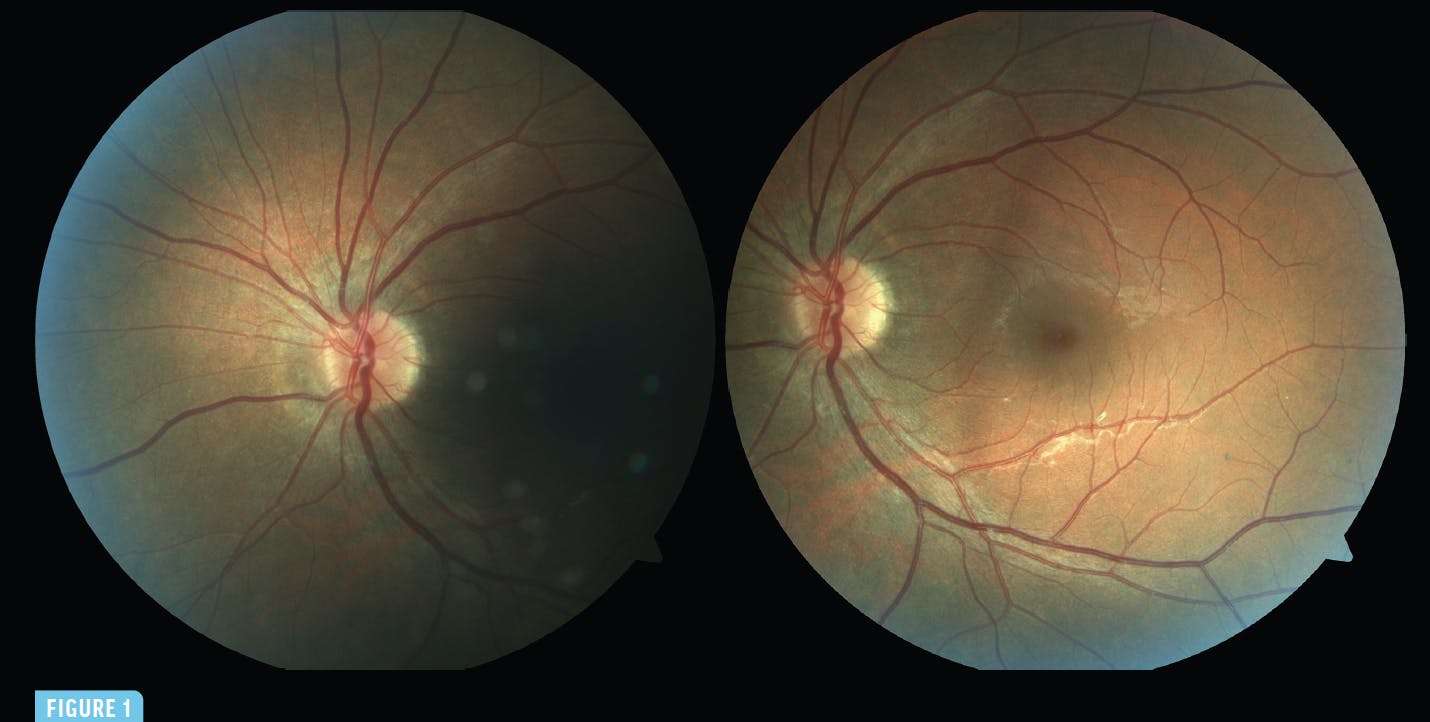
A 30-year-old White man presented with loss of peripheral vision in his left eye for 1 week, photopsia, and awareness of a darkened area in this field of vision, all after a “flash bulb” sensation. His medical history was unremarkable other than LASIK surgery in his right eye 2 years earlier. His BCVA was 20/20 OU. There was a trace relative afferent pupillary defect 1+ in his left eye. The anterior segment was normal in each eye. The fundus examination of the right eye was normal, while the left eye had retinal pigment epithelium changes and circumpapillary subretinal grayish discoloration (Figure 1).
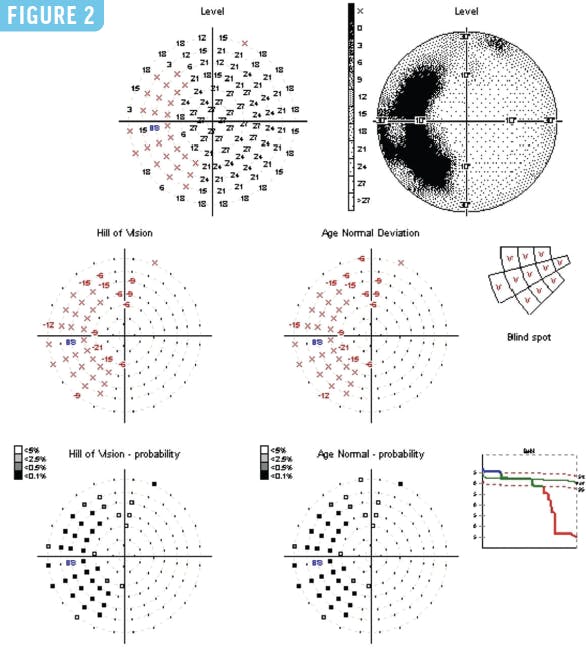
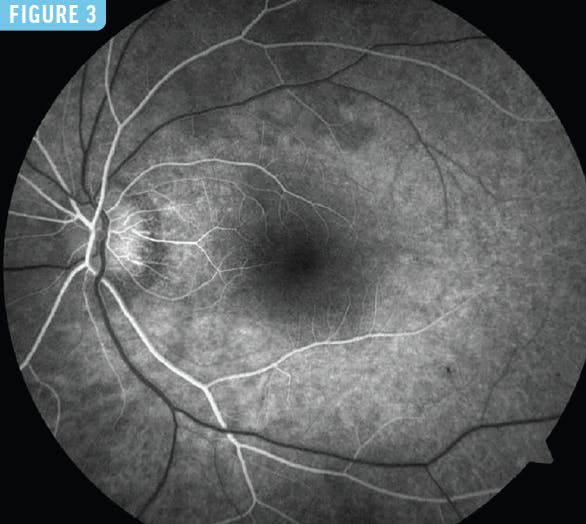
The map of the central 30° of the left eye’s visual field, plotted 2 weeks after the vision loss, revealed an enormous blind spot (Figure 2). Spectral-domain OCT showed damage to the photoreceptors (ie, loss of ellipsoid zone [EZ]) in the nasal retina of the left eye. Fluorescein angiography arterial phase demonstrated a ring of circumpapillary hypofluorescence, filling the defect in the superior arcade (Figure 3).
DIAGNOSIS AND FOLLOW-UP
Based on the symptomatology, examination findings, and imaging, we diagnosed the patient with acute idiopathic blind spot enlargement (AIBSE) syndrome. The patient was monitored without intervention.
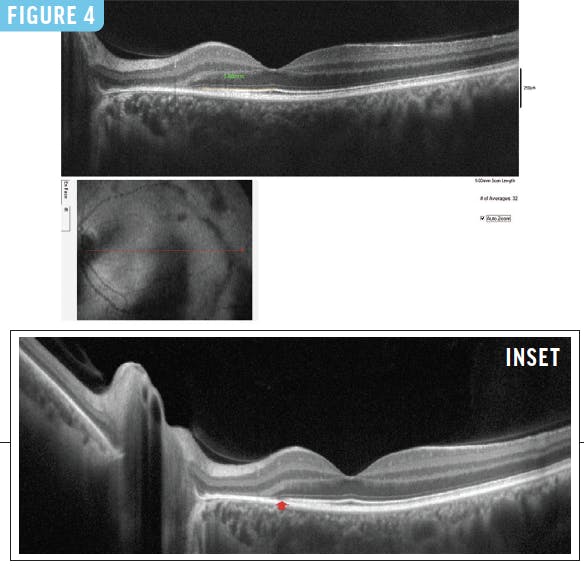
Upon returning to the clinic 3 months later, his dilated fundus examination was unremarkable. Swept-source OCT imaging (Figure 4) showed minimal loss of the parafoveal EZ (1,460 μm of intact EZ from the foveal center at baseline vs 1,340 μm [Figure 4, inset] at 3 months). Further loss of EZ was limited to the part of the retina that had a relatively intact outer nuclear layer. There was no improvement; the condition remained stable at the 3-month follow-up.
DISCUSSION
AIBSE is a rare outer retinopathy that more commonly affects women. It has been postulated to present either as an isolated finding or as an entity of primary inflammatory choriocapillaropathies with circumscribed loss of outer retinal function. All races and ethnicities can be affected, with a higher incidence in White individuals and those with moderate-to-high myopia. AIBSE may also be a late manifestation of multiple evanescent white dot syndrome without the dots, although the penchant for the peripapillary retinal dysfunction suggests a local etiology.1
Treatment strategies for AIBSE syndrome remain unclear, and there are no preventative measures. The enlargement of the blind spot usually does not return to normal, and peripapillary scars may be observed. Moreover, residual photopsia and visual defects can occur. Rarely, the disease may recur.2
If you have an image or images you would like to share, email Dr. Nagpal.
Note: Photos should be 400 dpi or higher and at least 10 inches wide.
1. Jampol L, Wiredu A. MEWS, MFC, PIC, AMN, AIBSE, and AZOOR: one disease or many? Retina. 1995;15(5):373-378.
2. Doan A, Lee AG, Boldt HC. Acute zonal occult outer retinopathy (AZOOR) and acute idiopathic blind spot enlargement syndrome (AIBSE): 34-year-old female awoke with painless loss of vision OS 3 weeks prior to presentation. The University of Iowa Ophthalmology and Visual Sciences EyeRounds.org. February 21, 2005. Accessed December 9, 2022. eyerounds.org/cases/case18.htm
_1674488812.jpg?auto=compress,format&w=70)

-1_1674489004.jpg?auto=compress,format&w=70)


_1784132761.jpg?auto=compress,format&w=75)





