




One of the most fascinating (and frustrating) aspects of the retina space is the sheer volume of patients we care for with just over 3,000 retina specialists in the United States.1 There are an estimated 19.8 million Americans with AMD (1.49 million of whom have vision-threatening disease) and another 9.6 million with diabetic retinopathy (DR; 1.84 million cases are vision-threatening).2,3 That’s approximately 1.1 million AMD/DR patients with vision-threatening disease per retina specialist in the United States! While there are myriad other retinal conditions that require our care, these two are often chronic with ongoing, even monthly, therapy.
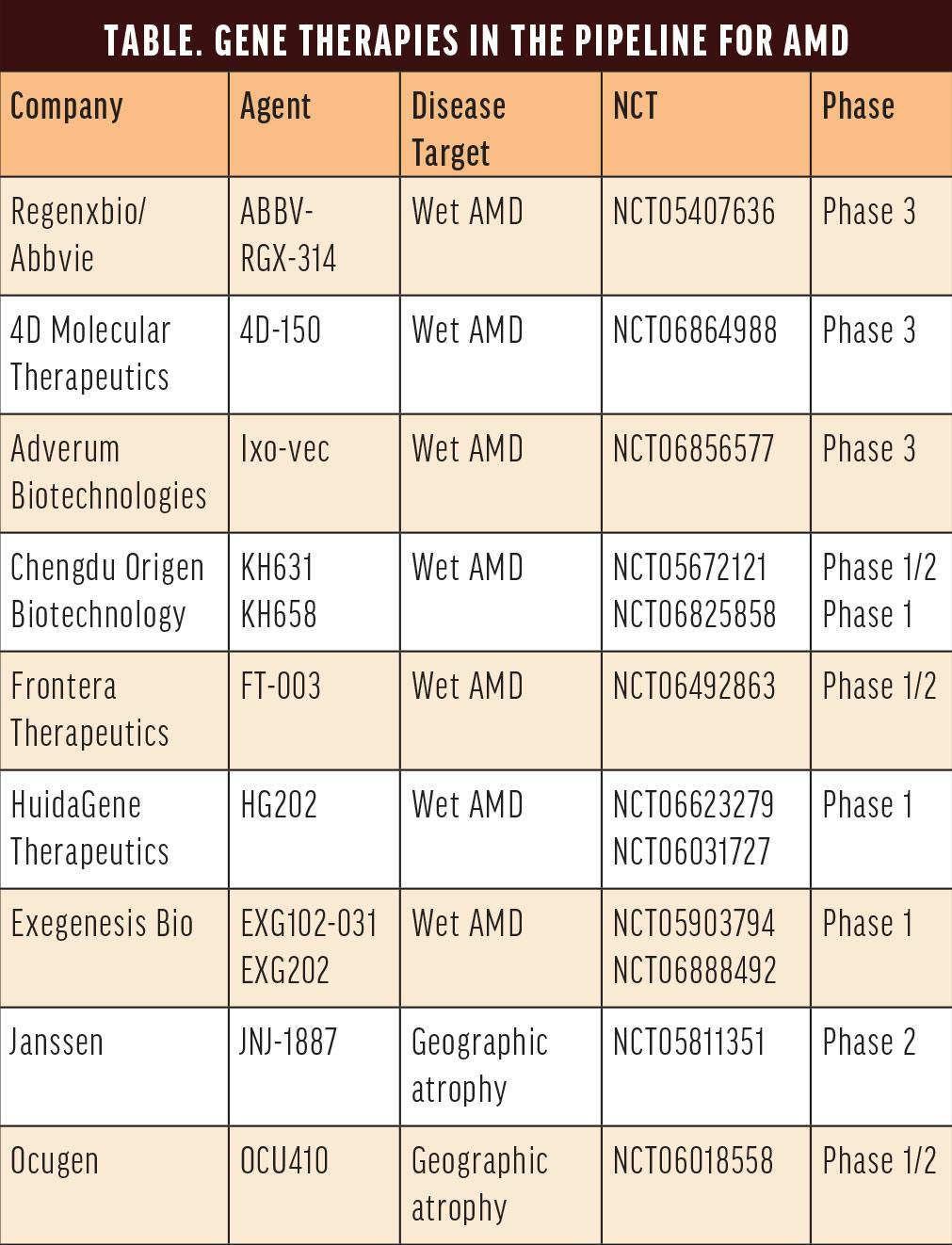
So, it’s no wonder our clinical trial pipeline is packed with efforts to extend the duration of treatment effect to help ease the burden on our patients and our clinics. For example, more than 20 therapies are under investigation for AMD—approximately half of which (11, to be exact) are potentially one-and-done gene therapies (Table). That’s a wild statistic. With so many shots on goal, we are reaching a tipping point; a few of these investigational drugs will likely cross the finish line in the next few years, completely disrupting our current treatment approach for wet AMD. But for now, we must watch and wait as the trials collect data and churn out interim findings every few months.
In this issue, we take a deep dive into AMD care, with articles on the therapies shaping our current treatment paradigm for AMD and those poised to completely upend our workflow with increased treatment durability.
Of particular interest is an article detailing those 11 gene therapies for AMD, authored by Szilárd Kiss, MD, FASRS, and Peyman Razavi, MD. Three are already in phase 3: ABBV-RGX-314 (Regenxbio/Abbvie), 4D-150 (4D Molecular Therapeutics), and ixo-vec (Adverum Biotechnologies).
In addition, Jacob S. Heng, MD, PhD, and Adrienne W. Scott, MD, discuss ways to incorporate our current second-generation AMD therapies into practice, and they provide their own treatment decision tree when switching AMD patients to faricimab (Vabysmo, Genentech/Roche), 8 mg aflibercept (Eylea HD, Regeneron), or the port delivery system (Susvimo, Genentech/Roche).
Aumer Shughoury, MD, and Thomas Ciulla, MD, provide a review of the dry AMD pipeline, giving us an excellent overview of the ways in which these new drugs are targeting inflammation, mitochondrial health, and neuroprotection. In addition, Maxwell S. Mayeda, MD, and Talisa E. de Carlo Forest, MD, share their research on imaging biomarkers in geographic atrophy to help us identify high-risk patients who might be candidates for complement inhibition.
Lastly, we stepped away from the clinic to look at the changing landscape of clinical trial designs, given the 2023 FDA draft guidance. Several biotech chief medical officers share how the document and their conversations with the FDA shaped their phase 3 clinical trial designs and what those decisions might mean for future therapeutics.
Retina seems to be a numbers game these days, as we do our best to balance the patient volume with the data volume. But if we stay the course and follow the numbers, we will, one day, have more durable treatment options to help our patients with AMD.
1. About us. American Society of Retina Specialists. Accessed May 6, 2025. www.asrs.org/about
2. VEHSS modeled estimates for age-related macular degeneration (AMD). Centers for Disease Control and Prevention Vision and Eye Health Surveillance System. May 15, 2024. Accessed May 6, 2025. bit.ly/4mcDpyp
3. VEHSS modeled estimates: Prevalence of diabetic retinopathy. Centers for Disease Control and Prevention Vision and Eye Health Surveillance System. May 15, 2024. Accessed May 6, 2025. www.cdc.gov/vision-health-data/prevalence-estimates/dr-prevalence.html


-1_1748961738.jpg?auto=compress,format&w=70)


_1784132761.jpg?auto=compress,format&w=75)





